
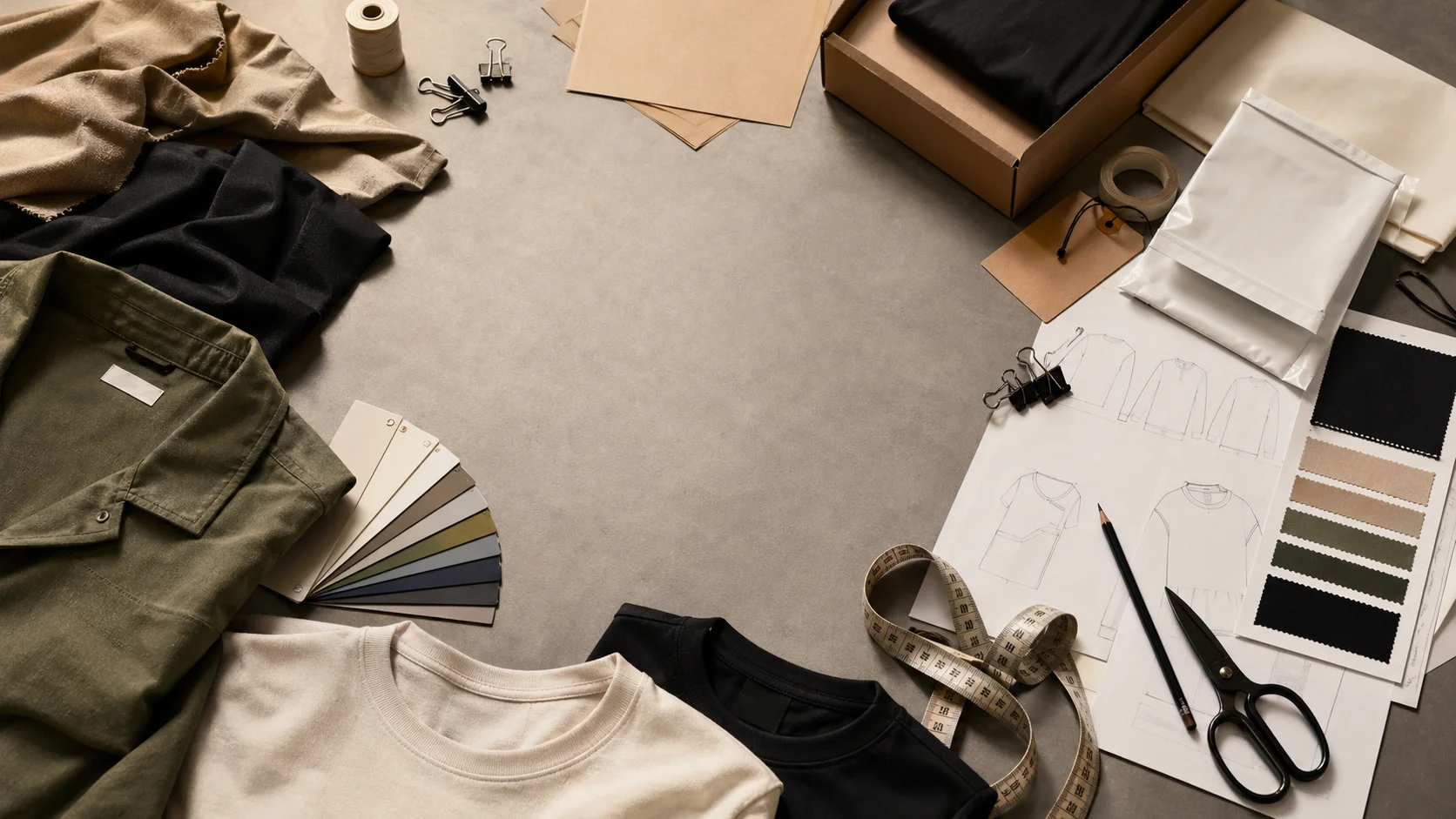
Startup Clothing Manufacturer Selection with checks for samples, fit, MOQ, QC evidence, pricing terms, and delivery risk.
Fast answer: Startup Clothing Manufacturer Selection: MOQ, Sampling, Capacity, and Risk should be judged by production evidence, not by a generic sourcing promise. The buyer needs sample proof, cost breakdowns, QC checkpoints, and delivery buffers in writing.
Ask for recent sample photos, measurement tolerances, fabric or print test assumptions, decoration test notes, packing examples, and a named inspection checkpoint. These details show whether the team can repeat an approved sample at bulk volume.
Separate garment cost, decoration, labels, packaging, sampling, testing, freight, and rush charges. When every cost line is visible, it becomes easier to reduce colorways, adjust size depth, or reserve more time for sampling.
The first collection usually doesn’t die on the rack — it dies in sampling. Nearly 3 out of 4 fashion startups stumble before their first production run sells through, and the best clothing manufacturer for startup brands is often the difference between a clean launch and an expensive reset. Weak design is rarely the culprit. The real problem is a bad manufacturing fit. I’ve watched founders sink $25,000 into launch plans, then lose another $10,000 to $17,500 in deposits, lab dips, and samples before a single unit reaches a shelf.
Across factory visits in China, Portugal, Turkey, the United States, and Vietnam, the pattern stayed stubbornly the same. Small brands chase the lowest quote, then pay for rework, air freight, and dead inventory when quality slips. A tee quoted at $2.50 per piece can turn into $4.10 after defect sorting, $1.20 in extra freight, and another $0.35 per unit in inspection. Cheap gets brutal fast.
Sampling is where many brands lose four to twelve weeks. One missed tech pack detail, one fabric substitution, one wash test failure, and the calendar slides. If your launch depends on selling 1,000 units by a certain date, that delay is not cosmetic. It hits sell-through, press timing, and cash conversion.
Asia often wins on unit cost and broad material access, but communication can be slower and minimums less forgiving. Eastern Europe tends to offer faster feedback, shorter transit times into the EU, and more willingness to discuss 100-300 unit pilots. North America usually gives speed, fewer language gaps, and cleaner approvals, yet MOQs can still surprise founders, often 300-1,000 units per style. So the real choice is not just sourcing. It is cash flow management dressed up as production.
After 200+ factory visits, one lesson stands out: the cheapest factory is rarely the cheapest program. If a supplier cannot explain why a French terry 320 GSM shrinks 3% after wash, or why a bar tack beats a plain stitch at stress points, the real cost is hiding in the dark. You pay for ignorance twice.
The best clothing manufacturer for startup brands is not the one with the flashiest showroom. It is the one that can move a product from sketch to approved bulk sample without wasting weeks or hiding process gaps. For a startup, the core services are pattern making, grading, sampling, fabric sourcing, cut-and-sew production, quality control, and packaging. Miss one of those, and the rest starts wobbling.
Large-label factories can be brilliant at 10,000-unit repeats and clumsy at a 150-unit test run. Their line setup is built for efficiency at scale, not for founder hand-holding. A startup-friendly manufacturer usually accepts 100-300 units per style, even if the factory can run 1,000+ when the order matures. That difference matters. A factory built only for large programs treats tiny orders like interruptions.
Tees, hoodies, leggings, and woven basics are the easiest categories to start with. Fewer pattern pieces. Fewer trims. Fewer fit risks than structured jackets or tailored trousers. A heavy hoodie in 320-400 GSM fleece may still be easier than a lined blazer, because the fit tolerance is broader and the production sequence is simpler. Complexity hides in details.
For documentation, I expect a startup to move through five approval steps: tech pack review, fabric and trim confirmation, size set sample, pre-production sample, and final bulk approval. Each step should have dates, revisions, and written sign-off. If a supplier wants to skip a step, I get nervous. A missing approval trail is where blame goes to hide.
Nearest does not always mean best. The clearest process usually wins. I would rather work with a factory 7,000 miles away that sends annotated photos within 24 hours than a local partner who answers in person but leaves every decision undocumented. That is also why brands with specialized products, from lingerie to babywear, often need sector-specific partners such as custom bra manufacturing or custom baby clothing manufacturing. Category fit beats geography.
Region shapes everything: MOQ, unit cost, sampling speed, and even the tone of emails. China remains strong for scale, trims, and fabric variety, making it a frequent choice for brands searching for the best clothing manufacturer for startup brands at volume. Typical MOQs for startup-friendly factories often start around 300-500 units per style, with sampling in 2-4 weeks and bulk in 30-50 days. Communication can be highly efficient, but the buyer must be precise. A vague tech pack turns into expensive assumptions.
Portugal sits in a sweet spot for premium basics and sustainable positioning. Many factories there are comfortable with 100-300 unit pilots, especially for knits and elevated casualwear. Sample lead times can run 2-3 weeks, bulk 4-8 weeks, and freight into Europe is comparatively efficient. A cotton jersey tee may cost $7.50-$11.00 depending on wash and trim complexity. That can look dear until you account for fewer defects and cleaner hand-feel.
Turkey is often the most underrated option for mid-range DTC brands. It is fast into Europe and the UK, and many factories can handle 200-400 unit starts. I’ve seen 2-3 week sampling and 3-6 week bulk timelines for basic jersey and fleece. A $6 tee in one region can be worse for margin than an $8 tee elsewhere once you add $0.60 in defects, $0.40 in inspection, and $1.10 in extra freight. Numbers do not care about ego.
The USA usually wins on speed, communication, and short runs. Expect 100-300 unit MOQs in the right factory, sampling in 1-3 weeks, and bulk in 2-6 weeks for simple items. Costs are higher. A heavyweight hoodie can land at $18-$28 per unit, especially with brushed fleece, specialty dyeing, or made-in-USA trim packages. That works for premium positioning, not for a race-to-the-bottom price point.
Price point should match brand strategy. Entry-level DTC brands usually need lower COGS, tighter style edits, and factories that can handle 500-unit launch buys. Premium sustainable brands can absorb higher unit costs if they get traceability, better cotton, or certified chemistry. Boutique luxury labels need even stricter finishing and often more development rounds. Data from WTO, trade.gov, and trade pattern reports shows that freight, tariffs, and lead times can shift final landed cost by 8-22%, which means your factory quote is only the first layer.
Hidden costs are where founders lose their margin. Lab dips can run $30-$80 per color, trims development can add $50-$200, tech pack cleanup may cost $150-$500, and third-party inspection can be $150-$400 per visit. I also budget for payment fees and one contingency round. Brands that ignore those expenses often underquote their retail price by 12-18%.
Five warning signs show up again and again. Vague MOQs. No written QC process. Refusal to share references. Inconsistent sample quality. Unclear payment terms. One more: a supplier that promises a 10-day turnaround on a complex style is usually hiding overtime, outsourcing, or both. Fast can be honest. It can also be a smoke screen.
If a factory cannot explain fabric shrinkage, seam strength, or defect tolerance in plain language, I walk. Shrinkage should be tested with measurable tolerance, often 3-5% depending on fabric and finish. Seam performance matters on stress points such as armholes, side seams, and crotch seams. A supplier that shrugs at those details is not controlling quality. It is guessing.
Ask direct questions. How many active production lines are running this month? What is the operator turnover rate, and is it under 15% or closer to 40%? How often do you conduct compliance audits? Which chemicals are used in dyeing, and can you provide test reports? According to standards bodies like OEKO-TEX, chemical testing and restricted substance control matter because fabric safety is measured, not implied.
Sustainability claims deserve skepticism. “Eco-friendly” means little without certification, traceability, or documented chemical testing. A factory may say it uses recycled yarn, but if it cannot show chain-of-custody records, the claim is thin. I have seen brands pay a 12% premium for green marketing and receive no better data than a line item on an invoice.
Score every supplier out of 25: quality process, responsiveness, MOQ fit, lead time honesty, and ethics. Give 5 points each. Anything under 18 is a hard pass.
A startup launch budget usually gets eaten in layers. Sampling, development, fabric, trims, freight, duties, inspection, and payment fees can consume 15-25% of the total before inventory lands. That surprises founders who thought production was the only real expense. It is not. It is only the biggest visible one.
For simple sampling, expect 2-6 weeks. Bulk production often takes 6-14 weeks, depending on complexity and region. A local small-batch model may cost more per unit but reduce cash lockup and transit risk. Overseas low-cost production can lower unit cost, yet extend lead times and create more checkpoints. A hybrid model, where development happens locally and bulk is made offshore, often gives the best balance for first-time brands.
Here is a practical side-by-side view. A 300-unit launch in the USA might cost $16-$24 per tee, with sampling at $120-$300, bulk in 2-6 weeks, and freight low. A 1,500-unit launch in China might cost $3.80-$6.20 per tee, with sampling at $80-$180, bulk in 30-50 days, and freight plus duties adding $0.70-$1.60 per unit. The second option looks cheaper until defects, delays, and capital time are priced in.
For a 300-unit order, I usually see total upfront spend of $5,000-$12,000 before goods arrive. For a 1,500-unit order, that can jump to $18,000-$42,000, depending on fabric and transport. Faster is not automatically cheaper if you have to airfreight 40% of the order or discount stock because the drop missed its campaign window.
I often recommend private label clothing only after a brand has proven repeat demand, because private label can hide poor construction behind a familiar silhouette. If the factory cannot show you a full cost stack, from lab dips to carton fees, it is not offering transparency. It is offering optimism.
Start with the product, not the factory slogan. Tees and basics need consistency in fabric weight, shrinkage, and stitch quality. A 180 GSM cotton jersey tee should not arrive as 165 GSM after washing. Activewear demands stretch recovery, four-needle flatlock or coverstitch performance, and seam integrity under motion. A legging that bags at the knee after 2 wears is a production failure, not a design quirk.
Denim and tailored pieces need more technical approval rounds and usually higher MOQs. Denim washes alone can add 2-4 weeks of development, especially if you want enzyme wash, stone wash, or a custom fade. Tailoring needs fit sessions, fusing tests, and pressing control. These categories are less forgiving for a first collection. They reward brands with patience and capital.
Sustainability should be matched to product type. Recycled synthetics make sense for activewear if you can verify content with certification. Organic cotton works well for tees, sweatshirts, and babywear. Low-impact dyeing matters across categories, but especially on dark colors where chemical load can rise. For technical knit programs, a reliable cut and sew manufacturing partner often matters more than a pretty sales deck, because construction controls how the garment behaves in wear and wash.
I usually treat tees, hoodies, and woven basics as the safest first collection. Activewear comes next if the factory has proven seam and stretch testing. Denim and tailoring are higher risk because fit sensitivity, wash variance, and finishing standards can make small errors look expensive. The best manufacturer for one category may be a poor fit for another. That is not a flaw. It is specialization.
Start with a shortlist of 8-12 factories. Request quotes, sample terms, lead times, and references from each. Then narrow to 3-4 based on fit, not charm. I make a mini scorecard with five columns: quality, responsiveness, MOQ, lead time, and ethics. Each category gets 1-5 points. The factory with the highest score is not always the cheapest, but it is usually the safest.
Before bulk, test everything. Wash test samples 3 times. Check fit on 2 body types. Pull seams on stress points. Review colorfastness under daylight and indoor light. If the style is a bra, a swim item, or a high-stretch garment, require fabric recovery and stitch elongation tests. If you need deeper technical support, specialized partners such as cut and sew manufacturing can help tighten the development process before larger commitments.
Negotiate the terms that protect cash. I push for a deposit of 30-50%, not 70%. I ask for a defect allowance in writing, usually 2-5% depending on category. I want re-order pricing locked for at least 2 production rounds, and timeline penalties if the factory misses agreed milestones by more than 7 days. If they refuse, I keep walking.
One hero style and one backup style is the right first move. It keeps launch risk contained and gives you a cleaner read on sell-through. I have seen brands launch 6 styles, then learn nothing except how fast capital can evaporate. Fewer bets. Better data. Better odds.
That discipline is what separates brands that survive from brands that post beautiful mood boards and then stall. The best clothing manufacturer for startup brands should protect margin, timing, and sanity. If the process feels vague in the first 2 emails, it will feel expensive by month 3.
Start by shortlisting 8-12 factories with experience in your product category, then compare MOQ, quality controls, sampling speed, and communication. The best clothing manufacturer for startup brands is usually the one that can document its process clearly and handle your launch quantity without forcing unnecessary bulk.
Ask about MOQ, production lead time, sampling rounds, quality checks, defect tolerance, and whether they can support custom development. You should also ask for references, certifications, and a full cost breakdown so you can compare factory quotes accurately.
For basic tees, expect roughly $3.80-$11.00 per unit depending on region, fabric, and order size. Sampling can add $80-$300 per style, and launch teams often spend 15-25% of budget before inventory lands.
Simple sampling can take 2-6 weeks, while bulk production usually takes 6-14 weeks. In faster regions or with smaller orders, some factories can finish basics in 3-6 weeks after sample approval.
Yes, but the fit is often better for short runs and premium pricing. Many U.S. factories prefer 100-300 units per style, and unit costs are usually higher than Asia or Turkey, especially for complex garments.
Start with 8-12 factories, then shortlist down to 3-4 using quality, MOQ, lead time, responsiveness, and ethics. Request samples, verify references, and place a 300-unit trial order only after wash and fit tests pass.