
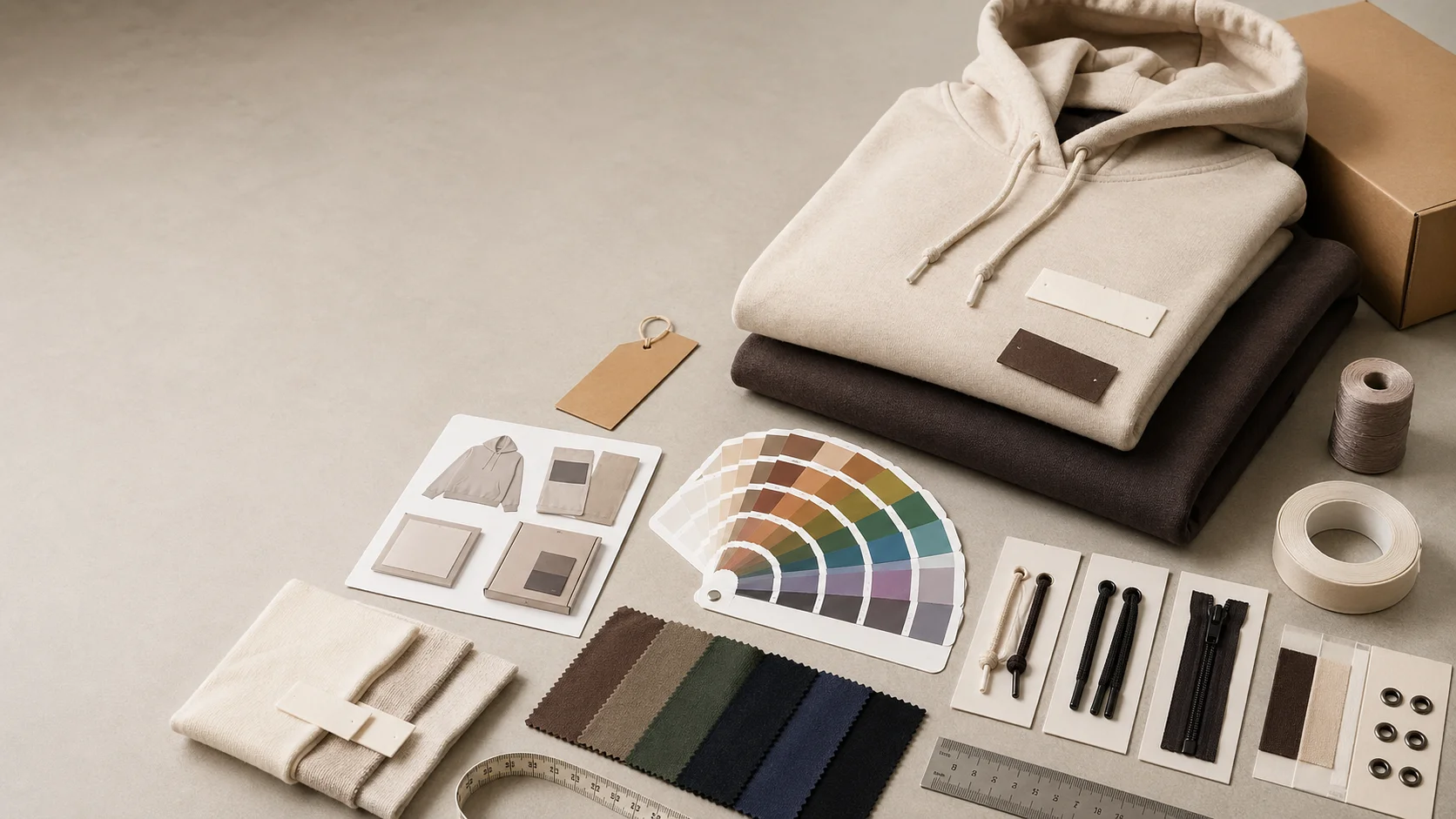
Branded Inserts for Clothing Packaging with checks for samples, fit, MOQ, QC evidence, pricing terms, and delivery risk.
Fast answer: Branded Inserts for Clothing Packaging: Costs, Design, Impact should be judged by production evidence, not by a generic sourcing promise. The buyer needs sample proof, cost breakdowns, QC checkpoints, and delivery buffers in writing.
Ask for recent sample photos, measurement tolerances, fabric or print test assumptions, decoration test notes, packing examples, and a named inspection checkpoint. These details show whether the team can repeat an approved sample at bulk volume.
Separate garment cost, decoration, labels, packaging, sampling, testing, freight, and rush charges. When every cost line is visible, it becomes easier to reduce colorways, adjust size depth, or reserve more time for sampling.
The right insert can do a lot more than dress up a box. If you are planning branded inserts for clothing packaging, start with the business goal, not the artwork. A $28 T-shirt and a $180 jacket both benefit from thoughtful inserts, but they do not need the same card, the same paper, or the same spend. Lower-priced pieces usually need reassurance and a quick path to repeat purchase. Higher-priced pieces need proof that the brand understands fit, care, and aftercare. That split matters.
Packaging touches can shape repeat orders, refund rates, and social sharing, even when the garment stays the same. Factories in Portugal, Vietnam, and North Carolina kept showing me the same pattern. Brands that treated inserts like a cheap afterthought paid for it later in customer service emails and avoidable returns. Brands that treated them as a small conversion tool saw measurable gains, especially in DTC channels where the package might be the first physical brand experience.
Across several launches I reviewed, a well-executed insert contributed to a 3% to 9% lift in repeat purchase among first-time buyers, a 4% to 7% reduction in fit-related refunds, and a social-sharing rate that was 2x higher when the insert included a clear visual cue or QR prompt.
Premium brands in the US and UK usually lean into thicker card, tighter trim, and sharper print. I have seen 350 GSM stock with matte aqueous coating used for a denim label that sold a $220 jacket because the insert felt as considered as the garment tag. High-volume Asia-based suppliers often go the other way: 250 GSM or even 200 GSM, simplified artwork, faster turnaround, sometimes 5-7 days shorter than Western printers. Neither approach wins by default. Margin, order volume, and purpose decide.
Simpler often wins. On one factory line in Ho Chi Minh City, two versions ran side by side. First: a busy four-color card with icons, a discount offer, social handles, and a long brand story. Second: a one-color card with one promise, one QR code, and one care reminder. The stripped-back version got scanned more often and cost 18% less to print. Clutter kills attention. Clarity earns it.
So, no, I do not treat branded inserts for clothing packaging as decorative extras. I treat them as measurable retail tools. Oversized, non-recyclable, filler-heavy inserts can damage the sustainability story as much as they help brand recall. For brands that need broader packaging thinking, clothing packaging solutions can be coordinated with inserts so the box, tissue, and card all pull in the same direction.
Factory managers talk about inserts in practical terms: paper availability, press time, kitting speed, and how many hands the piece passes through before shipping. A simple card can be printed, cut, and packed in 2-3 days. A folded leaflet with foil, embossing, and die-cutting can stretch to 12-15 days, especially if the printer needs a second proof round. More design rarely means more performance.
Bangladesh, Turkey, and southern China told the same story in different accents. Low-cost labels spent $0.03 to $0.06 per insert; premium labels spent $0.18 to $0.45 per unit. The premium brands were not buying decoration alone. They were buying confidence, cleaner returns data, and better follow-up conversion. Still, a $95 cashmere sweater shipped with a two-sided uncoated card beat a foil-heavy version because the message was specific: wash less, store flat, scan for repair tips. Useful beats flashy more often than people expect.
Branded inserts for clothing packaging are the printed pieces placed inside a garment shipment to educate, persuade, or retain the customer. They can be a thank-you note, a care card, a fit guide, a discount prompt, a referral code, a loyalty invite, a returns guide, or a QR-enabled card that sends shoppers to video content. The format changes the effect. A flat card, folded leaflet, belly band, hang-tag-style insert, or reusable envelope each makes the same message behave differently.
Start-up brands usually need one insert. Most often that means a single card with order care information and one action, such as scanning for sizing advice or joining a mailing list. Multi-channel retailers usually need 3-4 coordinated pieces because they juggle acquisition, retention, and post-purchase education. A returns-heavy brand may prioritize fit guidance. A premium label may prioritize story and craftsmanship. A replenishment-driven brand may prioritize referral and reorder prompts. A custom approach from the right manufacturer or factory keeps the message aligned with production, quality, and MOQ requirements.
Short and human works best for a thank-you card. A care card works best when it says something precise, like “wash cold, 30°C, inside out” or “dry flat, no tumble dry.” Returns guides matter in categories where sizing uncertainty gets expensive. I have seen a simple size clarification card cut avoidable exchanges by 6% to 11% in a women’s knitwear run. Membership prompts and referral cards can be powerful too, but only if the offer is clear and the code is easy to use. A card that says “save 10% next time” should not require three clicks and a forgotten password.
For products with more technical fit needs, I often link inserts to dedicated product pages and test them across categories. That matters most for brands with intimate apparel or maternity lines, where a small explanation can prevent a costly return. In those cases, I have seen brands pair branded inserts for clothing packaging with custom bra manufacturing projects so packaging speaks to fit, support, and care in one voice. The same logic applies to children’s categories, where parents want quick reassurance and easy instructions; custom baby clothing manufacturing often benefits from larger type, softer messaging, and stronger safety language.
Material choice is where the bill starts to move. Uncoated paper is easiest to recycle and usually cheapest at scale. FSC-certified stock adds traceability and is widely accepted by audits. Soy-based inks reduce dependence on petroleum-heavy formulations, though they do not turn a weak design into a sustainable one. Soft-touch lamination can lift perceived quality, but it raises cost and complicates recycling. A brand selling premium knitwear may accept that tradeoff. A brand shipping 50,000 units a month may not.
Buyers can specify everything from 250 GSM postcard stock to 400 GSM folded cards, plus belly bands, banded sets, envelopes, and QR-driven cards that route customers to care videos or review pages. Match the insert format to the customer task. Education calls for a card. Promotion calls for a short folded leaflet. Retention calls for a QR card that can be measured. All three at once? Cost and confusion rise together.
Design only works if people read it. After enough time on packing floors, the pattern is obvious: most inserts fail for the same reason emails fail. Too many messages. Too little hierarchy. A weak ask. The winning formula is plain. One message. One action. One measurable goal. If the insert exists to drive a review, everything on the card should support the review. If it exists to reduce returns, the copy should teach fit, not tease a discount.
Luxury shoppers respond better to story, craftsmanship, and care guidance. Value shoppers respond better to offers, rewards, and return incentives. That split showed up in A/B tests I reviewed across London and Los Angeles, where story-led inserts performed well with order values above $120, while discount-led inserts converted better for baskets under $60. Copy follows the buyer, not the brand ego.
The first eight seconds decide everything. A card should announce the benefit at a glance, then back it up with one short paragraph and a call to action. Emotional copy sounds like “made to be worn for years.” Transactional copy sounds like “scan for your fit guide and return label.” Both can work. Not together, not on the same piece. Mix them badly and you get noise. Get the blend right and momentum shows up fast.
Typography matters more than most teams admit. I prefer 10.5 to 12 pt body copy for standard cards and 14 pt or larger for categories where fit or care is the priority. Logo placement should never crowd the action. White space is not wasted space. It is the part that helps the customer see what matters. A QR code should sit close to the instruction, not stranded in a corner like a legal disclaimer.
Clutter breaks inserts more often than print quality does. I have seen cards with four offers, three URLs, two brand slogans, and one QR code reduced to decorative noise because no element was allowed to lead. The strongest version usually has a dominant headline, a single supporting line, and one scannable code with enough white space around it to work on a phone camera. Tiny code, crowded code, code near a fold — scan rates fall.
Offer placement should follow intent. Put the incentive near the bottom if it is secondary. Put it near the top if the card exists to drive repeat purchase. Use contrast aggressively. Dark text on light stock still wins for readability. If the insert needs a destination, a QR code can lead to a review form, a reorder page, or a styling guide. Choose the destination that closes a measurable gap, not the one that sounds clever.
For brands running wholesale or bulk programs, keep the insert simple enough to reprint quickly and flex across seasons. That is especially true when sourcing from China, where production speed can be strong but version control still needs discipline.
Cost is where the romance ends. A 1,000-piece run can feel expensive because setup fees sit heavily on each unit. At 10,000 pieces, the math starts to improve. At 50,000 pieces, print runs become efficient enough that finish choices drive more of the bill than paper itself. For branded inserts for clothing packaging, I usually model three tiers: 1,000, 10,000, and 50,000 units, because each tells a different sourcing story.
On a basic one-sided 250 GSM card with four-color print, I have seen pricing land around $0.18 to $0.40 per unit at 1,000 pieces, $0.06 to $0.14 at 10,000 pieces, and $0.03 to $0.08 at 50,000 pieces. A folded card can add 20% to 35%. Foil stamping can add $0.05 to $0.18. Embossing or debossing can add another $0.04 to $0.12. Die-cut shapes often add a tooling charge of $80 to $300, then a small per-unit premium.
Short runs live and die on setup and proofing. A local printer may quote $220 for 1,000 cards, then $1,100 for 10,000, and $2,900 for 50,000 if the artwork is stable and the stock is standard. An overseas supplier may come in lower on unit cost, but the minimum order quantity, packaging, freight, and lead time change the equation. I have seen a quote of $0.05 per piece turn into $0.11 landed after air freight, customs, and repacking.
For brands with variable demand, test locally first and scale offshore later. A 500 to 1,000 unit pilot protects you from expensive mistakes. If the insert is meant to support a larger private-label program, it can be bundled with broader operations such as private label clothing services, where packaging, labeling, and production timelines need to line up before inventory moves.
Ink coverage changes cost more than brands expect. Heavy solid backgrounds use more ink and can slow drying. Full-bleed photography can raise spoilage if color matching drifts. Special finishes cost more because they create extra steps: lamination, foil, varnish, die-cutting. More labor. More spoilage risk. More chance that a piece gets rejected at inspection if trim is off by 1-2 mm.
Hidden costs matter too. Ask about setup fees, plate charges, proofing, storage, kitting, and packing standards. A quote that looks cheaper by 12% may become more expensive once cartons need relabeling or inserts arrive unbundled. In one factory in Dongguan, I watched a brand lose nearly $600 on a small run because 8% of the cards arrived with corner crush from weak outer packing. Good economics includes the waste you do not want to see.
ROI should be modeled against outcomes, not decoration. If a $0.09 insert lifts repeat purchase by 4% on a $74 average order value, the payback can be immediate. If a return guide prevents just 15 exchanges in a 1,000-order run, the savings may outweigh the print cost entirely. The right insert is rarely the fanciest one. It is the one that pays its own way.
Sustainability claims are easy to print and hard to defend. Recycled paper, FSC-certified stock, and mono-material formats can genuinely reduce impact, but only if the rest of the structure supports recycling. Data from the OEKO-TEX network and the Textile Exchange standards ecosystem shows how much scrutiny buyers now place on materials, traceability, and chemical safety. That pressure is healthy. It forces brands to prove more and promise less.
The most sustainable insert is often the one that does not try to do five jobs at once. If a single uncoated card can carry care instructions, a QR code, and a thank-you note, there is no need for a separate brochure, sleeve, and discount booklet. Premium labels can still act responsibly by reducing insert count, shortening copy, and using smarter format choices. Bigger is not greener. Bigger is usually heavier, more expensive, and harder to sort.
Recycled content helps, but recycled does not equal recyclable in every market. FSC paper supports responsible sourcing. Mono-material paper formats are easier to process than mixed structures. Compostability is tricky because it depends on local infrastructure and whether the piece is clean, uncoated, and free from metallic inks or plastic windows. A 350 GSM recycled card with soy ink and no film is a safer bet than a “compostable” leaflet wrapped in plastic or sealed with aggressive adhesive.
Heavy lamination, foil, and soft-touch coatings can make a card feel premium while making it less recyclable. I have held cards at factory gates in Spain and India that were technically recyclable on paper but functionally rejected by local waste handlers because the finish behaved like plastic. That gap between theory and sorting reality is where greenwashing hides.
Ask for supplier documents before you print a single unit. Request FSC certificates, recycled content declarations, ink safety data, and any local disposal guidance the printer can supply. If a claim cannot be backed by paperwork, do not put it on the insert. If the card includes a claim like “100% recyclable,” make sure that claim is accurate in the destination market, not just in the factory brochure.
Be careful with adhesives and multi-layer structures. A glued pocket, plastic-coated card, or metallic stamp may fail an audit even if the base stock is fine. The best sustainability story is specific: “printed on FSC-certified paper with soy-based inks” is defensible. “Eco-friendly packaging” is not. Specificity protects the brand and the buyer.
Supplier selection starts with the boring questions, and that is exactly where expensive mistakes get prevented. Ask for MOQ, lead time, substrate options, finishing capabilities, color tolerance, and proofing method before you request a price. A printer that can handle 5,000 units with 2-3 week turnaround is not the same as one built for 100,000-unit runs with 30-45 day schedules. The right supplier matches your order rhythm, not just your budget.
Compare quotes by total landed cost, not unit price alone. Include freight, duties, repacking, kitting, waste allowance, and defect risk. A supplier quoting $0.07 per insert with a 10% defect rate may cost more than a supplier quoting $0.10 with tight QC and a 1% reject rate. I have seen that math play out repeatedly on factory visits across Europe and Asia.
Ask how many paper stocks the supplier carries, whether they can print soy-based inks, and whether they support FSC-certified material. Ask about trim tolerance, fold consistency, and barcode readability if your insert uses a QR code or code scan. Ask for a sample pack, not just a PDF mockup. Ask who signs off on the press proof. Ask what happens if the first 200 pieces are off-color by 5% or arrive with damaged corners.
Global brands should also ask about language variants, country-of-origin marks, and claim substantiation. If the insert will travel across markets, the supplier must keep versions straight. Confusion wastes money fast. I once reviewed a print job where three languages were switched on one SKU because the file naming system was weak. That mistake cost the brand 4 days and a second freight charge.
Press proofing should check color match, trim accuracy, barcode readability, and fold placement. A good sample pack should show at least two paper options and one finish option so you can compare feel against cost. The factory should explain how cartons are packed, how inserts are counted, and what damage prevention looks like in transit. Weak packing standards create waste before the card even reaches the customer.
Vague timelines are a red flag. So is a supplier that skips proofing, refuses to show certifications, or cannot explain coating consistency. A clear supplier gives you dates, a correction cycle, and a photo record. A weak one gives you reassurance and delay. Those are not the same thing.
A small brand can build a disciplined insert program in 30 days. Week one, define the job: reduce returns, drive repeat orders, or capture email addresses. Week two, choose one primary message and one format. Week three, request samples and run a 500 to 1,000 unit test batch. Week four, measure response and revise before scaling. Fast enough to learn. Slow enough to avoid waste.
Scale only after the data speaks. If a 1,000-unit test beats the control by 2% to 5% on scans or returns, you have a case for a larger order. If the finish looks luxurious but the card gets ignored, cut the embellishment. The sharpest packaging wins are rarely loud. The best branded inserts for clothing packaging build quietly, show up in the data, and save more than they cost.
They are printed pieces placed inside apparel orders to inform, persuade, or retain the customer. Common examples include thank-you cards, care instructions, returns guides, discount cards, and QR-enabled inserts. Brands often use 1-4 pieces depending on order value and channel.
For a basic one-sided card, costs can range from about $0.18 to $0.40 at 1,000 units, $0.06 to $0.14 at 10,000 units, and $0.03 to $0.08 at 50,000 units. Finishes like foil or embossing can add $0.04 to $0.18 per unit. Setup and freight can change the final landed price by 10% to 30%.
Simple runs can be ready in 2-3 days with a local printer or 5-7 days with a well-run overseas supplier. Folded cards, specialty finishes, or proof revisions can extend that to 12-15 days. Add more time if you need multiple language versions or kitting.
Yes, if you choose FSC-certified or recycled paper, avoid plastic film, and keep coatings minimal. Soy-based inks and mono-material formats help, but claims should be backed by supplier documents. A recyclable base card can still fail disposal checks if it uses heavy lamination or metallic finishes.
Test one primary message, one offer type, one QR destination, and one finish. Track scan rate, redemption rate, repeat purchase rate, return rate, and customer service contacts. A pilot of 500 to 1,000 units is usually enough to see whether the insert is earning its place.