
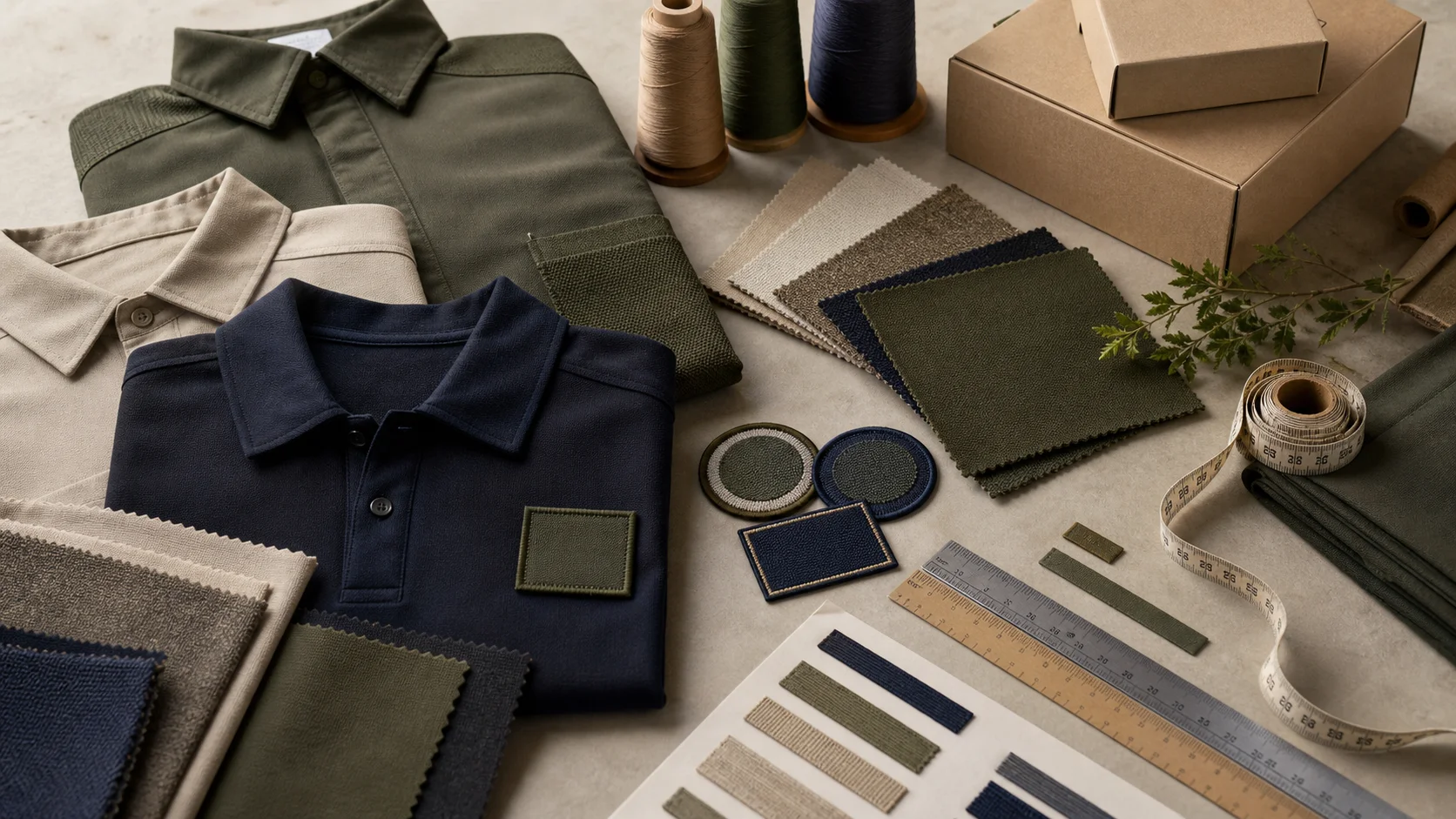
Lookbook Inserts for Fashion Packaging with checks for samples, fit, MOQ, QC evidence, pricing terms, and delivery risk.
Fast answer: Lookbook Inserts for Fashion Packaging: Page Count, Paper, Print, and ROI should be judged by production evidence, not by a generic sourcing promise. The buyer needs sample proof, cost breakdowns, QC checkpoints, and delivery buffers in writing.
Ask for recent sample photos, measurement tolerances, fabric or print test assumptions, decoration test notes, packing examples, and a named inspection checkpoint. These details show whether the team can repeat an approved sample at bulk volume.
Separate garment cost, decoration, labels, packaging, sampling, testing, freight, and rush charges. When every cost line is visible, it becomes easier to reduce colorways, adjust size depth, or reserve more time for sampling.
The smartest retail pitch is still the one that lands after checkout. Lookbook inserts for clothing packaging show up at the exact moment a brand already has attention: the first unboxing. I have watched labels burn through $8 to $24 in customer acquisition costs on social ads, then overlook a printed insert that can ride inside a parcel for under 30 cents in low-volume runs and keep selling for weeks. Not theory. Factory-floor reality. I have seen it across 200+ visits in eight countries.
Near Ho Chi Minh City, a denim plant packed a premium brand’s 12-page booklet into a rigid mailer with tissue and a return card. In the next bay, a mass-market label used a single folded sheet with size guidance and a QR code. Same paper mill source. Different intent. Premium buyers kept the booklet on desks and coffee tables. Value shoppers scanned fast and tossed anything that did not answer a question in 10 seconds.
That pattern repeats by region. In Italy and Portugal, luxury teams treated inserts like small editorials, often printing 4,000 to 10,000 units to match a capsule launch. Bangladesh and Vietnam were tougher. If the insert did not reduce returns or lift second-order conversion, it got cut. Same truth at both ends of the market: retention depended more on paper stock, contrast, and layout than on page count alone. A 6-page insert on 170 gsm uncoated stock with a sharp hierarchy often got more attention than a 16-page brochure on glossy stock that felt like an ad flyer.
Packaging is not dead weight. It is a retail surface. Lookbook inserts for clothing packaging usually do four jobs at once: sell the next item, explain fit, reinforce brand story, and lower friction on care or returns. If your packaging already includes clothing packaging solutions, the insert becomes the easiest place to keep the conversation going after checkout.
Short on ego. Long on utility. I have seen a 4-page card drive more scan time than a 16-page mini catalog because the structure was disciplined: one hero image, one supporting outfit, one fit note, one clear call to action. Commercially, that is the job. Cross-sell. Storytell. Guide sizing. Point to the next drop. Reduce uncertainty. A lookbook that does not help the buyer decide what to do next is expensive stationery.
Design decisions show up in the numbers. Cover image first. Typography second. White space third. CTA placement last, even though many brands cram a discount code on page one. A clean 8-page format with a strong opening spread usually wins because it leaves room for three things: product imagery, care or fit information, and a brand cue that feels editorial rather than promotional. Hold time rises when the grid calms down. No clutter. No tiny type. No desperation.
Catalog-style insert versus mini editorial lookbook — different tools. The catalog sells SKU coverage. The editorial version sells desire. Basics, replenishment, and private label clothing services where assortment breadth matters? Catalog wins. Limited runs, seasonal capsules, premium outerwear where mood, texture, and styling drive the sale? Editorial wins. If the product is a 320 GSM French terry sweatshirt or a garment-dyed overshirt, photography should show depth, drape, and close-up texture. Flat lay alone will not do the work.
Page count should follow purpose. Four pages can handle size, care, and one outfit story. Eight pages gives room for a product matrix or a QR-linked landing page. Twelve pages is the sweet spot for many brands because it balances cost and narrative depth. Sixteen pages can feel rich, but only if the seasonal content justifies it. Premium finishing helps even when page count stays flat. Soft-touch cover stock, a thin matte varnish, or a tight saddle stitch can lift perceived value without forcing a longer booklet. For baby and toddler lines, the same logic shows up inside custom baby clothing manufacturing programs, where trust and clarity matter more than ornament.
Region changes the math more than brands admit. China brings broad print capability and fast finishing; with final artwork and stock on hand, a 12-page saddle-stitched insert often lands in 7 to 12 days. On a 5,000-unit run, pricing may sit around $0.22 to $0.55 per piece before freight, depending on paper weight, inks, and coatings. Vietnam usually comes close on unit price, sometimes 5% to 12% lower on assembly-heavy work, though imported paper can stretch lead time when mills are booked. India can beat both on labor-heavy handwork and some paper costs, yet the gap between first article and final bulk is wider unless the supplier runs disciplined QC. Europe? Usually the most expensive. Premium 12-page inserts often run 20% to 60% higher than comparable Asian production, though shorter freight routes and less inspection friction can claw some of that back.
Three suppliers, same spec, three different outcomes. Simple reason: a spec sheet is not a factory. Two vendors can promise 170 gsm FSC stock, soy inks, and 4-color process, then one runs a clean binding line and the other uses worn rollers that shift registration by a millimeter. I have seen a lower-cost Chinese supplier beat a European competitor on color consistency because the finishing line was maintained daily and the press operators held delta-E checks tighter. Counterintuitive, sure. Cheap does not always mean sloppy. Expensive does not always mean precise.
MOQ is another divider. China and Vietnam often accept 1,000 to 3,000 units for custom inserts, though better pricing usually starts at 5,000. India can offer flexible setups for niche runs, but substrate sourcing may get patchy if you need a specific shade or recycled-content level. Europe tends to favor 2,500 to 10,000 units for efficient booklets, especially when local certification or tight color matching is required. If your product line is built through private label clothing services, the wrong region can turn a cheap insert into a delayed launch.
Sustainability certifications vary too. FSC and PEFC papers are easier to source in Europe and parts of China than many buyers expect, but recycled-content papers with consistent caliper can be harder to secure in some Indian supply chains. Shipping distance matters. A 2,000-kilometer inland haul can erase a unit-price advantage if it adds two weeks and a second inspection. Choose the supplier for the market you are serving, not only the invoice. A brand shipping to the EU may value compliance and traceability more than a $0.07 savings per unit. A brand shipping to the US may prioritize speed, freight predictability, and post-print finishing.
For sourcing and compliance checks, it also helps to review textile supply chain standards from Textile Exchange and packaging or export guidance from Trade.gov before final supplier selection.
Sustainable insert choices are not abstract. They show up in grams per square meter, recycled fiber percentages, coating chemistry, and the distance between paper mill and packing line. I have toured facilities where a brand claimed “eco paper” but used 18% recycled content with a laminated gloss coating that made the sheet hard to recycle in local waste streams. Not green. Branding dressed as responsibility.
The practical baseline for lookbook inserts for clothing packaging is often 140 to 200 gsm FSC-certified stock with 30% to 100% recycled fiber, printed in soy or vegetable-based inks. According to OEKO-TEX, chemical transparency matters across textile-adjacent materials, and buyers should think the same way about packaging inputs. Water-based coatings can preserve print quality while avoiding the recyclability penalty that comes with heavier plastic films. Uncoated stock is usually easiest to recycle and often feels more premium than people expect, especially with strong photography and a restrained grid.
Matte coatings cut glare and improve text legibility. Gloss coatings boost color pop, but they can make skin tones and dark garments look overly synthetic. Soft-touch brings a luxury feel on first contact, yet it can add cost and create recycling complications if the coating chemistry is not disclosed. Spot UV and foil look expensive, and they can work on a 4-page or 8-page insert, but they also raise scrap rates and can slow downstream recycling. I have seen production teams lose 3% to 7% of a run to setup waste when embellishments were overused or misaligned.
Where does premium finishing help? High-margin outerwear. Bridal. Designer basics. Where does it waste money? Value tees, replenishment socks, and size-critical basics where shoppers care more about fit than shine. If the insert is meant to support cut lines, trims, or product development notes, a clearer route is often to connect with cut and sew manufacturing teams and keep the booklet functional. Simple rule: spend on the surface customers touch, save on anything that does not change reading, reuse, or recyclability. Sustainability is not a mood board. It is a material ledger.
A unit price tells only half the story. The real cost of lookbook inserts for clothing packaging sits in six buckets: design, prepress, printing, finishing, packing, and freight. For a 1,000-unit run of a 4-page insert on 170 gsm uncoated stock, I have seen quotes from $0.45 to $1.20 per piece depending on region and proof requirements. Move to 5,000 units and the same item can drop to $0.14 to $0.38. At 20,000 units, prices may fall below $0.10 if artwork is stable and paper is standard.
Now the 12-page premium booklet. At 1,000 units, the range often lands between $1.10 and $2.80 per piece because binding, heavier stock, and more press time all stack up. At 5,000 units, many suppliers can bring it into the $0.55 to $1.10 zone. The economics improve quickly once setup costs are spread across more units, but only if the content can support the page count.
Hidden costs bite harder than most buying teams admit. Plate changes can add $75 to $300 per version. Color proofing can run $40 to $180 if you want a hard proof instead of a PDF. Packing labor often adds another $0.02 to $0.08 per insert when manual insertion is required. Wastage allowances matter too. I usually budget 3% to 5% for a clean run, and 7% to 10% if the finish is complex or the artwork has heavy solid coverage. Freight can add a surprising layer; a 500-kilogram pallet of inserts may move cheaply by sea but painfully by air when a launch date slips.
ROI is where the argument gets sharp. If an insert lifts repeat purchase by just 2% on a cohort with a $78 average order value, payback can beat a paid ad burst. I worked with one brand that tested a 12-page insert against a discount card and saw a 14% higher second-order click-through rate, with QR scans at 9.6% versus 2.1%. Not every program will mirror that, but the method scales: measure repeat order rate, average basket size, and retention lift, then compare print spend against those gains.
Speed begins with a complete brief. Before quoting, I want trim size, page count, stock, quantity, finish, ship-to location, and target in-hand date. I also want the final use case. Is the insert going into a polybag, a mailer, or a rigid box? Will it sit beside hangtags, swing tags, or care cards? Leave those details out and you will lose at least 3 to 7 days chasing corrections later.
The cleanest workflow starts with a digital mockup, then moves to a PDF proof, then a press proof or contract proof for color-critical jobs. If the artwork includes photography, send files at 300 dpi at final size, with 3 mm bleed on all sides and type kept safely inside trim. Late copy changes are the most common delay point. So are missing Pantone references and last-minute barcode edits. A single mismatch can push a job back one full week.
Rush jobs are expensive because they compress the whole chain. Standard custom inserts often need 10 to 15 working days after approval. Rush work can be turned in 5 to 7 days, but the price may rise 15% to 40%, and color risk goes up when proof cycles are shortened. I have seen brands lose an entire seasonal launch because the booklet copy was still being revised after cartons were already on the water. Avoidable.
The fastest teams lock content early. They hand merchandising, design, and production the same final sheet, then freeze it. That discipline matters if the insert has to match a product drop tied to private label clothing services or a new assortment refresh. The print file should be treated like a production component, not a marketing afterthought. Once garment sizes are packed and the delivery window is set, every hour spent tweaking a headline costs money somewhere else.
Start with a 30-day plan. Week one, define the objective: repeat purchase, cross-sell, care education, or launch storytelling. Week two, choose format, page count, and paper, then request quotes from at least three suppliers in two regions. Week three, build two versions. Week four, approve, print, and insert. Simple sequence. Not simple discipline.
Test one variable at a time. I like A/B tests on CTA copy, hero image order, or offer structure. Version A may push a QR code to a product page. Version B may point to a styled bundle or a care guide. If your AOV is $64 and your repeat order rate is 18%, even a small lift matters. Track QR scans, redemption rate, second-order conversion, and average basket size over 30 to 60 days. Enough time to see whether the insert earned its keep.
Keep the first two runs honest. One should be conservative: 4 or 8 pages, standard stock, no special finish. The other can be bolder: 12 pages, better paper, perhaps a soft-touch cover if your margin allows it. The goal is not the prettier piece. The goal is the version that keeps getting opened, kept, and acted on. I have seen teams pour money into embellishment when a simpler layout would have sold more product.
My practical sequence is this. Design signs off first. Merchandising confirms the product mix second. Production locks the print specs third. Then procurement confirms lead time, freight, and waste allowance. If you want a clean starting point for packaging and inserts as one system, begin with clothing packaging solutions and let the insert do a specific job inside that box. The best lookbook inserts for clothing packaging are not the prettiest. They are the ones that keep earning a place inside the box.
For a 4-page insert, low-volume runs of 1,000 pieces often cost $0.45 to $1.20 each, while 5,000 pieces can fall to $0.14 to $0.38. A 12-page premium booklet usually ranges from $1.10 to $2.80 at 1,000 units and drops sharply at 5,000 units or more.
Eight to 12 pages is the most useful range for most brands. Four pages suits size guidance and one product story, while 16 pages only makes sense if you have enough seasonal content to justify the added cost and assembly time.
Standard production usually takes 10 to 15 working days after final approval. Rush jobs can be done in 5 to 7 days, but they usually add 15% to 40% to price and reduce proofing time.
Yes. Inserts can lift repeat purchase by steering shoppers to the next product, explaining fit, and promoting QR-linked offers. I have seen a 12-page insert outperform a discount card by 14% in second-order click-through rate in one brand test.
FSC-certified paper with 30% to 100% recycled fiber is a strong starting point. Uncoated or lightly coated stock printed with soy inks is usually easier to recycle than laminated gloss or heavy spot UV finishes.