
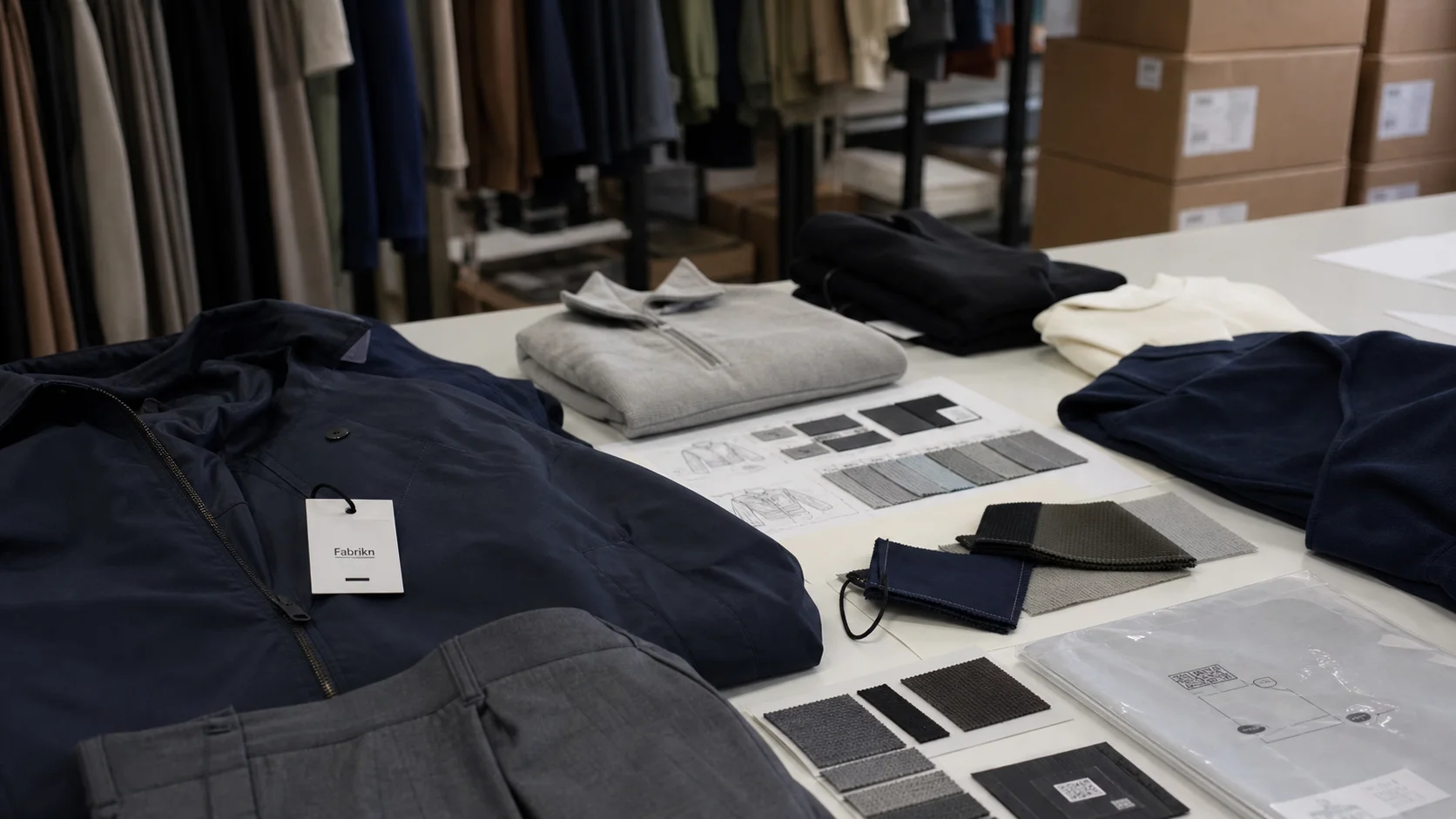
Branding Inserts for Clothing Subscription Box Packaging with checks for samples, fit, MOQ, QC evidence, pricing terms, and delivery risk.
Fast answer: Branding Inserts for Clothing Subscription Box Packaging: Material, Print, Packing Flow, and Cost should be judged by production evidence, not by a generic sourcing promise. The buyer needs sample proof, cost breakdowns, QC checkpoints, and delivery buffers in writing.
Ask for recent sample photos, measurement tolerances, fabric or print test assumptions, decoration test notes, packing examples, and a named inspection checkpoint. These details show whether the team can repeat an approved sample at bulk volume.
Separate garment cost, decoration, labels, packaging, sampling, testing, freight, and rush charges. When every cost line is visible, it becomes easier to reduce colorways, adjust size depth, or reserve more time for sampling.
The box can be modest. The impression should not be. I have watched a $48 shirt box feel premium and a $180 box feel cheap, and the difference was never the garments. It was the branding inserts for clothing subscription box customers saw before they touched a single seam. In the first 30 seconds, shoppers decide whether the fit feels believable, the price feels fair, and the brand understands their life. That judgment drives churn, referrals, and the quiet decision to keep the next shipment.
Across 200-plus factory visits in eight countries, one pattern keeps showing up: brands that treat inserts as afterthoughts pay for it in returns and support tickets. Retention lifts of 6% to 14% are common when inserts explain styling, sizing, and care clearly, especially during the first two deliveries. A modest thank-you card with a fit guide can beat a glossy box sleeve that cost three times as much. Data from Global Organic Textile Standard and trade reporting on consumer textile behavior shows clarity beats decoration when trust is still forming.
Premium boxes usually include a foldout styling edit, a member note, and a QR code to a fit video. Mid-market brands tend to use one two-panel card, often with a referral code and garment care instructions. Budget services cut down to a single postcard or even a stickered tissue wrap. That is not always a mistake. I have seen a $0.22 card in Ho Chi Minh City do more for repeat orders than a $1.80 rigid insert from a European printer because the message was specific, local, and immediate.
The box itself is a container. The insert is the conversation. When I visited a knitwear factory outside Porto, the packout team told me customers complained less about pilling after they received a concise care card explaining cold wash, inside-out drying, and a 30-second steam reset. That card cost $0.09 at 10,000 units. The same brand spent $1.15 per box on rigid mailers that did nothing for service calls.
This is where private label clothing gets judged brutally. A label may have a 45% gross margin target and a 500-piece MOQ, but the subscriber never sees that spreadsheet. They see whether the branding inserts for clothing subscription box shipments make the outfit feel curated or careless. The same principle holds for private label clothing programs with $60 average order values and for smaller monthly clubs shipping 2,000 boxes.
Packaging strategy should track measurable outcomes: refund rate, repeat purchase rate, referral clicks, and the share of customers opening the second shipment on time. Branding inserts for clothing subscription box programs are not decoration. They are a line item with a conversion job.
People read packaging with their hands before their eyes. Paper cards, foldouts, belly bands, and tissue wraps each send a different signal. A thin postcard says efficiency. A multi-panel lookbook says curation. A belly band around a folded knit feels tidy and premium. In a category where shipments arrive every 30 days or every 60 days, repetition quickly reveals whether the brand understands consistency.
Paper cards are the cheapest workhorse, usually $0.06 to $0.28 each at 5,000 to 20,000 units. They suit welcome notes, size reminders, and referral codes. Foldouts run about $0.18 to $0.65 depending on panel count, die-cutting, and finishing. They work well for styling edits or a mini lookbook with 2 to 6 outfit ideas. Belly bands sit in the $0.04 to $0.16 range and are effective for denoting size, collection name, or a short seasonal message. Tissue wraps cost more in labor than in paper, especially when kitting adds 4 to 8 seconds per box.
For brands shipping lingerie, sleepwear, or activewear, inserts often need to do more than brand-building. They need to explain elastane recovery, cup fit, and wash care. That is where custom bra manufacturing clients use size-callout cards, while activewear boxes benefit from fabric-performance notes such as 240 GSM interlock or recycled nylon percentages. Babywear brands need gentler language and simpler diagrams, which is why custom baby clothing manufacturing programs often favor safety guidance and care tabs over layered promotional copy.
On the material side, recycled stock tells a sustainability story, but not every recycled sheet prints beautifully. FSC-certified paper signals responsible sourcing, and soy inks usually reduce solvent concerns while keeping color acceptable for high-volume runs. Coated finishes make images pop, yet they can feel slick and anonymous if the design lacks restraint. According to OEKO-TEX, material choices now sit under more scrutiny than ever because buyers want proof, not slogans.
In factories, I have seen 350 GSM recycled card stock feel luxurious in one brand and look generic in another. The difference was design discipline. Heavy paper cannot rescue weak typography, muddy color separation, or too many competing messages. A clean 2-color layout on FSC board often beats a busy 4-color sheet with foil. The right choice should match the garment category, price point, and shipment frequency. A $25 basics box and a $120 premium knit subscription should not use the same insert strategy.
Pricing looks simple until you break it down into print, kitting, storage, and waste. I have seen brands obsess over a $0.05 difference per card while ignoring the $1,200 cost of redesigning artwork after a late sizing change. For branding inserts for clothing subscription box programs, the real question is not what one card costs. It is what the system costs across a 12-month calendar and 24,000 to 100,000 shipments.
Here is the rough range I see most often. Simple 4x6 cards: $0.05 to $0.22 at 10,000 units. Two-panel inserts: $0.14 to $0.42. Folded guides with 6 to 8 panels: $0.28 to $0.90. Custom multi-piece kits with cards, stickers, and care slips: $0.55 to $1.80 before labor. At 1,000 units, those numbers can double. At 25,000 units, digital printing often gives way to offset, and the per-unit price can drop 20% to 45%.
Domestic print shops usually quote faster turnaround, often 5 to 10 business days for standard cards and 10 to 15 days for folded pieces. Offshore production can lower unit cost by 15% to 35%, but freight adds 2 to 6 weeks and minimums often start at 5,000 or 10,000 pieces. A brand shipping monthly cannot afford stale insert inventory when a collection changes every 8 weeks.
Design revisions are a silent budget leak. Three proof rounds at $150 to $400 each can erase the savings from a cheaper printer. Kitting labor adds another layer. If an insert takes 6 seconds to place and a warehouse processes 8,000 boxes, that is 13.3 labor hours per cycle before rework. Storage matters too. A 50,000-piece run may look efficient until 18,000 pieces go obsolete because the referral code expires.
Brands should measure packaging cost as a percentage of order value. I like to see insert spend stay between 0.5% and 2.5% of monthly box revenue, depending on average price and churn risk. Trade data from trade.gov shows freight volatility can swing landed cost enough to change sourcing decisions within a single quarter.
The sharpest cost savings usually come from standardizing dimensions, limiting finishes, and printing variable data only where it matters. A 3-panel guide with one QR code and one care block can do the work of a 12-page booklet if the information is edited ruthlessly.
Good design reduces doubt. That is the job. I have seen brands lose repeat orders because customers did not know how a blazer should fit at the shoulder or whether a knit dress was machine-washable. The best inserts remove friction, answer fit questions, and make the next purchase feel easier than the last. That matters more than pretty photography. It matters even more for cut and sew manufacturing programs where garment construction varies across trims, silhouettes, and seasonal fabric weights.
The strongest inserts follow one clear action, one supporting benefit, and one proof point. Example: “Try this fit note,” “to reduce returns,” “because 72% of members keep the same size for two consecutive boxes.” That is cleaner than a paragraph of brand poetry. Welcome messaging belongs first. Education comes second. Cross-sell should stay last and subtle, usually with one product link or one style code rather than four competing offers.
High-performing copy themes are practical. Care instructions. Style fixes. Layering suggestions for 8°C to 14°C weather. Referral prompts tied to a real reward, such as $15 off after a friend’s first box. I have seen referral cards outperform discount posters by 2 to 3 times because they feel like a favor, not a push.
Personalization works best when it saves time. A customer name is fine. A style profile is better. Regional weather cues are even better when a box is meant for wear now. If a subscriber in Chicago gets a note that says “Best with a thermal layer this week,” the brand feels attentive. If a subscriber in Miami gets the same note, trust drops fast.
Fewer inserts with stronger content usually beat bulky mailers full of noise. I have watched a 2-card system outperform a 7-piece kit because the warehouse made fewer mistakes, the message was faster to read, and the customer actually kept the card for reference.
Supplier selection is where packaging dreams meet operations. I have toured plants in Mexico, Vietnam, Turkey, and Poland where beautiful mockups collapsed under poor quality control. The best vendors do not just print. They understand kitting, color consistency, storage constraints, and what happens when the monthly box ship date moves by 4 days.
Ask for proofing method, color tolerance, paper origin, and defect thresholds. Ask whether they can handle 500-piece pilot runs and 25,000-piece reorders without changing substrates. Ask how they measure fold accuracy, what happens if ink rubs off, and whether they can reprint within 72 hours if the first batch misses spec. If a vendor cannot explain trim size tolerance to within 1 to 2 mm, keep looking.
Also ask about certifications and traceability. FSC, recycled-content claims, and packaging compliance matter. According to ASTM, standardized testing and tolerances reduce disputes when packaging sits inside a larger quality system. That matters for brands shipping to multiple regions with different warehousing partners and customs documentation needs.
Timeline depends on print method. Digital print can move in 3 to 7 business days after approval. Offset usually takes 7 to 14 days. Specialty finishing, such as embossing, foil, or spot varnish, can stretch to 15 to 25 days. Rush work is possible, but rush jobs often cost 20% to 60% more and leave less room for correction.
Factory audits reveal the same failures again and again: incorrect trim size, weak adhesive on belly bands, ink rub-off on uncoated stock, and fold lines that drift by 2 or 3 mm across a batch. A late insert can throw off a full fulfillment cycle, especially when warehouse teams are already packing 3,000 to 12,000 boxes per run. Price matters. Risk matters more.
Start small, test hard, then scale only what proves itself. I have worked with brands that launched 40,000 inserts before measuring anything. That is not strategy. That is expensive guesswork. A controlled pilot of 500 to 2,000 boxes can tell you more than a polished pitch deck. The goal is to prove that the insert changes behavior, not to admire the artwork.
Test 2 to 4 variants against a control group over at least one billing cycle. Keep the variables tight. Change the headline, the QR destination, or the referral offer, not all three at once. Measure repeat purchase rate, code redemptions, customer support tickets, and return reasons. If one insert cuts “fit confusion” tickets by 12% and lifts referral clicks by 8%, that is a winner even if the design is less glamorous.
Use a simple workflow. Concept approval in week 1. Copy and layout in week 2. Proofs and color sign-off in week 3. Production booking in week 4. Warehouse receipt in week 5 or 6 depending on freight. Then insert into packout with a one-page SOP so the team knows where each piece goes and what to do if a box ships without it.
Track business metrics, not vanity metrics. A 3% redemption rate on a QR code may be fine if retention rises 5 points. A 0.5% code rate may still be valuable if it reduces returns on a $90 average order by 9%. I care about support tickets, refund requests, and net revenue retained over 60 and 90 days.
Checklist: define the goal, cap the number of insert variants, set a print budget ceiling, confirm warehouse capacity, approve one fallback card, and write a measurement plan before you approve artwork. If any of those steps are missing, the program is not ready.
The next wave is less paper, more function. Hybrid print-digital systems are already replacing static brochures in subscription programs that ship 10,000 to 100,000 units a month. QR codes now link to size videos, outfit builders, and style quizzes that update weekly. Some brands still use inserts as little flyers. Others are turning them into shoppable media with real conversion tracking.
I have seen scan rates rise when brands cut from 6 pages to 1 card and made the call to action painfully clear. That sounds backward, but it is true. Fewer pages reduce waste and increase the chance that a customer actually scans. When the QR code leads to one specific action, such as “watch fit guide” or “save this outfit,” engagement climbs. If it leads to a cluttered homepage, it dies.
Sustainable brands are also replacing paper clutter with detachable cards, single-sheet guides, and variable printing that changes seasonally instead of monthly. Ink choice is shifting toward lower-solvent systems. Paper choice is moving toward recycled and certified stocks with less coating. In some categories, especially babywear and essentials, one durable insert used across 3 deliveries can outperform a different paper sheet in every box.
The smartest teams are asking a better question: what information must live in the box, and what can move online? Size charts, return policies, and style libraries can sit behind a QR code. Care instructions still belong on paper for the customer who never scans. The future is not zero print. It is selective print with a job to do.
In factories, this shift is already visible in lower waste bins, smaller paper pallets, and tighter packout routines. A 20,000-box program that removes one 2-panel insert saves paper, labor, and freight. That is packaging strategy, not virtue signaling. And it is why branding inserts for clothing subscription box programs will keep evolving from decoration into a measurable media channel.
They explain fit, care, styling, referrals, and brand story inside the shipment. In many programs, a strong insert reduces return confusion and support tickets by 5% to 15% over two billing cycles.
Simple cards often cost $0.05 to $0.22 each at 10,000 units, while folded guides can run $0.28 to $0.90. Total cost should also include design, kitting, storage, and waste, which can add 15% to 40% on top of print.
Digital print can take 3 to 7 business days after proof approval. Offset usually needs 7 to 14 days, while specialty finishes such as foil or embossing can take 15 to 25 days.
Yes. Inserts that clarify sizing, fabric behavior, and wash care can reduce avoidable returns, especially in apparel categories with fit sensitivity. I often see the biggest effect in the first 2 shipments, when customer confidence is still forming.
Choose a manufacturer, factory, or supplier that can prove color consistency, paper traceability, and reprint reliability. Ask for sample proofs, defect thresholds, and fulfillment compatibility, because a late or defective insert can disrupt an entire monthly shipment cycle. For bulk or wholesale production in China or elsewhere, compare lead times, MOQ, and quality controls before committing.