
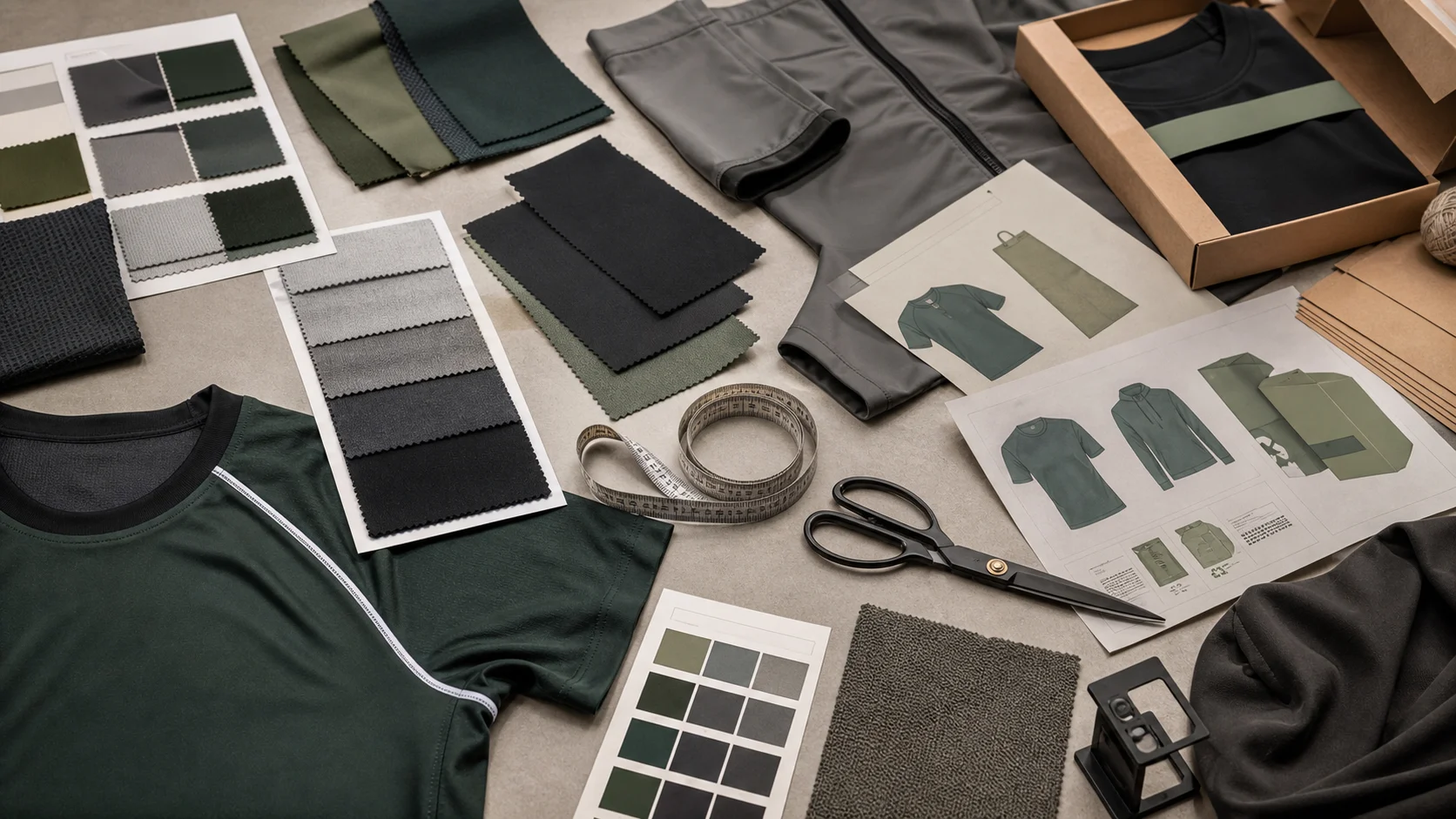
Branded Packaging for Online Clothing Store with checks for samples, fit, MOQ, QC evidence, pricing terms, and delivery risk.
Fast answer: Branded Packaging for Online Clothing Store: Costs, Options, ROI should be judged by production evidence, not by a generic sourcing promise. The buyer needs sample proof, cost breakdowns, QC checkpoints, and delivery buffers in writing.
Ask for recent sample photos, measurement tolerances, fabric or print test assumptions, decoration test notes, packing examples, and a named inspection checkpoint. These details show whether the team can repeat an approved sample at bulk volume.
Separate garment cost, decoration, labels, packaging, sampling, testing, freight, and rush charges. When every cost line is visible, it becomes easier to reduce colorways, adjust size depth, or reserve more time for sampling.
A plain poly mailer can make a brand feel cheaper before the customer even touches the garment. In factories from Ho Chi Minh City to Porto, I have watched the same hoodie move from forgettable to premium with a $0.18 printed belly band and a $0.27 tissue wrap. That is why branded packaging for online clothing store operations is not decoration. It is pricing power in cardboard and ink.
Across 200-plus factories in 8 countries, the pattern kept repeating. Not fabric alone. Not fit alone. The first 10 seconds after delivery mattered more than most founders wanted to admit. Brands selling $18 tees in North America often shipped in uncoated mailers and got acceptable repeat rates, around 18% to 22% in the first 90 days. Mid-market labels in Europe, especially those pricing tops at $42 to $68, used heavier cartons, 1-color debossed logos, and a care card, and their customers described the order as “more expensive” even when the product was identical. In Asia, where presentation standards are often sharper at lower price points, I saw $12 basics arrive in structured boxes with 2 inserts and a 3-panel fold, and complaints about quality dropped because the packaging framed the product before the product framed itself.
The unboxing moment starts before the garment is seen. A rigid mailer with a crisp opening edge creates anticipation. A dented box says discount bin. For a $25 basic, packaging can add 5% to 8% to landed cost and still raise acceptance if it reduces returns or boosts repeat orders by even 2 points. For a $180 knit sweater, a better box can protect margin by lowering damage claims and return friction. The garment does not need a luxury coffin. It needs a package that matches the promise.
In the factory yards of Italy and Vietnam, I learned that customers do not inspect packaging with a ruler. They read weight, stiffness, and print clarity. A soft-touch laminated box can feel expensive, but so can a simple kraft mailer with a 2-color flexographic logo, clean fold lines, and a thank-you card on 350 gsm stock. The trick is consistency. If the shirt is priced at $34 and the packaging looks like it cost $1.50, the customer assumes the margin went into the product. If the shirt is priced at $34 and the packaging looks like it cost $0.03, the customer assumes the brand cut corners.
Packaging is a profit decision, not a decoration. I have seen brands spend $0.85 more per order on presentation and gain back $3 to $6 in higher perceived value, lower returns, or stronger repeat behavior. That math changes fast when monthly volume hits 5,000 units. It becomes even sharper at 50,000 units, where a cent saved on print or structure can fund better inserts, stronger corrugate, or faster fulfillment. The question is not whether packaging matters. It is which package earns its keep.
For branded packaging for online clothing store brands, format should follow product, not ego. Lightweight tees, socks, and babywear usually ship best in folding cartons or paper mailers with internal tissue. Denser knits, denim, and athleisure tolerate corrugated mailers or E-flute boxes better because they resist crush and can handle 1.5 to 3.0 kg parcels without buckling. Outerwear changes the equation again. A puffer jacket in a slim poly mailer may save $0.22 in material, but you can lose more than that if the package arrives wrinkled or compressed.
Folding cartons give the strongest shelf-style presentation, but they consume warehouse space and are slower to pack. On factory lines I watched in Spain and China, carton packing added 8 to 12 seconds per order versus a poly mailer. Small number, big impact. Corrugated mailers sit in the middle: better protection than a soft mailer, easier stacking than a rigid box, and often cheaper than a folding carton at volumes above 5,000 units. Poly mailers remain the speed king for basics, especially if the garment is already folded, bagged, and barcoded.
Think about the components separately. Tissue wrap costs roughly $0.04 to $0.10 per sheet at mid-volume. Belly bands can run $0.03 to $0.12 depending on paper grade and print count. Thank-you cards often sit at $0.05 to $0.18. Each element does a different job. Tissue adds drama. A band keeps folds neat. A card holds the brand story and care instructions. In practice, the cheapest-looking order is often the one with too many pieces and no hierarchy.
For basics, I prefer a simple mailer, one band, and one card. For denim, use a stronger carton or reinforced mailer because button flys and rivets puncture weak film. For athleisure, especially technical fabrics like French terry 320 GSM or brushed jersey, choose packaging that prevents creasing and static cling. Premium apparel benefits from a cleaner opening experience, but that does not require a heavy box. A precise fold, tissue, and a logo seal can outperform a large format that wastes freight and storage.
Simple formats often drive better brand recall. When I reviewed post-purchase surveys from three brands shipping 10,000 to 40,000 orders monthly, customers remembered the logo more often when the package was easy to open and reuse. A beautiful box that frustrates the hand becomes a nuisance. A smart mailer with one strong design cue becomes part of daily life. For brands using clothing packaging solutions, the winner is usually the format that protects product, speeds pick-pack, and still gives the customer one memorable visual cue.
The cost model shifts sharply by volume. At 500 units, a custom folding carton with 2-color print, basic matte coating, and a custom dieline can land around $1.10 to $2.40 per piece before freight. Add a plate charge of $60 to $180, a die-cut tool at $120 to $350, and sample rounds at $25 to $75 each. That means the packaging may cost more than the tee in low-volume test runs. At 5,000 units, the same carton often drops to $0.42 to $0.88. At 50,000 units, I have seen comparable specs land at $0.18 to $0.36, especially when artwork is standardized and the board grade stays stable.
Print method matters. Digital print is flexible for 500 to 1,500 units, but it usually carries a higher unit price. Flexo and offset improve at scale. Foil stamping can add $0.08 to $0.25. Embossing may add $0.06 to $0.20. Soft-touch coating can add $0.10 to $0.30 and is rarely worth it on lower-priced apparel unless the box is being reused. A premium-looking package can be cheaper than expected if you use one-color print on a high-quality kraft stock, then add structure rather than decoration. Structure often sells better than shine.
Freight is where brands get surprised. Packaging ships as volume, not beauty. A carton that weighs 48 grams but measures 30 x 22 x 4 cm can trigger dimensional weight charges that erase any savings from lower unit cost. Storage matters too. A 20,000-unit run of flat-packed boxes can consume 12 to 18 pallets, while poly mailers may fit in 3 to 5. Labor is the hidden line item most founders miss. If a package takes 7 extra seconds to assemble, a team packing 2,000 orders a day can burn 3.9 extra labor hours daily.
According to ISO packaging and quality standards, consistency in dimensions and material specs is not cosmetic; it is operational control. I have seen brands lose margin because one supplier’s “same box” was 2 mm too wide, which broke carton stacking efficiency and forced a new shipping configuration. This is where private label brands often stumble. Good private label clothing services usually price packaging as a system, not a single component.
One more cost point. Minimum order quantities are not always negotiable, but they are sometimes strategic. MOQ 500 may be right for a capsule launch. MOQ 5,000 makes sense once a SKU has stable sell-through for 8 to 12 weeks. A premium box that costs $0.52 at 10,000 units may beat a cheap mailer that costs $0.31 if the box lowers damage, cuts returns, or improves average order value by $2 or more. Scale changes everything.
Packaging is a trust signal. For a first-time buyer, a neat, branded arrival can confirm that the checkout page was real, the product is legitimate, and the brand cares about detail. That feeling affects behavior. In my own review of brand audits, orders shipped with branded inserts saw 9% to 14% more review submissions than plain shipments in the same price band. The effect was strongest at $30 to $90 apparel price points, where customers have enough spend to expect polish but not enough to forgive rough edges.
Packaging also reduces confusion. A care card that says wash cold, inside out, and dry flat cuts customer service tickets. A size insert with chest, length, and fit notes can reduce returns by 2 to 5 points on fashion basics, especially in categories like bodysuits, leggings, and soft bras. That is one reason brands with technical intimates or fit-sensitive product lines, such as those using custom bra manufacturing, often treat inserts as part of the product, not afterthoughts.
Unboxing content drives free acquisition, but only when the package has one clear visual cue. A single color band, a distinctive tissue pattern, or a stamped logo is enough. I have seen creators film a $22 tee because the mailer had a strong opening moment, then ignore a $220 jacket that arrived in a generic box. That is not vanity. It is media behavior. The better the packaging cue, the better the odds of organic reach.
Budget labels gain from clarity and consistency, not expensive finishes. Direct-to-consumer mid-market brands gain the most from thoughtful inserts and tidy presentation. Premium brands need tighter material control because any inconsistency damages trust. Ultra-low-price basics with repeat purchase cycles under 30 days often need less ceremony; a clean poly mailer and a sharp insert can outperform an ornate box that eats margin.
Waste is not reduced by claims. It is reduced by materials, sizing, and recovery rates. FSC-certified paper, recycled corrugate, and water-based inks are the safest starting points because they are familiar to recyclers and easier to validate in audits. A corrugated mailer made from 70% to 100% recycled content usually performs well if the print coverage stays modest and coatings remain repulpable. Compostable mailers sound attractive, but only if your customers actually have access to industrial composting. In many markets, they do not.
Data from Textile Exchange and recycling-focused industry groups shows that material choice matters less than claim discipline. A package labeled “eco-friendly” without proof invites skepticism. I have seen brands use “biodegradable” for film mailers that needed specific heat and moisture conditions to break down, which is not how most households dispose of packaging. That claim fails in real supply chains because the disposal path is unclear.
International variation matters. In Germany, paper recovery systems are strong and customers expect minimal plastic. In the U.S., curbside acceptance varies by county and even by city block. In parts of Southeast Asia, collection systems are inconsistent, so a recyclable label may not translate into actual recycling behavior. The smartest route is to specify packaging the average customer can understand in 5 seconds: paper-based when possible, minimal mixed materials, and obvious separation between the outer shipper and the inner insert.
Durability versus material use is a real trade-off. A thicker mailer that survives one failed delivery may be more sustainable than a thinner one that tears and forces reshipment. I have seen brands save 8 grams of material per order, then lose those gains to 4% more replacements. The right answer is not always the lightest package. It is the package with the lowest total waste over 10,000 orders.
If you communicate sustainability, be precise. Say “FSC paper,” “recycled corrugate,” or “water-based inks.” Avoid vague language unless you can back it with certification and supplier records. Use the data, not the halo. If you need third-party packaging guidance, the standards and compliance pages at WRAP are a better reference than marketing copy. You can also review international trade and supply-chain guidance from trade.gov when sourcing across borders.
A strong brief cuts weeks off production. Start with dimensions, garment weights, and the exact fulfillment method. A tee folded to 28 x 22 cm does not need the same carton as a winter coat folded to 40 x 35 cm. Include branding assets in vector format, the target landed cost, the shipping method, and whether the package must survive retail shelf display or only parcel transit. If the supplier does not know the product weight range, ask them to test with 3 sample garments, not one.
Artwork and dielines are where errors hide. Ask for a print-ready dieline, bleed allowance, and a prepress checklist before you approve any sample. Color tolerance should be written down. I prefer a Delta E target if the factory can measure it, or at least a signed visual standard under D50 lighting. Paperboard shade shifts. Ink shifts. Lamination shifts. A 5% difference on screen can become a visible mismatch on the line.
Lead time depends on format. Plain printed mailers may ship in 2 to 3 weeks. Custom boxes often need 4 to 6 weeks. Complex finishing can push that to 6 to 8 weeks, especially if a factory has to source specialty board or new plates. Rush orders raise prices quickly, sometimes by 15% to 30%, because the supplier has to interrupt scheduled runs. Factory-floor reality is ugly in a useful way: if the carton does not stack cleanly on the gluer, the whole line slows.
Ask three questions before approval. Can the package run on your existing machine set without manual trimming? Does the carton stack efficiently on a 1.2 m pallet? Will the inner insert interfere with folding, bagging, or barcode placement? These questions sound boring. They save money. I have watched brands rework a box because the flaps were 4 mm too long and the warehouse team could not close 1,000 units without hand-folding.
For brands that serve babywear, fit-sensitive intimates, or modular capsule collections, the package brief should match the product architecture. A company handling custom baby clothing manufacturing cannot afford loose sizing information or sharp-edge packaging. Babies do not care about logos. Parents care about safety, clarity, and clean presentation. The right manufacturer, factory, or supplier should be able to explain production tolerances, quality checkpoints, and MOQ options before you place a wholesale or bulk order, whether the program is based in China or elsewhere.
Give yourself 30 days, not 3 months. Week 1: audit current packaging, measure damage rate, note labor time per order, and calculate packaging cost as a share of average order value. Week 2: choose 2 formats, not 5. Week 3: request quotes from at least 3 suppliers, sample both options, and test them with real garments. Week 4: launch on core SKUs first, usually 1 to 3 hero products, then expand after the first 500 orders.
Test four metrics. Repeat purchase rate. Review volume. Damage rate. Cost per order. If branded packaging for online clothing store shipments raises cost by $0.40 but lowers damage by 1.2% and improves repeat purchase by 2 points, the package is earning. If the box looks beautiful but labor climbs 10 seconds per order and support tickets do not move, cut it back. Do not guess.
Check every team before launch. Operations needs pallet counts and pack speed. Customer service needs care and return language. Inventory needs storage space. Finance needs landed cost and reorder timing. Marketing needs photo consistency. The smartest brands phase packaging by product tier, starting with core SKUs and then rolling into full assortment once the numbers hold. Packaging should earn its keep by order 1, not by wishful thinking.
At 500 units, custom packaging often lands between $1.10 and $2.40 per piece. At 5,000 units, the same spec may fall to $0.42 to $0.88, and at 50,000 units it can drop to $0.18 to $0.36. Freight, inserts, and finishing can add 15% to 40% on top.
For tees, socks, and light knits, a printed poly mailer or a folding carton with tissue and one insert usually works well. If the garment is under 500 grams, keep the structure simple and focus on print clarity. That approach often saves $0.20 to $0.60 per order.
Plain printed mailers usually take 2 to 3 weeks. Custom boxes often need 4 to 6 weeks, while specialty finishes can stretch to 6 to 8 weeks. Rush orders can add 15% to 30% to the price.
Yes, especially when inserts explain sizing, fit, and care. In my factory and brand audits, better packaging and clearer inserts reduced return rates by 2 to 5 points in fit-sensitive categories. The biggest gains came from bras, leggings, and premium basics.
Start with your top 1 to 3 SKUs, request 3 quotes, and sample 2 formats. Measure cost per order, damage rate, and repeat purchase over the first 500 shipments. If the numbers improve, expand in phases rather than converting the whole catalog at once.