
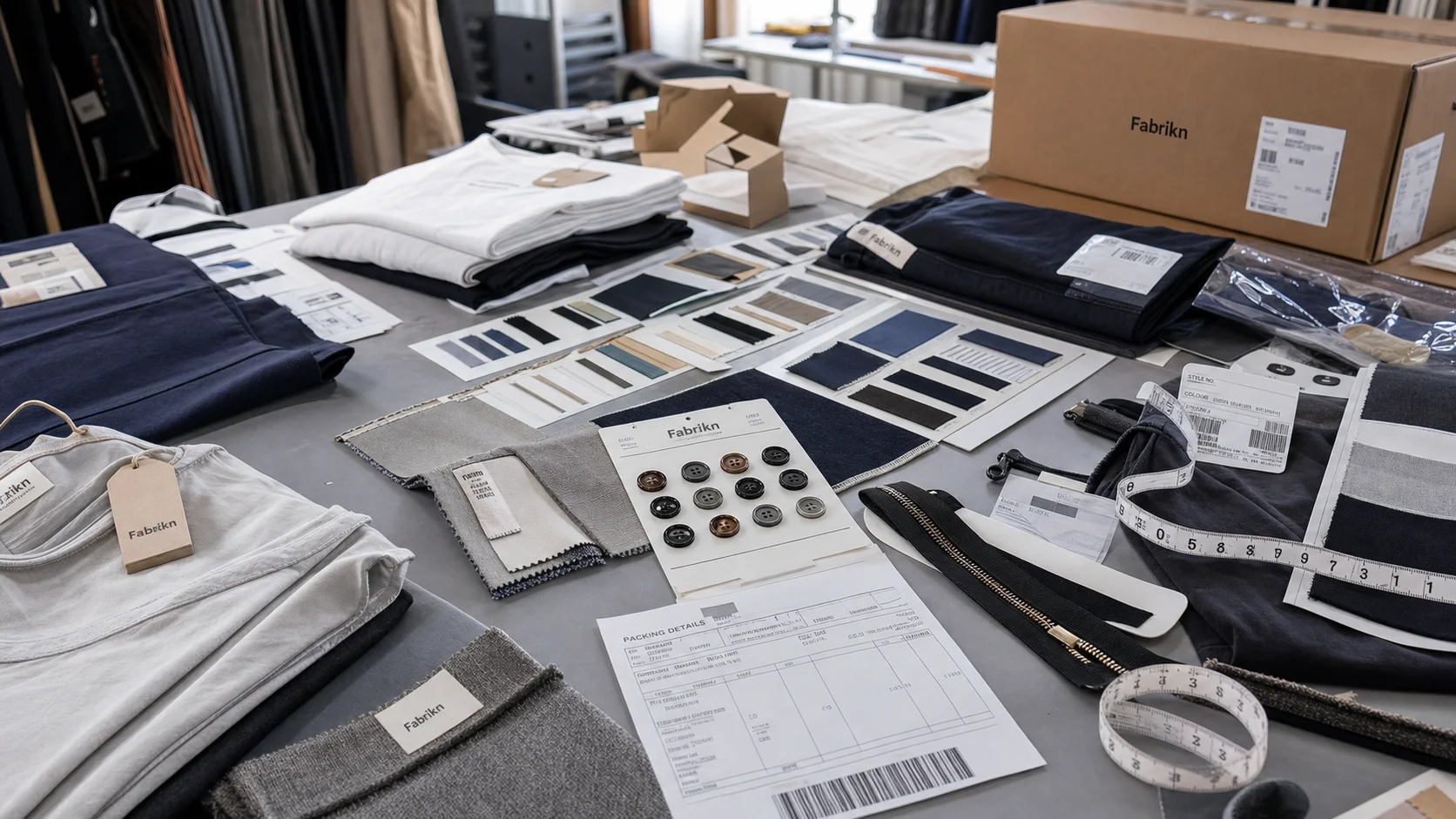
Apparel Order Packaging Inserts with checks for samples, fit, MOQ, QC evidence, pricing terms, and delivery risk.
Fast answer: Apparel Order Packaging Inserts: Cost, Message, ROI, and Packing Rules should be judged by production evidence, not by a generic sourcing promise. The buyer needs sample proof, cost breakdowns, QC checkpoints, and delivery buffers in writing.
Ask for recent sample photos, measurement tolerances, fabric or print test assumptions, decoration test notes, packing examples, and a named inspection checkpoint. These details show whether the team can repeat an approved sample at bulk volume.
Separate garment cost, decoration, labels, packaging, sampling, testing, freight, and rush charges. When every cost line is visible, it becomes easier to reduce colorways, adjust size depth, or reserve more time for sampling.
Apparel customers know within seconds whether an order feels worth keeping, posting, or sending back. branded packaging inserts for apparel orders are often the first tactile proof that a brand paid attention, and that tiny moment can shape the whole unboxing experience. I’ve watched it on packing floors in Guangdong, Ho Chi Minh City, and near Istanbul: tissue paper comes off, the insert appears, and the order either feels considered or careless.
A small card can do more than a bigger box. A $0.08 insert inside a $120 order can make the purchase feel deliberate if the copy is specific, the paper stock is honest, and the message matches the product. A cheap-looking insert in a $20 order can do the opposite. Customers read visual shortcuts fast. I’ve seen DTC basics brands lift review volume by 12-18% after standardizing their thank-you card and care note, while premium labels often get more social shares than discount codes from a simple, well-printed message.
Factory visits taught me that consistency beats novelty.
Brands that change inserts every season create extra checkpoints, more version-control headaches, and more rework. On one line producing 15,000 units a day, I saw a 2.5% packing error rate on mixed insert programs, versus under 1% when the insert stayed fixed for six months. That difference sounds small until you price it across 50,000 orders and a returns team that has to answer the resulting emails.
Here is the business case: inserts are not decoration; they are a retention tool, a service tool, and a margin tool. They can reduce return confusion, increase repeat purchase rates, and support social sharing in a way that still works on lower-priced product. When I visited brands selling everything from $18 tees to $280 outerwear, the strongest results came from branded packaging inserts for apparel orders that behaved like operational assets, not seasonal props. For brands building a broader packaging system, clothing packaging solutions matter as much as the garment itself.
The category is broader than many buyers expect. A branded packaging insert can be a thank-you card, a care guide, return instructions, a referral card, a loyalty offer, a QR code sheet, or a multi-piece bundle that does all of those jobs at once. In practice, the best version depends on the customer journey. First-time buyers need reassurance. Repeat buyers need a reason to come back. Return-prone products need sizing and care clarity.
Simple paper inserts travel best through fulfillment because they are flat, countable, and easy to collate. A single 100 x 150 mm card printed on 350 gsm stock can be packed by hand at speed, while a three-piece insert kit slows the line and multiplies mistakes. I’ve seen a factory in Vietnam cut its packing labor by 14% after dropping a coupon card that nobody redeemed. The team was happier, the cartons were cleaner, and the customer service inbox got fewer “where is my offer” messages.
Cheap-looking inserts are often skipped. That surprised me too, until I stood at a packing bench and watched testers ignore a flimsy 200 gsm sheet that arrived curled and dull. A heavier card on 300 gsm or 400 gsm stock can feel premium without adding much to unit cost, especially if the finish is matte rather than glossy. The physical signal matters. Customers infer effort from weight, color consistency, and edge quality.
Post-purchase education is where inserts earn their keep. A sizing chart reduces avoidable returns. A care guide for enzyme-washed denim, French terry 320 GSM, or delicate knitwear can lengthen product life and reduce complaints. For resale-minded shoppers, a plain-language material note can improve secondhand value because it answers the questions that matter later. I’ve seen that work especially well for brands in private label clothing, where product education travels with the item and carries the brand into the next owner’s hands.
Paper weight changes perception quickly. A 300 gsm card feels credible for most DTC apparel brands. At 400 gsm, the card takes on a more substantial, premium feel, especially with soft-touch lamination or a clean matte coat. I’ve handled inserts from high-end lingerie brands that used 350 gsm uncoated stock and looked more expensive than some laminated sheets twice their price. Material honesty matters more than decorative excess.
On sustainability, the trade-offs are real, not cosmetic. Recycled fiber content can be strong, but recycled paper sometimes has a rougher surface and weaker color saturation. Soy inks are a useful choice for many print runs, while water-based coatings can improve recyclability if the end user’s waste system accepts them. Plastic-free closures help, but not if they drive up spoilage because the packers cannot seal or sort consistently. According to OEKO-TEX, material claims need traceability, not vibes, and that applies to inserts as much as textiles.
Greenwashing shows up fast in this category. “Eco paper” without FSC or recycled-content documentation is not enough. A card that looks sustainable but uses heavy laminate, metallic foil, or mixed adhesives may be harder to recycle than a standard printed sheet. I ask suppliers for the paper mill certificate, the ink specification, coating details, and a clear end-of-life note. If they cannot tell me whether the substrate is FSC-certified, 100% recycled, or mixed-fiber, I treat the sustainability claim as marketing copy, not proof.
Regional sourcing also changes the math. Many Asian factories can source certified paper quickly at three- to seven-day material lead times, while smaller European converters may offer lower minimums of 500-1,000 units but charge 15-30% more per piece. I’ve seen a Turkish printer deliver beautiful short runs on 250 gsm recycled stock, yet the same order cost nearly double a mainland China quote once shipping and finishing were included. For apparel teams using custom bra manufacturing, where delicate brand presentation is part of the fit story, the packaging choice has to match the product’s price and the customer’s tolerance for waste.
Unit economics shift sharply with volume. At 1,000 units, a simple printed card might land at $0.18-$0.35 each from a domestic short-run supplier, while a folded leaflet can run $0.28-$0.55 depending on size and ink coverage. At 10,000 units, offset printing can push that down to $0.06-$0.14 for a flat card and $0.10-$0.22 for a folded piece. At 100,000 units, the card may fall below $0.05, but only if the artwork is stable and the job is not buried under special finishes.
Die cutting, foil stamping, embossing, and variable data printing can change the math fast. I’ve seen a die-cut loyalty card add $0.07 per unit before packing, then another $0.03 in labor because the shape was harder to count. A QR code with a unique SKU or offer code is cheap at scale, but setup and proofing can add $150-$400 to the first run. That is manageable on a 10,000-unit launch and painful on 800 units.
Hidden costs matter more than many buyers admit. Design revisions can consume two to four extra days. Proofing mistakes can trigger a full reprint. Color mismatch, especially across coated and uncoated paper, creates spoilage that sits around 2%-6% in my factory experience. If the pack format requires collating two cards and a folded note, packing labor often rises by 10%-20% compared with a single insert. For brands that also run cut and sew manufacturing, those small per-unit changes can move the gross margin more than a freight-rate swing.
Region matters. Mainland China often offers the lowest print cost on higher runs, Vietnam is competitive on mid-size orders with solid turnaround, Turkey can be stronger for European delivery windows, and domestic short-run suppliers win on speed rather than price. A buyer should ask what is included: prepress, plates, finishing, packing, QC, and freight. If a quote looks too clean, it probably hides labor, correction fees, or carton charges somewhere else.
Low price is the easiest number to win and the hardest one to trust. I look for MOQ, paper sourcing, color control, finishing skills, lead-time discipline, and whether the supplier can print variable QR codes or SKUs without chaos. A manufacturer with a stable factory process and a reliable production line is more useful than a glossy brochure with no proof of packing consistency.
Sampling is where many brands cut corners. They approve from a flat PDF, then wonder why the real card shifts color or curls in transit. I ask for a pre-production sample, a press proof, and a packed sample inside a real apparel order. That last step is crucial, because a beautiful insert can still fail if it jams the carton or smears against tissue paper. When I visited one supplier in southern China, the operations manager talked about waste rates first, not aesthetics. That told me more than the sales pitch ever could.
Commercial printers are useful for large volumes and straightforward specs. Packaging specialists are better when the job involves multiple components, niche folding, or strict color matching. If your inserts carry market-specific offers, language variants, or a multi-SKU matrix, the specialist usually controls risk better. Cross-border production adds another layer: language gaps, time-zone delays, and missed seasonal deadlines can all happen in the same order. Clear documentation reduces damage. I want dielines, Pantone references, carton pack lists, and signed artwork approval on every job.
For brands building technical product lines, including custom bra manufacturing, the supplier needs to understand how packaging supports fit, returns, and brand voice. That is not a nice-to-have. It is a production control issue.
Real timelines are usually longer than the sales estimate. Artwork approval can take 2-5 days, plate making another 1-2 days, printing 2-7 days, drying and finishing 1-3 days, then shipping 3-20 days depending on origin and mode. A simple digital print may be ready in 3-5 days total. Offset runs usually need 10-18 days. Specialty finishes such as foil, emboss, or spot UV can stretch that to 15-28 days, especially if the supplier is juggling multiple seasonal programs.
Inventory planning affects fulfillment speed directly. If the insert sits out of stock, the warehouse either ships blank or delays the order, both of which are expensive. If the insert is overbought, obsolete messages clog storage. I have seen a warehouse in Europe hold 42,000 outdated promo cards after a sale extension changed the coupon logic by seven days. That was avoidable waste.
Storage should be boring and disciplined. Cartons need clear labels for size, language, market, and batch number. I prefer FIFO by print date and separate locations for old and new offers. If a brand sells in the US, UK, and EU, the inserts should never be mixed casually. The best operations team I worked with used color-coded carton tape, scanned batch IDs at intake, and kept no more than 30 days of insert stock at the packing station.
Testing should start with one variable at a time. Compare discount versus care education. Test loyalty points against referral prompts. Compare a QR landing page with a printed URL. I’ve seen care-led inserts outperform discount cards by 9-14% in repeat purchase for premium basics, while value shoppers often respond better to a direct offer with an expiration date of 14-21 days.
The metrics are straightforward. Track scan rate, redemption rate, repeat order rate, return rate, and customer service contacts. If the insert reduces “how do I wash this” tickets by 8% and improves repeat order rate by even 3%, the return can justify a higher print cost. If it only boosts vanity engagement and not retention, it is decoration.
Sample size matters. I do not trust a 50-order test unless the signal is very strong. A pilot of 500-1,000 units per version is more useful, especially when order value is above $60 or when the audience is split across markets. Luxury buyers and value shoppers react differently, which is why one insert often fails to travel across price tiers. The best insert is usually the one that matches the product’s price psychology, not the brand’s taste.
For structured product businesses such as private label clothing, the insert becomes part of the retention system. Measure it like one.
Start with purpose. Pick one primary message, one substrate, and one measurement method before you request pricing. If the goal is repeat purchase, say so. If the goal is fewer returns, build the insert around fit and care. If the goal is loyalty enrollment, make the QR path short and mobile-friendly.
Your supplier brief should include size in millimeters, paper weight, ink requirements, finishing, pack method, target markets, and any sustainability claims that need proof. Ask for MOQ, lead time, proof schedule, packing configuration, and overrun tolerance. I also want carton counts, pallet specs, and whether the supplier can separate versions by language or promotion code. A good supplier, factory, or wholesale partner should be able to answer those questions clearly.
Roll out in phases. Test 1,000 to 5,000 units first. Review results after the first batch, then decide whether to scale, revise, or stop. Align packaging, e-commerce, and customer service so the insert message matches the site, the email flow, and the returns policy. That alignment is where waste falls and consistency rises.
Branded packaging inserts for apparel orders are small, but they sit at the junction of brand perception, repeat purchase, and waste control. Choose them like a production decision, not a decoration decision.
For broader sourcing context, buyers can also review guidance from U.S. Commercial Service trade resources and Textile Exchange when comparing material standards and supplier claims.
They are printed items placed inside apparel shipments, such as thank-you cards, care guides, return notes, referral offers, or QR sheets. Most brands use one insert, but some use a two- or three-piece set when they need both education and promotion.
At 1,000 units, simple cards often cost $0.18-$0.35 each, while folded inserts may run $0.28-$0.55. At 10,000 units, many flat cards drop to $0.06-$0.14, depending on paper weight, finishing, and print method.
Simple digital runs can take 3-5 days. Offset printing usually needs 10-18 days, and specialty finishes can take 15-28 days, plus shipping time. A cross-border order may need 3-20 extra days depending on origin and freight mode.
Yes, if the insert addresses sizing, fabric care, or fit guidance clearly. I have seen return-related customer service contacts fall by around 8% when brands used a simple care and sizing note with a QR link to product education.
Ask for MOQ, paper source, color control, lead time, packing method, and proofing steps. Also request a pre-production sample and a packed sample, because a flat mockup does not show curl, scuffing, or collation problems.