
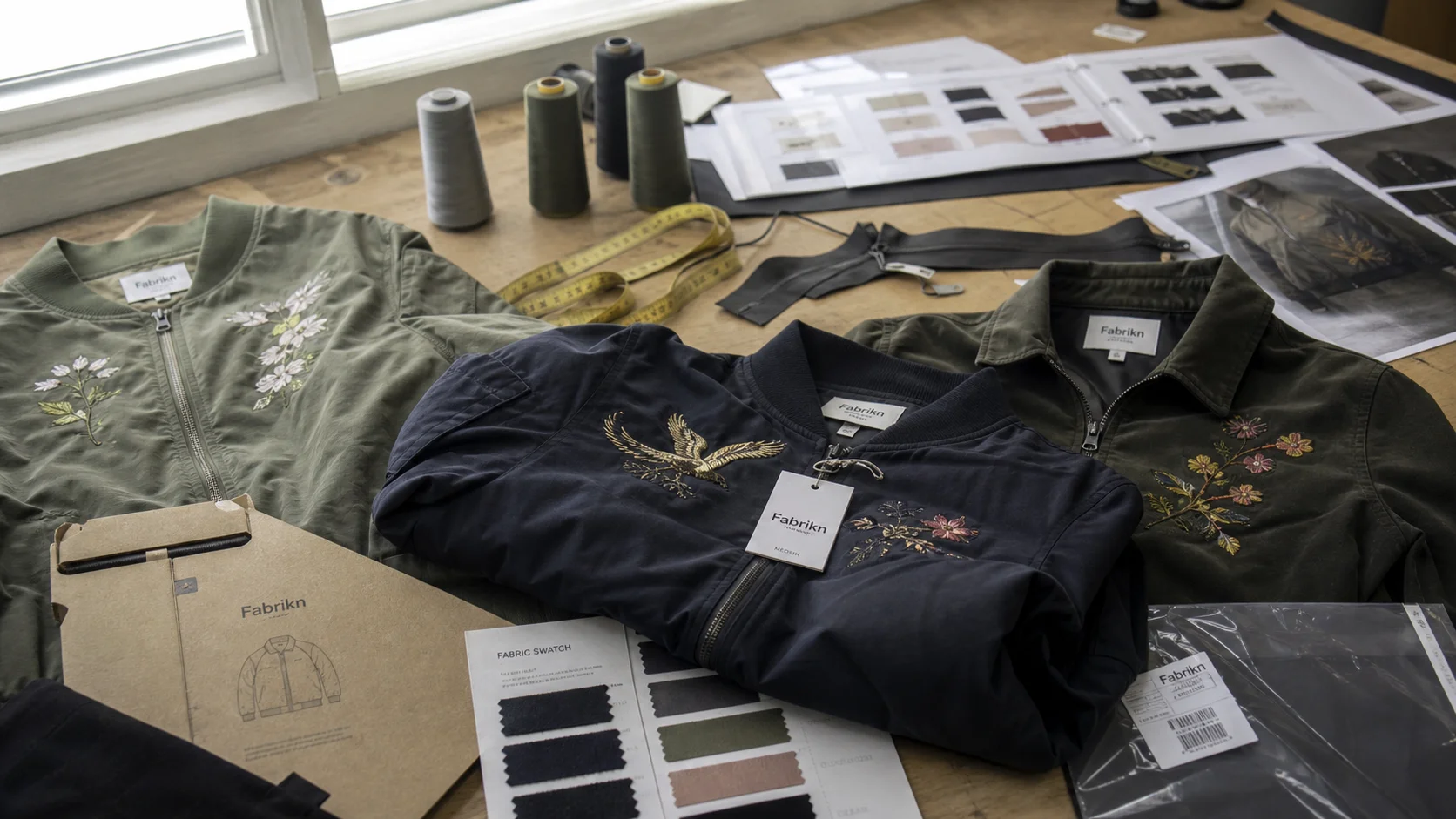
Clothing Manufacturer for Small Brands with checks for samples, fit, MOQ, QC evidence, pricing terms, and delivery risk.
Fast answer: Clothing Manufacturer for Small Brands: MOQ, Sampling, Cost, and QC should be judged by production evidence, not by a generic sourcing promise. The buyer needs sample proof, cost breakdowns, QC checkpoints, and delivery buffers in writing.
Ask for recent sample photos, measurement tolerances, fabric or print test assumptions, decoration test notes, packing examples, and a named inspection checkpoint. These details show whether the team can repeat an approved sample at bulk volume.
Separate garment cost, decoration, labels, packaging, sampling, testing, freight, and rush charges. When every cost line is visible, it becomes easier to reduce colorways, adjust size depth, or reserve more time for sampling.
The first mistake is usually the most expensive one: brands chase a clothing manufacturer for small brands on unit price, then watch the rest of the bill quietly multiply. Across factory visits in China, India, Portugal, Turkey, Vietnam, and nearshore supplier hubs, I kept seeing the same story. A 300-piece launch can rack up $600 in sampling, $250 in fabric swatches and lab dips, $180 in trims, and $400 to $900 in freight before one shirt is sold. The product may be fine. The math won’t be.
I’ve watched a $4.90 T-shirt quote swell to $7.80 landed after three sample rounds, a revised neck label, and air freight because production missed the window by 12 days. Same shirt. Different factory. In a better-run 1,000-piece order, the unit cost came in at $4.40 and freight dropped $0.62 per piece because the mill reserved fabric early and the line never stalled for approvals. Small orders punish disorganization. They don’t reward hope.
Then there’s the first-order trap. Factories rarely write it as one neat fee, but they collect it through pattern corrections, color dips, stitch comments, and late sign-offs. On a 300-unit run, the setup charge can be the same $150 to $300 you’d pay on a 1,000-unit order, which means the smaller order often ends up $0.50 to $1.00 more per garment before labor even starts. In Portugal, I saw a knitwear factory quote €11.20 per piece for 250 sweaters, while a Turkish partner came in at €9.10 for 800 units. The Turkish quote looked worse at first glance. Then the Portuguese factory added re-sampling, higher packaging costs, and slower delivery, and the landed total climbed above €13.00.
Counterintuitive, but true: the pricier factory can cost less overall. I’ve seen factories charging 8% to 15% more per unit cut total spend by reducing rework from three sample rounds to one, and by keeping shipping delays under five days instead of three weeks. That’s the difference when launch capital is tight and cash conversion bites. Burn $6,000 to save $0.40 per unit, and you haven’t bought efficiency. You’ve bought stress.
A clothing manufacturer for small brands does not want a mood board pretending to be a business plan. It wants a tech pack, a measurement chart, artwork files, fabric references, trim details, labeling rules, and packaging notes that can survive a floor supervisor turning them into cutting tickets. Ask any production manager and the questions are the same, just phrased differently: What is the garment? What is the tolerance? What finish is approved?
Missing details hit the budget hard, usually adding 10% to 25% through revision loops and sample churn. “Soft heavyweight jersey” can mean 180 GSM to one supplier and 220 GSM to another. Call it out properly — French terry 320 GSM, ring-spun cotton, enzyme wash, 1x1 rib cuff, twin-needle topstitch — and the guesswork disappears. I’ve seen brands pay for four fit samples because collar depth was written in centimeters on one sketch and inches on another. That isn’t design. That’s a billing strategy for the factory.
Production-ready packs get cleaner quotes. Screenshots get silence or inflated pricing. A Ho Chi Minh City factory once laid two hoodie inquiries side by side: one had a 14-page pack, graded specs, and color references; the other was a Canva collage. The first quote came back in 48 hours with a narrow spread. The second took nine days and carried a 17% buffer for uncertainty.
Build in-house what you can control: the tech pack, size spec, reference photos, barcode and care label text, and a target cost. Outsource what needs specialist hands: pattern development, grading, test fitting, if you don’t have the tools. With more technical garments — molded cups, recovery-heavy intimates, or anything where the fit can go sideways fast — the bar gets higher; for categories like custom bra manufacturing, measurement detail alone can decide whether a sample passes or comes back twice. Clarity beats ambition. Every time.
Comparing a clothing manufacturer for small brands by country only works if you compare the whole equation: unit cost, MOQ, sample speed, defect rate, freight, and communication friction. Labor in Asia may run 20% to 40% cheaper than Europe, but duties, shipping, and rework can wipe out the gap. A low-cost factory that misses size tolerances by 1.5 cm on 30% of the run isn’t low cost. It’s expensive inventory with paperwork attached.
For a 200-piece order, a Chinese cut-and-sew factory often quotes lower on labor, with MOQ starting around 300 to 500 pieces for woven styles and 200 to 300 for basic knits. India can be strong on cotton basics, especially 180 GSM and 220 GSM jersey, though sample timelines often run 10 to 18 days instead of five to 10. Portugal and Turkey may ask for 150 to 300 pieces in some categories; communication is cleaner, revisions move faster, but unit prices can be 25% to 60% higher. Vietnam sits in the middle on many styles, while nearshore options in Eastern Europe or Mexico cut freight by four to 12 days and make correction runs less punishing.
Quality differences show up in stitch consistency, shrinkage control, fabric sourcing access, and packaging accuracy. I’ve watched a Vietnamese factory hold a 2% defect rate on basics and a 6% rate on complex outerwear, while a Turkish supplier delivered exceptionally clean finishing on premium knits but needed tighter confirmation on embellishment details. A 200-piece order in Europe may cost more upfront; if you save two sample cycles and avoid a $900 airfreight panic, the total can still come out lower. That’s why landed cost beats unit cost.
Use product complexity, cash flow, and reorder strategy as the filter. A simple tee for a test launch can tolerate a longer lead time if the price is right. A structured blazer, padded jacket, or private label clothing program with woven labels, hangtags, and garment washing may justify a higher-cost clothing manufacturer for small brands that knows how to control tolerance, especially when the style needs 3D pattern work or cut and sew manufacturing. For more technical builds, cut and sew manufacturing is often the right route because it reduces component mismatch. Country stereotypes are lazy. Production math isn’t.
According to WTO trade data and freight trends I track regularly, shipping volatility can swing landed cost by more than 10% on small shipments. Put all-in landed cost in the spreadsheet, not just FOB. If the factory can’t quote that clearly, keep looking.
Price starts with the parts nobody wants to talk about. Sampling, pattern work, fabric consumption, cutting, sewing, printing, embroidery, labels, packaging, cartonizing, and freight all live in the quote, even when only two show up in the headline number. A T-shirt priced at $3.20 may become $5.10 once you add 1.8 meters of shrink-tested fabric per piece, neck ribbing, screen printing, neck labels, hangtags, and bulk cartons. Normal. What’s not normal is finding those costs after you’ve approved the sample.
I’ve seen the cheapest quote become the most expensive option because the factory left out setup fees. One supplier in South Asia quoted 500 hoodies at $7.60 each, then tacked on $240 for pattern digitizing, $180 for print screens, $160 for lab dips, and $95 for carton inserts. A better factory quoted $8.10 upfront and itemized everything. That second quote looked 6.6% higher, yet the final landed difference came in under 1% because nothing was hidden. Honesty like that usually comes from systems, not charm.
Price bands shift hard by product type. A basic tee in 180 to 220 GSM jersey may sit between $3.00 and $6.50 depending on region, print method, and trims. A structured jacket with lining, interfacing, and metal hardware can jump to $18 to $42. Technical garments with seam sealing, waterproof zippers, and performance testing may start at $24 and climb fast. Add embroidery or all-over print, and the spread widens. A quote that looks perfect for a tee says nothing useful about a padded coat.
Data from OEKO-TEX makes the testing angle obvious, and that changes pricing. If a factory knows you need tested dyes, certified trims, or wash fastness against AATCC methods, the price moves because the process moves. Ask for itemized pricing with line items for sampling, fabric, labor, decoration, labels, packaging, and freight. Then ask for a landed-cost estimate at 200, 500, and 1,000 pieces. Side by side, those numbers reveal whether the quote is honest or just low.
I once visited a factory that only accepted 700-unit minimums. Sounds restrictive. It was also one of the cleanest quoting systems I saw, because each approved style followed a fixed workflow and the cost variance stayed within 3% to 5%. Smaller brands often want flexibility, but flexibility can hide inefficiency. The right price is the one that survives production, not the one that flatters your inbox.
A small brand can’t lean on one final sample and hope for luck. QC has to happen at three points: pre-production approval, inline checks during sewing, and final inspection before packing. Miss one stage and the bill shows up later in returns, chargebacks, and brand damage. On a 1,000-piece run, a 4% defect rate means 40 garments that may need rework, discounting, or write-off. Not a rounding error. Margin loss.
The defects that hurt most are the predictable ones. Shade variation across dye lots. Uneven stitching at side seams. Measurement drift of 1 to 2 cm on critical points. Pilling after two washes. Print cracking after the first stretch test. Packing errors that mix sizes or labels. I’ve watched good factories ship flawed lots when approval chains moved too slowly, because operators kept sewing while waiting for a final sign-off on a collar shape or pocket position. Silence on the brand side becomes waste on the factory side.
Third-party inspection can cost $180 to $350 per man-day, depending on region, while chargebacks and returns can blow past that on a single failed style. A brand I worked with paid $620 for inspection on a 900-piece order and caught a 7% measurement issue before shipment. Replacement cost would have hit nearly $2,800, plus delayed launch revenue. That’s the sort of math founders should keep on the wall.
Before production starts, set acceptable tolerances in writing. For knits, 1 cm to 1.5 cm on key widths may be acceptable; for tailored garments, keep tolerances tighter. Define test methods for wash, stretch, seam strength, and color fastness. If the style is babywear, the standard gets stricter, which is why custom baby clothing manufacturing often needs extra documentation on trims and safety. If the factory knows the defect threshold, it can stop problems early. If it doesn’t, you’re paying for uncertainty twice.
For brands that care about material transparency and certified inputs, third-party standards can help reduce risk before bulk. Resources from Textile Exchange and the U.S. International Trade Administration are useful when screening suppliers and building compliance expectations. That doesn’t replace a factory audit, but it does make early sourcing conversations sharper and more credible.
In one week, you can build a serious shortlist. Day 1: define your product category, target MOQ, and budget range. Day 2: prepare a one-page inquiry pack with sketches, measurements, fabric references, target price, and delivery window. Day 3: send it to 8 to 12 factories. Day 4 and 5: compare responses. Day 6: request samples or a paid quote revision. Day 7: cut anyone slow, vague, or evasive.
Ask direct questions. What is your MOQ by fabric type and color? How long is sampling, seven days or 21? What are your sample fees, and are they credited back on bulk orders? What are your payment terms, 30/70 or 50/50? Can you source fabric, or do I need to supply it? What inspections or audit records do you keep? Can you show export experience for the US, EU, or UK? A real clothing manufacturer for small brands answers without drama.
Build a simple scorecard with four columns: responsiveness, transparency, compliance, and category fit. Score each 1 to 5. A factory that replies within 24 hours, gives itemized pricing, shows test records, and has made 500-unit runs in your category is usually safer than one with a glossy website and weak documentation. Ask for reference photos from actual bulk orders, not showroom samples. Ask for carton marks, packing lists, and shipping documents. Those details tell you how the operation behaves under pressure.
Keep your first commitment small. Sample one style, not your whole line, before you commit cash. If the factory handles a simple 180 GSM tee well, you can think about scaling to knit dresses or outerwear later. That’s how brands cut risk, keep cash alive, and build a supplier base that grows with them.
Factories treat repeat buyers differently. A brand with a second order gets better production slots, faster answers, and more willingness to solve fabric substitutions when the original mill is delayed by two weeks. A first-time buyer gets caution. A proven buyer gets trust. I’ve watched a 400-piece re-order price drop by 9% simply because the factory already had the pattern, the grading, and the approved trim set on file.
That trust is earned through fast approvals, realistic forecasts, and payment discipline. Promise 800 units and confirm 500, and the factory remembers. Approve strike-offs in 48 hours instead of 10 days, and the line keeps moving. Efficiency improves margins and reduces waste. Fewer sample cycles mean less deadstock. Better material planning means fewer dye lot surprises. Sustainability isn’t only recycled fiber; it’s also not wasting fabric because your approvals wandered for three weeks.
The best relationship isn’t built on chasing the cheapest quote. It’s built on a factory that keeps your brand alive when demand spikes, a carton gets damaged, or a reorder needs a seven-day turn. Good manufacturing is disciplined, not romantic. It’s the unglamorous part of growth, and it decides whether you survive the next season. If you want a clothing manufacturer for small brands to act like a partner, start by acting like a partner yourself: be clear, be fast, and pay on time.
For a first order, many small brands spend $3,000 to $15,000 before launch, depending on category and quantity. A basic tee at 300 units may land near $4.50 to $7.50 per piece, while a jacket can run $18 to $42. Sampling, freight, and trims often add 15% to 30% on top of unit cost.
MOQ varies by product. Basic knits may start at 200 to 300 pieces, while woven or tailored garments often begin at 300 to 500 pieces. Decorative work, such as embroidery or all-over print, can push the minimum higher because setup costs need more units to spread out.
Sampling usually takes seven to 21 days, depending on complexity and fabric availability. Bulk production commonly takes 30 to 60 days after sample approval, and shipping can add five to 30 days depending on region and method. Delayed approvals can extend that timeline by one to three weeks.
Choose by product type, budget, and urgency. Asia often offers lower unit costs and larger fabric access, Europe and Turkey can provide faster communication and tighter finishing, and nearshore factories reduce freight time by several days. The best choice is the one that fits your cash flow and reorder plan.
Yes, many can, but only if you provide clear branding details. Private label clothing usually needs approved labels, hangtags, packaging specs, and barcodes before bulk starts. If you do not define those details early, expect 10% to 25% more in revisions and extra sample rounds.