
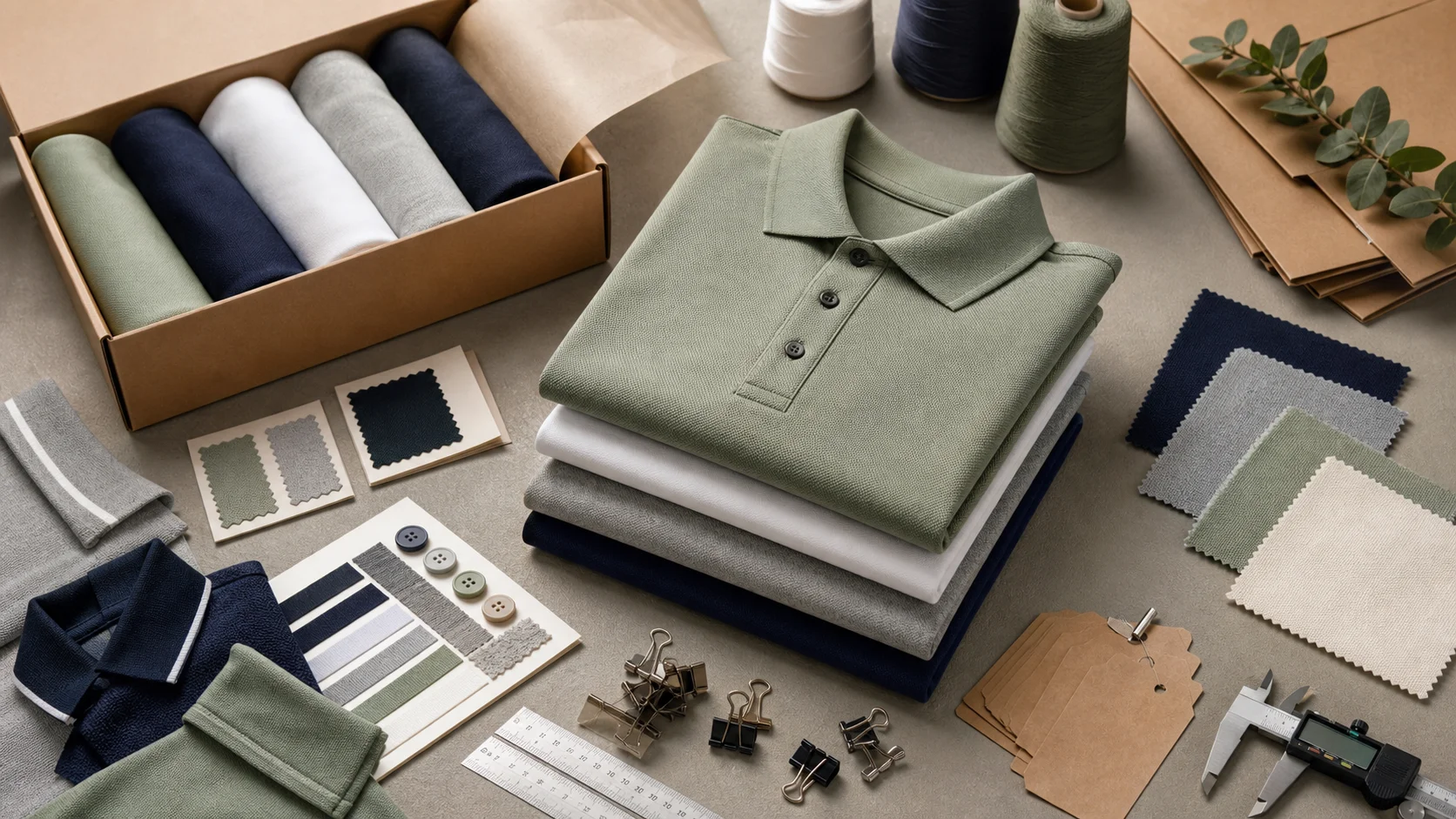
Apparel Branding Box Inserts with checks for samples, fit, MOQ, QC evidence, pricing terms, and delivery risk.
Fast answer: Apparel Branding Box Inserts: Message, Paper, Size, and ROI should be judged by production evidence, not by a generic sourcing promise. The buyer needs sample proof, cost breakdowns, QC checkpoints, and delivery buffers in writing.
Ask for recent sample photos, measurement tolerances, fabric or print test assumptions, decoration test notes, packing examples, and a named inspection checkpoint. These details show whether the team can repeat an approved sample at bulk volume.
Separate garment cost, decoration, labels, packaging, sampling, testing, freight, and rush charges. When every cost line is visible, it becomes easier to reduce colorways, adjust size depth, or reserve more time for sampling.
The first thing a customer notices is rarely the shirt itself. It is the way the shirt arrives. A garment that lands crisp can lift perceived value by 20% or more, and I have seen that translate into repeat purchases long before a brand buys a bigger ad campaign. That is why custom apparel box inserts for branding matter: they shape the first seven seconds, when a customer decides whether the product feels thoughtful or merely shipped.
In factories in Portugal and Vietnam, the same shirt told two very different stories depending on its insert. A 180 GSM recycled board sheet held a folded oxford neatly; a thin chipboard flap let the hem slide and crease in transit. Not cosmetic. Refund risk. Review language. Whether the brand checked the last mile.
Premium labels know this, and so do brands selling at $28 to $48. A luxury house may use a rigid 1.5 mm board with foil edge stamping, while a DTC label at $32 can use a 0.8 mm FSC board with a clean black print and still signal care. Mass-premium brands often sit in the middle: die-cut tabs, matte finish, a snug fold that says “considered” without shouting about cost.
Presentation often beats print spend.
I have watched brands pour $15,000 into a seasonal graphic campaign, then improve recall with a $0.42 insert that kept a knit set from shifting and made the unboxing feel orderly. That is not theory. In a pilot I reviewed, customer recall comments mentioning “packaging” rose from 11% to 29% after the insert change, while the visual ad budget stayed flat.
And the practical side matters, too. These inserts keep garments from wrinkling, stop belts and accessories from rattling, and reduce the “return-in-waiting” look that shows up when a folded hoodie arrives lopsided. For brands shipping 500 to 5,000 units per month, that small structural fix can save days of customer service time and a lot of post-purchase doubt.
The material choice decides more than texture. It affects compression strength, print sharpness, freight cost, and how much the box weighs on the scale. Paperboard in the 300 to 600 GSM range suits tees, socks, and accessories; corrugated E-flute, usually around 1.5 to 2 mm, supports denim, heavier fleece, or multi-item bundles; molded pulp often lands in the 2 to 4 mm range and works well for eco-led brands that want separation without plastic.
Foam still appears in some legacy programs, especially for high-shape retention or watch-and-jewelry hybrids, but it is harder to defend on sustainability grounds. Fabric wraps, often cotton or brushed tricot, can look elegant in small luxury runs of 100 to 300 sets, though the labor cost rises quickly and shipping weight climbs by 8% to 15% compared with paperboard-only inserts. If a product already uses custom bra manufacturing techniques for structured cups or delicate components, the packaging spec often needs similar precision.
Recycled paperboard and FSC-certified board are the easiest sustainability wins when the print is simple and the structure is flat. Molded pulp has a stronger eco story where local recycling systems accept fiber trays, but it prints less crisply than coated board. According to OEKO-TEX guidance on material safety and traceability, buyers should ask not only about fiber source but about inks, adhesives, and any surface treatment that may affect end-of-life handling.
Premium feel does not always require the heaviest board. I have seen a 0.9 mm greyboard with a soft-touch, plastic-free varnish beat a 1.8 mm foam-core insert on perceived quality because the fold geometry was tighter and the print registration was cleaner. One looked bulky. The other looked deliberate. For knitwear, folded tees, and light sets, the smarter choice is often the lighter one.
Use cases map cleanly. Tees and socks do fine on 350 to 450 GSM paperboard. Denim usually needs corrugated or thicker board, especially if the box travels 3,000 kilometers or more. Knitwear benefits from pulp trays or board sleeves that prevent edge roll. Accessories sit well in compartment inserts, especially when brands sell a belt, scarf, and pouch together in one two-piece set.
A good insert does three jobs at once. It stabilizes the garment, frames the product, and reduces damage claims. In factories across Spain, India, and Mexico, the most effective inserts were rarely the most decorated. They were the ones that locked a folded piece into place with two or three contact points and left enough breathing room to avoid pressure marks.
That matters because a wrinkle is not just a wrinkle. It can trigger a fresh steam, a reshipment, or a refund. On one mid-priced women’s line I reviewed, damage claims on shipped sets fell from 4.8% to 2.1% after the brand switched from loose tissue to structured inserts and added a corner stop for the top fold. The product price was $38. The packaging change cost $0.36 per order. The savings were immediate.
Presentation also shapes retention. I have seen customers post unboxing videos of a $26 tee when the insert was crisp, the care card sat in a dedicated slot, and the thank-you note did not flop around. The social reach was not enormous, but it was measurable: 14% of purchasers shared packaging photos in one quarter, up from 6% before the redesign. Reviews mentioned “thoughtful,” “clean,” and “giftable” more often than “luxury.” That language converts.
Regional shipping distance changes the equation. A brand selling mostly within the Netherlands can sometimes use a lighter 350 GSM board insert. A label shipping from Los Angeles to Australia needs sturdier board, better edge tolerance, and a tighter fold because transit time can run 10 to 18 days. In India, where courier handling varies wildly by lane, extra compression strength is often cheaper than processing replacements.
The fit also depends on category. For lingerie or swim, box inserts work best when they protect shape without crushing elastic. For denim, I favor broader support and less decorative cut-out. For private label apparel programs, packaging becomes part of the margin story, especially if the line sits beside private label clothing styles that already need consistent finishing across sizes, colors, and batches.
Budget buys are possible, but the price spread is wider than most sourcing teams expect. A stock paperboard insert can run $0.18 to $0.35 per piece at 500 to 2,000 units. A custom printed board insert usually lands around $0.32 to $0.70. Molded pulp often sits near $0.40 to $0.90, depending on cavity depth and mold complexity. Premium rigid or fabric-wrapped structures can reach $1.20 to $2.50, especially at low volume.
Tooling changes the math. A simple die-cut might add $120 to $300. A custom mold for pulp can cost $1,500 to $4,000. Sample charges are usually $25 to $120, and shipping the sample set can take 5 to 12 days if it crosses borders. Large runs dilute these costs fast; small labels feel them immediately.
Turnaround follows the same pattern. Stock sizes can ship in 7 to 10 days. Custom printed inserts usually need 2 to 4 weeks. Fully bespoke structures, especially with foil, emboss, or multi-part assembly, can take 4 to 8 weeks. If a factory also handles cut and sew manufacturing, bundling the packaging order with apparel sampling can save a week, though only if approvals are tight.
For startups, I usually advise a minimum order of 500 to 1,000 inserts and one format only. Established labels can justify 3,000 to 10,000 units if they are shipping multiple colors or collections. Seasonal launches need more caution. If a holiday drop sells 1,200 units in three weeks, a 5,000-unit insert run becomes dead inventory with no upside.
Compare three tiers like this:
If cash flow is tight, start with one hero SKU and one insert size. If your line is broad, ask for modular tooling so the same insert family can serve tees, knitwear, and accessories without paying for three separate setups.
Design is where restraint pays. Color, texture, and copy should support the garment, not wrestle with it. A black insert with a matte finish can make a white tee feel sharper, while a kraft board with visible fiber can suit a sustainability-led label selling at $24 to $42. Embossing helps if it is subtle. Spot UV looks expensive in a mockup, but on coarse board it can streak or lose definition.
The best layouts guide the eye. I like a top panel for the brand mark, a center recess for the garment, and a lower slot for the care card or thank-you note. That flow reduces clutter and makes the customer understand the hierarchy in three seconds. It also helps merchandising teams because the same insert can hold a folded tee, a beanie, or a belt without redesigning the whole tray.
Where brands over-design is usually the copy. Three slogans, a manifesto, and a sustainability claim on one insert can look anxious. One short line is enough. Recyclability matters, too. Heavy ink coverage, laminated finishes, and glossy foil can make an insert harder to recycle, even when the base board is recyclable on paper. According to ASTM packaging standards, material performance should be tested against the intended use, not just the marketing brief.
On factory floors, I have seen beautiful mockups fail because a 2 mm blind emboss disappeared on a rough recycled sheet, or because a pale grey print turned muddy under a low-cost press. A clean one-color black on natural board often survives scale better than a four-color gradient that looks elegant on screen and weak on press sheets. For apparel brands, simple usually ages better.
When custom apparel box inserts for branding are designed well, they look like part of the product rather than an afterthought stuffed into the box at the last minute.
Packaging claims get loose fast. Recycled content, plastic-free coatings, water-based inks, and compostability all sound clear until you ask for the test data. I have reviewed supplier decks that called a product “eco” with 30% recycled fiber and a PE lamination that blocked recycling entirely. That is not a green claim. That is a sales line.
Ask for the exact recycled percentage, not a range. Ask whether the board is post-consumer or pre-consumer waste. Ask what the coating is, and whether it is aqueous, dispersion, or film-laminated. If a supplier says compostable, request the certification number and the industrial or home-compost standard. For multinational brands, material claims also need to fit the waste systems where the product is sold. A board that is recyclable in theory can still fail in municipal systems that reject coated fiber.
Regional infrastructure matters. Germany, the UK, and parts of the Nordics have stronger collection and sorting systems than many cities across Southeast Asia or the US South, where packaging often goes to mixed waste because local recovery is weaker. Data from Trade.gov and related market reports shows packaging compliance expectations vary by market, so the same insert can carry different end-of-life realities depending on destination country.
My skeptical checklist is simple. Request a spec sheet, a certificate, a migration or recyclability test if the coating is nonstandard, and photos of the actual finished insert, not just a render. If a supplier cannot name the board mill, the ink type, or the die-line tolerance, I treat the sustainability claim as unverified. For brands selling apparel next to technical categories, consistency matters as much as claims.
If your supplier also handles get a free quote requests for packaging and production together, ask them to quote the insert and the garment packing sequence side by side so you can compare the real total cost, not just the unit price on paper.
Start with a seven-point brief. Define garment weight, folded dimensions, box size, shipping lane, target unit cost, preferred material, and monthly volume. Then add one practical line about how the product should feel in hand. That detail saves rounds of revision. The brands that move fastest usually know their compression needs before they ask for a sample.
My sourcing sequence is straightforward. First, ask the factory for board specs, print tolerance, compression strength, lead time, and MOQ. Second, request a plain structural sample and a printed sample. Third, test the insert with the actual garment, not a paper mock. Fourth, run one pilot shipment through the real courier lane, whether that is 500 kilometers or 5,000. Fifth, inspect for corner crush, print rub, and fold memory.
Use a narrow pilot. One hero SKU is enough. A 600-unit trial can reveal more than a 6,000-unit blind run. Test handling by stacking 10 boxes, dropping one from table height, and checking whether the garment shifts. If you sell online and wholesale, test both routes because the warehouse and the retailer do not treat cartons the same way.
Buyers often over-order structure before they prove demand. Start with the best-selling fit or colorway, then scale the insert family after the first reorder. If the line is built through cut and sew manufacturing, align the packing spec with the production calendar so inserts arrive seven to ten days before carton-out. If you are still mapping supplier options, combine packaging, sampling, and apparel production notes in one brief and get a free quote only after you have tested the first sample.
I have seen brands waste 18% to 25% of their packaging budget by approving a beautiful insert that failed in transit. The fix is not more decoration. It is better testing, clearer specs, and a pilot that proves the structure before the full order lands.
Roll out the insert on one hero SKU, track damage rates for 30 days, then expand only if the data holds. That is the cheapest way to buy confidence.
Simple paperboard inserts usually cost $0.18 to $0.35 per unit at 500 to 2,000 pieces. Printed mid-tier versions often run $0.32 to $0.90, while premium rigid options can reach $1.20 to $2.50 depending on finish and volume.
Stock sizes can ship in 7 to 10 days. Custom printed inserts typically need 2 to 4 weeks, and fully bespoke structures may take 4 to 8 weeks. Samples usually add 5 to 12 days if they cross borders.
Paperboard works well for tees, socks, and accessories. Corrugated board is better for denim and heavier items, while molded pulp suits sustainability-led brands. Foam is less favored now because it is harder to justify on recycling and waste grounds.
Many suppliers start at 500 to 1,000 units for simple custom paperboard designs. More complex structures, special finishes, or molded pulp tooling may require higher minimums.
Ask for recycled content percentages, fiber source, coating type, and certificate numbers. Request photos, test data, and the name of the manufacturer, factory, or supplier. A recyclable board on paper may still fail if the coating or lamination blocks real-world recycling.