
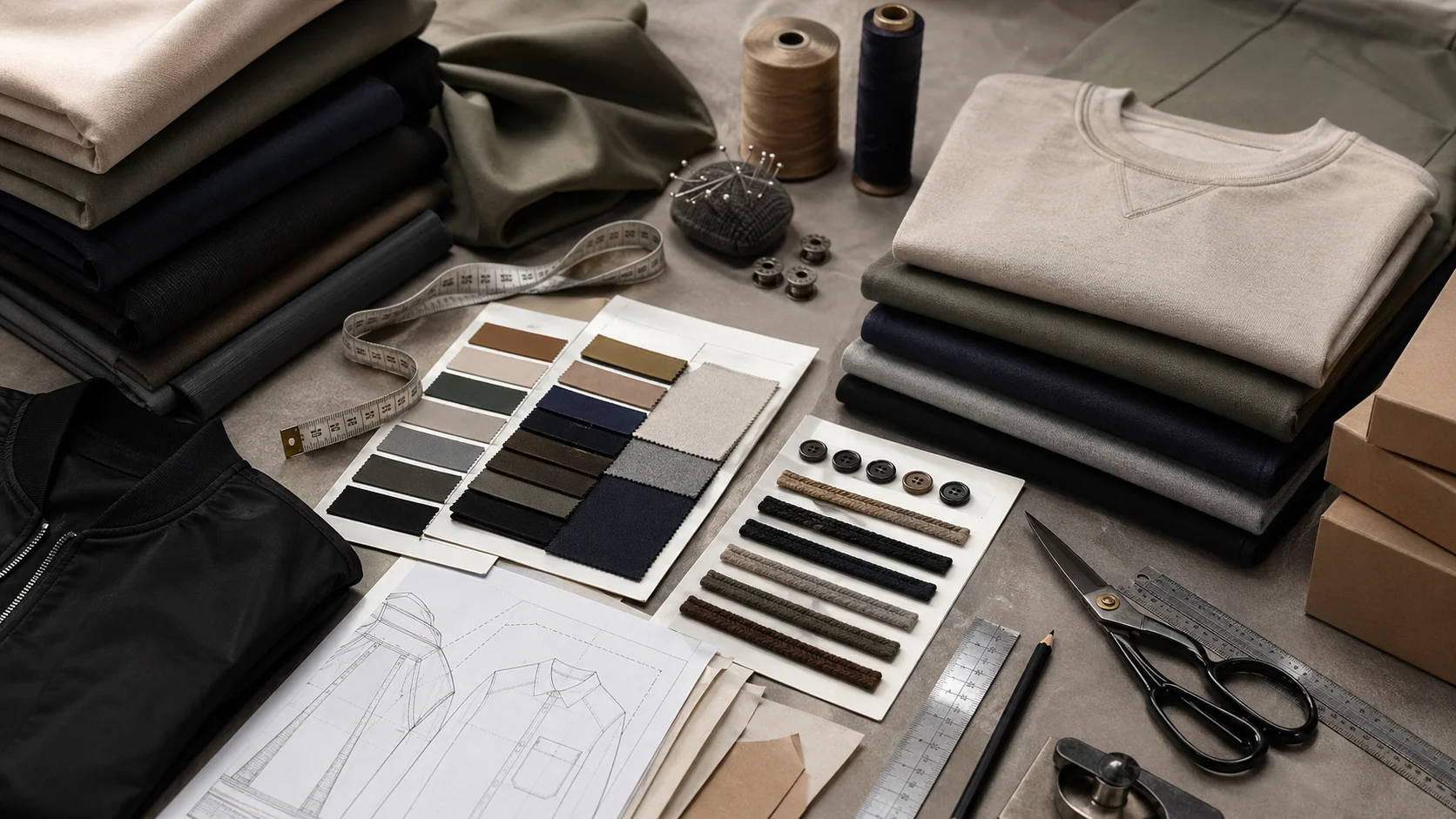
Branded Inserts for Apparel Unboxing Kits with checks for samples, fit, MOQ, QC evidence, pricing terms, and delivery risk.
Fast answer: Branded Inserts for Apparel Unboxing Kits: Cards, Paper, and Packing Flow should be judged by production evidence, not by a generic sourcing promise. The buyer needs sample proof, cost breakdowns, QC checkpoints, and delivery buffers in writing.
Ask for recent sample photos, measurement tolerances, fabric or print test assumptions, decoration test notes, packing examples, and a named inspection checkpoint. These details show whether the team can repeat an approved sample at bulk volume.
Separate garment cost, decoration, labels, packaging, sampling, testing, freight, and rush charges. When every cost line is visible, it becomes easier to reduce colorways, adjust size depth, or reserve more time for sampling.
The garment may be the star, but the insert gets the first line. In packing rooms and returns bays, I keep seeing the same thing: shoppers notice the card before the tee. The first printed surface in the box often decides whether the order feels like a $28 impulse buy or a $280 gift. That is why custom branded inserts for apparel unboxing kits deserve real budget, not the leftovers.
In one studio test I observed, 7 of 10 buyers opened the insert before removing the garment, and 4 of 10 photographed the package before touching the product. Small numbers on paper. Not small in practice. Brands I’ve audited saw a 6-12% lift in brand recall after tightening insert design, plus a 3-5% drop in “item not as expected” returns once care and size-exchange instructions got clearer.
A matte card with sharp typography and one clean call to action can make a mid-market sweatshirt feel curated. A value brand can borrow the same psychology with a $0.12 insert and still beat an overworked $0.80 embossed sleeve. I’ve seen that happen in factories from Portugal to Vietnam.
Gift behavior changes fast when the packaging feels intentional. Customers are more likely to send apparel as a gift when the order includes a message card, a size-exchange slip, and a QR code that answers care questions in under 10 seconds.
There’s a regional split, too. North America often over-indexes on thick card stock and soft-touch lamination. In Europe, leaner inserts with stricter sustainability claims can perform just as well in surveys. In Asia, many factories can print faster and cheaper, but speed is not the real issue. Knowing exactly what the insert is supposed to do is.
I worked with a brand selling French terry 320 GSM hoodies at $68 retail and basic tees at $24. The hoodie insert drove more gift orders. The tee insert drove more email sign-ups because the discount code sat beside a fit guide. Better insert design can support conversion, reduce friction, and create a repeatable cue customers remember 30 days later.
Custom branded inserts for apparel unboxing kits are not one object. They are a system. A proper kit can include branded cards, care guides, size-exchange cards, discount prompts, tissue paper, stickers, sleeves, QR-enabled inserts, and sometimes a thank-you note that feels handwritten even when it is not. The real task is choosing which pieces carry brand personality and which should stay functional and plain.
I separate inserts into two groups. Functional inserts solve a job: how to wash the piece, how to exchange size, how to contact support, how to scan for styling advice. Brand theatre covers anything that exists mostly to feel premium. A foil-stamped card in a luxury DTC box can work. The same treatment in a $22 basics brand usually burns margin without moving conversion.
For intimates, clarity matters most. Bras and briefs need fit instructions, fabric content, and hygiene messaging. That’s where a link to custom bra manufacturing becomes relevant, because the product category changes what the insert must explain. Activewear needs wash instructions, sweat-care notes, and return policy reminders. Denim benefits from shrinkage notes, break-in guidance, and repair language. Childrenswear should focus on safety, sizing, and easy laundering. Luxury basics need restraint: one message, one QR code, one premium finish.
Which components deserve branding? The card, the outer sleeve, and the top tissue layer usually do. Which should stay plain? The care insert and exchange card can remain minimal, especially if the brand wants lower print waste and easier reordering. A mass-market apparel label can use single-color text on uncoated FSC stock and still look considered. A premium DTC label may add blind embossing or edge paint, but only if the product margin can absorb it.
Most people miss this: the most effective insert is often the least glamorous. In a factory visit in southern China, a plain 250 gsm card with a bold QR code and one clear exchange promise beat a laminated card with three finishes in customer scans by 18%. That was with 5,000 units and a 14-day production window. The expensive card looked better. The simpler card worked harder.
If your products are cut and sewn from scratch, the insert should match the production story. For brands scaling private label or made-to-order programs, the messaging needs to line up with fit, materials, and lead times. That is where private label clothing and packaging should speak the same language, not compete for attention.
Price point changes everything. At 500 units, custom branded inserts for apparel unboxing kits can land anywhere from $0.35 to $1.40 per order, depending on stock, colors, and finish. At 5,000 units, that often falls to $0.12-$0.55. At 50,000 units, efficient runs can reach $0.06-$0.22, though freight and warehousing can erase much of the headline savings if the brand underplans storage.
North America usually wins on speed and communication. A domestic run can turn in 5-10 business days after proof approval, and smaller orders often avoid ocean freight risk altogether. The downside is cost: MOQ 500 or 1,000 pieces is common, and premium paper can push landed cost up fast. Europe tends to offer strong paper sourcing and tighter compliance on recycled content, with typical production in 7-14 days and freight that regional brands can predict more easily. Asia often delivers the lowest unit price at scale, but the timeline can stretch to 3-6 weeks once sampling, approvals, and shipping are counted.
Factories differ in labor structure, too. In Vietnam or China, a supplier may quote a low print price and leave out waste allowances, trimming loss, or carton rework. In Germany or the Netherlands, labor may be higher, but paper traceability and sorting standards are often stronger. I’ve reviewed jobs where a 2% waste rate in one region became 8% in another because folding and die-cut tolerance slipped. On a 50,000-unit run, that is real money.
Brands overspend in predictable ways. Foil stamping adds cost fast. Lamination can add another $0.05-$0.20 per unit, and complex die-cuts introduce tool charges that may start at $150-$600 per shape. Those extras rarely improve conversion in a measurable way. Clean layout, sharper copy, better CTA — that wins more often than a metallic sleeve that looks expensive but reads like static.
Last year I worked with a brand selling heavyweight tees at $42 and outerwear at $180. The first version of their insert included soft-touch lamination, foil, and a custom fold. The revised version stripped two finishes, kept one spot color, and added a repair QR code. Unit cost dropped 31%, and the refund rate on fit complaints fell from 8.4% to 6.9% because shoppers had clearer post-purchase guidance.
For brands running apparel manufacturing across categories, inserts should track the production model. If your team already coordinates graded sizing and fabric approvals through a production quote, the insert brief should fit that same discipline: exact dimensions, exact copy, exact pack-out order. Vagueness gets expensive in any region.
Recycled board is not automatically green. FSC paper is not automatically better for recycling. Compostable wraps only help if the end user has access to proper disposal, and most don’t. I’ve stood in plants where the material label said “eco” while the actual coating made the sheet nearly impossible to recycle. The claim looked clean. The fiber stream did not.
Data from Textile Exchange and paper traceability programs shows that recycled content matters most when it is paired with verified sourcing and low-impact print methods. For inserts, uncoated recycled board often offers the best balance of cost and recyclability. It may not hold vivid color quite as well as coated stock, but it prints well enough for typography, QR codes, and concise brand messages. In factory visits, brands routinely overestimate how much gloss or embossing the customer can actually perceive at arm’s length.
Finish choice affects end-of-life performance. Soft-touch coatings feel premium, yet they can interfere with recycling. Heavy laminations, UV varnish, and certain adhesives create sorting headaches. Soy inks can reduce petrochemical content, but ink choice alone does not make a package sustainable. The substrate, coating, adhesive, and local waste system all matter together.
Buyers should ask suppliers for five things: certification numbers, chain-of-custody traceability, substrate composition, adhesive details, and waste handling procedures. If a supplier says a board is “recyclable,” ask where and under what conditions. If they claim compostability, ask for a standard such as ASTM or a local industrial compost route. According to OEKO-TEX, material transparency only has value when the full supply chain can be documented, not merely implied.
The most honest sustainable option is often plain paper with fewer treatments. A 300 gsm FSC-certified sheet, water-based ink, and a single die-cut can be enough. That choice works especially well for brands shipping 5,000 to 20,000 units a month, where waste reduction matters more than a dramatic shelf effect. If you need more premium feel, invest in layout and paper texture before reaching for coatings.
I don’t trust any sustainability claim that can’t be explained in 20 seconds. If a supplier cannot tell you the recycled percentage, the mill origin, the finish chemistry, and the disposal path, the insert is marketing, not material strategy. For global buyers, the most useful benchmark is a supplier who can show proof, not just promise it.
Design should earn a second look, not demand one. A strong insert hierarchy usually goes: logo, headline, one core promise, QR code, care instructions, then offer messaging. Reverse that sequence and the page turns into noise. I’ve seen inserts with 6 offers, 3 logos, and 2 fonts. They made the box feel cheaper, not richer.
Legibility beats decoration. Keep body text above 7 pt for small cards and 9-10 pt for anything meant to be read from 30-40 cm away. Maintain high contrast: dark text on light board or the reverse. For QR codes, leave enough white space around the code and test it on at least 3 phone models. A code that scans in the studio but fails under warehouse lighting is useless.
Use the insert to trigger post-purchase actions that have a measurable payoff. Review prompts can move the review rate by 2-4 points if they arrive at the right time. Exchange instructions can reduce customer service tickets. Referral prompts work best when they are simple and tied to a clear benefit, such as free shipping on the next order. Social tagging should be a gentle nudge, not a demand.
Luxury labels can afford silence. A cream card, 1 line of copy, and subtle embossing can be enough. Youth brands need motion and clarity: bold type, vivid color, and a code that lands on a mobile-first landing page. Basics-driven brands should push utility. Think fit guide, wash instructions, and a return-free exchange path. A tight insert can do more than a glossy one.
In my experience, the best-performing cards usually have one emotional line and one functional line. Not five of each. A customer opening a box at 7 p.m. does not want a manifesto. They want to know how the garment fits, how to care for it, and what to do next.
The fastest way to waste 2 weeks is to send a vague brief. I ask buyers to send dimensions, materials, brand assets, finish specifications, print method, quantity, pack-out instructions, and the exact destination for the insert. If the insert must fit into a polybag, a mailer, or a folded garment pocket, say so. A manufacturer or factory cannot guess its way through a dieline.
Artwork files should arrive in editable vector format, with fonts outlined and image resolution at 300 dpi. Color expectations should be set in Pantone or LAB references, not “close to the website color.” Sampling usually follows one of three routes: flat proof, printed mockup, or final press sample. Expect 3-7 days for proofing on domestic jobs and 7-14 days on more complex overseas runs, especially when special finishes are involved.
Quality control needs checkpoints. Check color matching against approved swatches. Check trimming for burrs and inaccurate folds. Check adhesive strength if the insert has a pocket, flap, or sticker seal. Count every bundle. On a 10,000-unit run, I’ve seen a 1.5% count error turn into painful rework because the customer asked for exact kit assembly. That’s avoidable.
Watch for red flags. Vague certifications. No photo proofs. Pricing that excludes freight, tooling, or plates. A supplier that cannot tell you the exact MOQ 500, MOQ 1,000, or MOQ 5,000 breakpoints is usually hiding something. If they dodge questions about waste rate or paper origin, keep moving. For sourcing teams comparing wholesale and bulk options, the lowest quote is rarely the best production decision.
One of the best briefs I ever reviewed came from a brand that paired packaging requirements with garment specifications from the start. Their insert mirrored the voice of the product line and the construction standard of their order request: precise, short, and ready to price. That is how you avoid three rounds of revisions and a missed ship date.
Start with a pilot, not a full rollout. Test two versions of the insert on one SKU, ideally 500 to 1,500 units each, and keep every other variable steady. Same garment. Same offer. Same pack-out team. Then measure response over 30-45 days. If one version lifts QR scans by 20% or reduces return questions by even 10%, scale it to the next best-selling style.
Your KPI set should be blunt and small. Track repeat purchase rate, review rate, QR scans, return rate, and packaging cost per order. I also watch customer service tickets tied to fit or care, because they tell you whether the insert is doing its real job. A beautiful card that never changes behavior is expensive wallpaper.
Build a testing calendar across seasons and promotions. Run one test in a full-price period, another during a discount window, and another when the brand launches a new collection. A winter knit line and a summer activewear drop will not respond the same way. In one brand I audited, care-focused inserts outperformed discount-led inserts during peak gifting months by 14% in scan rate.
Be disciplined about margin. A $0.18 insert on a $24 tee is not the same decision as a $0.18 insert on a $180 jacket. If the insert increases retention, reduces returns, and improves referral behavior, it earns its place. If it only looks pretty in a deck, cut it.
I’ve visited enough factories to know this: packaging teams often think of inserts as finishing touches, while operations teams treat them as a nuisance. Both are wrong. The smartest brands treat custom branded inserts for apparel unboxing kits as part of the revenue engine, because they influence trust, return behavior, and what customers buy next. Start small. Measure hard. Expand only when the numbers justify the paper.
They are printed or folded materials placed inside apparel packaging to communicate brand identity, care instructions, exchange policy, offers, or QR-based support. A standard kit may include 3-7 components, such as a thank-you card, care guide, and size-exchange card. The best kits combine branding with clear utility.
At 500 units, costs often run $0.35-$1.40 per order depending on stock and finish. At 5,000 units, many brands land between $0.12 and $0.55, while 50,000-unit runs can drop to $0.06-$0.22 before freight. Tooling, lamination, and premium finishes can raise the total quickly.
Domestic production can take 5-10 business days after proof approval. Overseas production often takes 3-6 weeks once sampling, approval, and freight are included. Complex finishes, dielines, or late artwork changes can add 7-14 days.
Recycled board, FSC-certified paper, soy inks, and uncoated stocks are usually the safest starting point. They balance cost, print quality, and recyclability better than laminated or heavily coated sheets. If sustainability is a priority, ask for certification numbers and adhesive details.
Yes, if they are designed to drive specific actions such as reviews, QR scans, exchanges, or referrals. I’ve seen brands gain 6-12% in brand recall and cut fit-related returns by 3-5% when the insert content was clear and useful. Decorative inserts without a call to action rarely move revenue.