
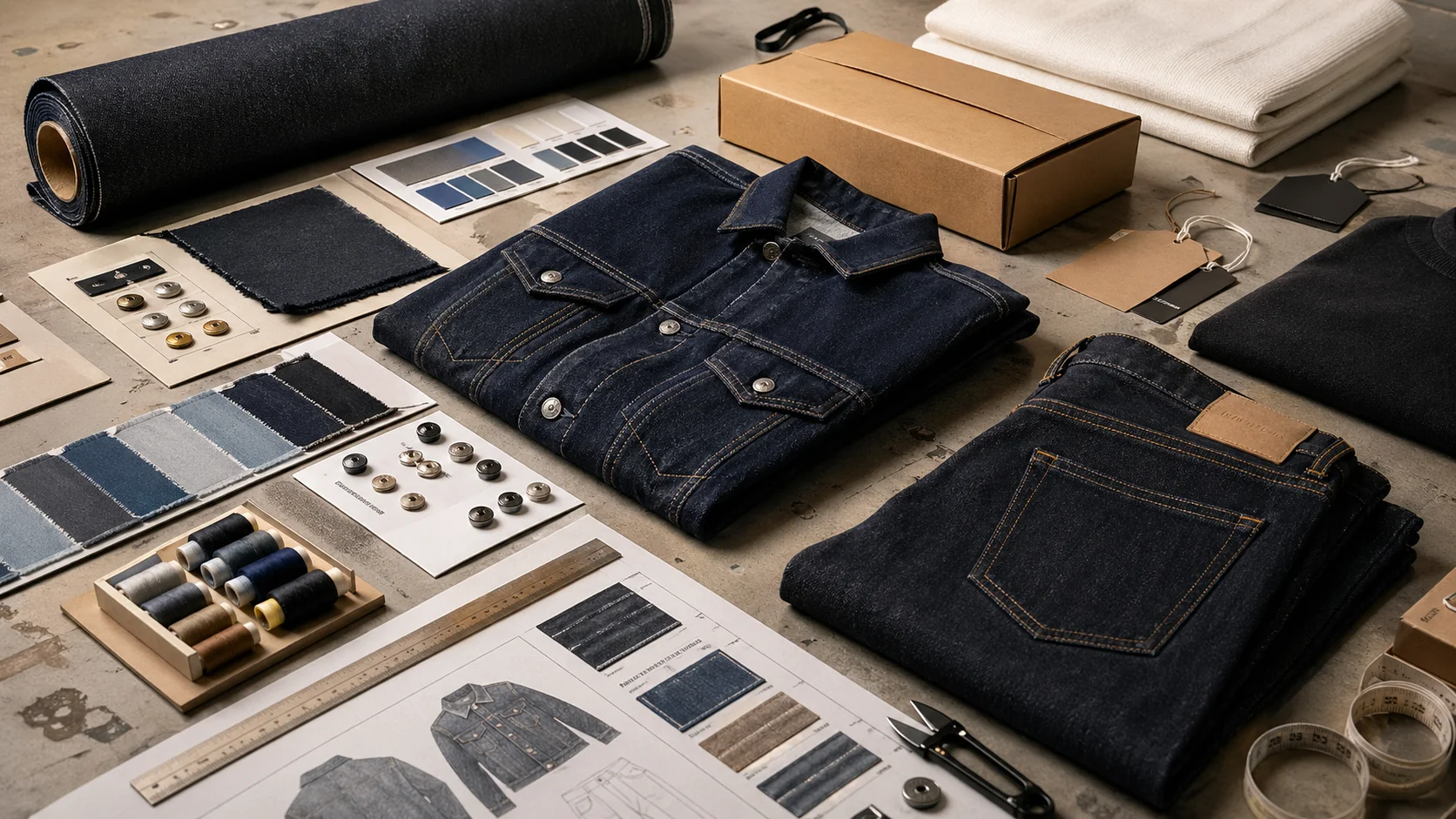
Custom Paper Mailer Bags for Clothing with checks for samples, fit, MOQ, QC evidence, pricing terms, and delivery risk.
Fast answer: Custom Paper Mailer Bags for Clothing: What Works should be judged by production evidence, not by a generic sourcing promise. The buyer needs sample proof, cost breakdowns, QC checkpoints, and delivery buffers in writing.
Ask for recent sample photos, measurement tolerances, fabric or print test assumptions, decoration test notes, packing examples, and a named inspection checkpoint. These details show whether the team can repeat an approved sample at bulk volume.
Separate garment cost, decoration, labels, packaging, sampling, testing, freight, and rush charges. When every cost line is visible, it becomes easier to reduce colorways, adjust size depth, or reserve more time for sampling.
The easiest packaging to ignore is the one that disappears into a bin, and that is exactly why brands are rethinking it. More than 1.2 trillion pieces of plastic packaging are produced globally each year, and a large share still moves through e-commerce parcels that get opened once and tossed. That pressure is why custom paper mailer bags for clothing have moved from niche to mainstream, especially for brands trying to improve both their returns story and their brand presentation.
I’ve walked factories in Portugal, Vietnam, Turkey, and China where the same conversation kept coming back: buyers want a package that feels more premium than a plain poly mailer, signals recyclability, and survives a 3-7 day shipping journey without turning to mush. Clothing brands are not switching because paper is magic. They’re switching because the optics are better, retail partners are asking harder questions, and customers notice the difference the moment they open the parcel.
Last year, at a converter outside Ho Chi Minh City, the packing line laid it out in plain numbers. Lightweight tees packed in 120-150 gsm mailers held up fine across 500-piece test batches. Failures showed up when operators overfilled the bag by 15-20 percent, or when the glue line was thin and warehouse humidity sat above 70 percent for a week. The bag did not fail because it was paper. It failed because the spec was lazy.
Retail returns matter too. A damaged outer mailer adds labor, reshipment, and brand friction. In one case I tracked, a mid-price DTC brand paid $0.18 more per shipment for paper mailers, then cut customer complaints about packaging from 6.4 percent to 2.1 percent across a 12-week period. That is not a vanity metric. That is operational noise shrinking.
Adoption is not even across regions. Western Europe moved faster, with some brands in Germany, the Netherlands, and the Nordics adopting paper mailers across 40-60 percent of apparel SKUs. Australia has also moved quickly, helped by retailer pressure and a consumer base that reads packaging claims closely. In price-sensitive markets, especially parts of South and Southeast Asia, uptake is slower because a 5-12 cent unit premium still hurts margin when a basic tee sells for $8-12.
I also see the strongest pull in brands already investing in private label clothing services, because packaging becomes part of the brand architecture. If you are building a label from scratch, the outer mailer is not an afterthought. It is the first tactile proof that the product belongs to a more disciplined price point. For brands comparing custom paper mailer bags for clothing from a manufacturer, supplier, or wholesale partner, the packaging choice should support the brand story without creating avoidable waste.
A mailer is not a poster with adhesive. It has a job. On the line, it must survive folding, stuffing, sealing, carton loading, parcel sorting, and abrasion against other parcels for 2-5 days, sometimes longer if the carrier reroutes the shipment. For clothing, the key metrics are burst strength, tear resistance, seal integrity, and scuff protection. Miss one and the package looks polished right up until it fails.
Paper grades around 120-200 gsm are the normal range I see for apparel, but the right answer depends on the product. A 180 gsm tee pack usually needs less structure than a 1.2 kg denim order. Shipping knitwear changes the calculation again; a fluffy sweater can exceed the bag’s practical capacity even when the scale says 400-600 grams.
Gusset depth matters more than many buyers expect. A 40-60 mm side gusset can make a slim stack of folded shirts fit without stressing the glue line. Seal width should be wide enough to tolerate imperfect machine application, often 12-18 mm for higher-volume lines. If the adhesive fails, the whole environmental argument becomes a story about a torn parcel and a redelivery charge.
Here’s what most people miss: a heavier bag is not always better. I’ve seen brands specify 200 gsm paper for a 220 gram tee, then wonder why freight rises and the bag feels stiff, wasteful, and expensive. In several factory tests, a well-constructed 140-160 gsm mailer with a stronger seal and better fold geometry beat a thicker, sloppier bag. Overbuilding can raise material cost by 8-14 percent without cutting damage at all.
Moisture resistance is the other quiet issue. Paper mailers are acceptable for dry warehouse environments, but edge swelling and seam creep show up in coastal warehouses where relative humidity sits at 75-85 percent for long stretches. That is why some factories test with 24-hour conditioning before seal trials. If a brand is shipping heavy basics, or working with cut and sew manufacturing partners that already use tighter packing specs, the bag should be matched to the garment and the route, not chosen from a generic catalog.
For tees, a 180 gsm folded pack in a 150-160 gsm mailer is usually fine. For denim, I would expect 160-200 gsm stock, a reinforced seal, and a wider fold allowance of 20-30 mm. Multi-item orders need more honest sizing than most brands admit. A bag that fits one sweatshirt may split when you add a second item and push the fill ratio past 90 percent.
In apparel packing, fit beats excess. The bag should hug the product, not trap it.
Material choice changes both the environmental story and the failure rate. Virgin kraft gives the cleanest fiber length and usually the best tear performance. Recycled content lowers virgin pulp demand, but high recycled percentages can reduce strength by 10-20 percent depending on the mill. FSC-certified stock helps buyers document sourcing, and many retailers now ask for chain-of-custody paperwork before they approve any packaging change.
Coatings are where many sustainability claims get muddy. A PE laminate improves water resistance, but it can weaken recyclability claims because it adds a plastic layer that some recovery systems reject. Water-based barrier coatings are better aligned with paper recovery, though they are not a free pass. If the coating is too heavy, repulping becomes harder and the bag can behave like composite waste in practice.
Print decisions matter too. High-coverage dark backgrounds look elegant, but dense ink coverage can affect fiber recovery and may require a more careful recycling route. CMYK on kraft is usually cleaner than a full flood of black or deep navy. I have also seen brands choose a matte finish to hide fiber variation, then complain that the bag feels less premium than expected under retail lighting.
Regionally, the sourcing split is clear. Mills and converters in Asia often quote lower unit prices, sometimes 8-15 percent below European equivalents, especially on large paper runs. European converters, though, often provide stronger traceability, better documentation, and tighter certification packets. If your customer-facing claim depends on proof, not just price, that paperwork matters as much as the bag itself.
According to OEKO-TEX, buyers are scrutinizing chemical transparency more closely across textile-adjacent supply chains, and packaging is now part of that conversation. That does not mean every brand needs the most expensive certified option. It does mean your paper specification should match the claims on your website, your carton labels, and your compliance file. For sustainable sourcing benchmarks, Textile Exchange standards and resources can also help brands compare material claims more carefully.
Price is where many packaging plans fall apart. Small runs of 500-1,000 units can land around $0.28-0.55 per bag depending on size, print, and coating. Mid-volume orders of 5,000-10,000 units often drop to $0.16-0.32. At 50,000 units and above, I have seen simple single-color mailers land near $0.11-0.22, before freight and duties. Those numbers move fast once the spec gets fancy.
The real price drivers are easy to list and annoying to ignore. Paper grade adds cost. Size adds cost. Two-color print adds cost. A water-based barrier adds cost. FSC paperwork can add a small premium, often 2-6 percent depending on the converter. Freight may add more than the bag itself if you are importing a low-value SKU in small volumes.
Hidden charges are where buyers get surprised. Tooling and plates can run $80-250 for simple jobs and more for complex artwork. Sampling may be free, or it may cost $30-120 per round. QC inspections, especially third-party checks, can add $150-400 per visit. Carton packing standards, palletization, and storage also matter, particularly if you are not taking full containers.
Compare that with poly mailers and you get a more honest picture. A plain poly mailer may cost $0.04-0.09 in volume, which looks cheaper on paper. But total landed cost includes damage, returns, and the brand perception hit. I worked with a label shipping 12,000 units monthly that switched from poly to paper and saw packaging cost rise by $920 a month, then recovered $1,300 in lower replacement shipments and fewer customer service tickets. The net result was not glamorous. It was better.
Factory visits have taught me to watch packaging math at the SKU level, not the brand level. A tee line can absorb a $0.08 premium more easily than a discount hoodie line. If your AOV is $48 and your gross margin is 62 percent, a more expensive bag may still be justified if it cuts complaint handling or supports higher repeat purchase rates.
For brands already scaling production across custom baby clothing manufacturing or adult basics, packaging should be built into the margin model before the order is placed. A supplier quote at $0.19 is not the same as landed cost at $0.27 after freight, duty, storage, and spoilage. In bulk and wholesale programs, the MOQ can be the difference between a viable test run and a costly overcommitment.
I audit packaging suppliers the same way I audit garment factories: proof first, promises second. Ask for ISO processes, FSC or equivalent chain-of-custody documentation, recent test reports, and social compliance audits. If a supplier cannot produce documents within 24-48 hours, they probably do not have them organized well enough for volume work.
Drop-test data, moisture resistance results, and seam-strength numbers should be part of the discussion before you approve a run. You do not need a lab full of equipment in-house, but you do need evidence. A competent converter should show how their bags performed after 1.0-1.5 meters of drop testing, plus whatever seal and humidity checks they use on production lots.
Communication quality tells you more than a polished brochure. I pay attention to sampling speed, because factories that reply in 12 hours usually move faster than factories that take 4 days to answer a simple dieline question. I also watch whether they flag risk. If a supplier says yes to every sketch, they are probably not protecting you from a design mistake.
Location changes the trade-off. Nearshore suppliers in Eastern Europe, Mexico, or parts of North Africa can shorten lead times by 1-3 weeks and reduce the pain of repeat sampling. Offshore factories are often cheaper by 10-18 percent, but they need tighter QC because small errors become expensive when freight, duty, and rework are folded in. That is where a brand’s own spec discipline matters more than romance about the country of origin.
For brands that want a packaging partner who can handle apparel growth from concept to shipment, it helps if the factory understands the broader product chain as well as paper. A supplier accustomed to garment programs, not just packaging, usually asks better questions and spots weak assumptions earlier. If you need to get a free quote, use the first inquiry to test how clearly they answer on materials, lead time, and compliance. Trade data and sourcing checks from Trade.gov can also help you benchmark importing risk, tariffs, and supplier location choices before you commit.
A good brief saves weeks. Start with garment type, folded dimensions, average pack weight, branding goals, sustainability claims, and shipping method. If you are sending a 220 gsm French terry sweatshirt, say so. If the order includes tees, leggings, and denim, separate the SKU groups. I have seen quoting errors of 18-25 percent simply because a brand said “assorted clothing” instead of giving actual measurements.
The sampling process should move in layers. First comes the virtual proof, usually within 1-3 days. Then the physical prototype, which can take 5-10 days depending on the factory. After that, a pre-production sample confirms the paper, print, adhesive, and fold pattern. A pilot batch of 20-50 units is the smartest way to catch a mistake before it becomes a 20,000-unit headache.
Common approval failures are embarrassingly practical. Artwork lands on the wrong panel. The adhesive is strong, but the bag is 8-12 mm too narrow after fold allowance. The kraft paper shifts color under warm warehouse light. Or the brand approves the proof without testing actual garments, only to find the packed hoodie pops the seam at the gusset corner after a single courier drop.
Test with the real thing. Put in the real garment, not a mock-up. Run the packed bag through warehouse handling, stacking, and a few rough drops. If the mailer is supposed to support enzyme-washed knits, brushed fleece, or heavier seasonal items, the sample must be judged with that product inside it, not a lighter cousin. That is the difference between a packaging concept and a packaging system.
Brands that already know their sizing blocks from cut and sew manufacturing can usually brief packaging faster, because the pack dimensions are already documented. That is worth a lot. So is a clean dieline, a tolerance note, and a named approver who signs off within 48 hours instead of 2 weeks. For quality verification, many teams also ask for a simple pre-shipment checklist before production starts.
Start with three suppliers, not ten. Request samples, line up the same garment in each test, and send 20-50 shipments through real carriers before you scale. That is the fastest way to see whether the bag protects the product or merely photographs well. I prefer to compare by SKU because a tee and a hoodie will punish packaging in very different ways.
Track four numbers after rollout: damage rate, return rate, cost per shipment, and customer satisfaction. If damage rises above 1.5-2.0 percent, something is wrong. If return complaints about packaging fall but freight costs spike, your spec may be too heavy. If customers praise the unboxing but the packaging adds $0.14 to every low-margin order, the optics are winning and the business is losing.
Roll out in phases. Start with lightweight apparel, then move to knits, then heavier items like denim or layered sets. I would never start with the hardest SKU unless the brand has already tested the bag under humidity, pressure, and rough handling. Small improvements stack. So do small mistakes.
The smartest brands treat packaging like a unit of production, not a decorative add-on. They compare quoted price, test results, and landed cost in the same spreadsheet. They ask for repeatability, not slogans. They choose the mailer that earns its price through performance, not the one that merely looks virtuous on a product page. For brands planning custom, bulk, or wholesale packaging programs, the best results come from aligning design, MOQ, and factory capability before launch.
They are usually made from kraft paper, recycled fiber paper, or FSC-certified paper stock, often in the 120-200 gsm range. Some versions include water-based barrier coatings or adhesive seals for extra protection during shipping.
Small runs of 500-1,000 units often cost about $0.28-0.55 per bag, while 5,000-10,000 unit orders may drop to $0.16-0.32. Large-volume pricing can fall near $0.11-0.22 before freight, duty, and storage.
Sampling can take 5-10 days for a physical prototype, and full production often takes 3-4 weeks after approval. If you are importing, add 2-6 weeks for ocean freight depending on route and season.
Yes, but only if the specification is correct. Lightweight tees and knits are the easiest fit, while denim and multi-item orders need stronger paper, wider gussets, and better seal performance.
Match the bag to the folded garment size, then add allowance for seals, gussets, and real packing tolerance. A 180 gsm tee usually needs a smaller spec than a bulky sweatshirt or denim order, and testing with actual garments is the safest way to confirm fit.
MOQ varies by factory, print method, and paper structure, but many suppliers start around 500 to 1,000 units for simple jobs. Larger wholesale orders usually get better pricing per unit, especially when the production run is standardized.