
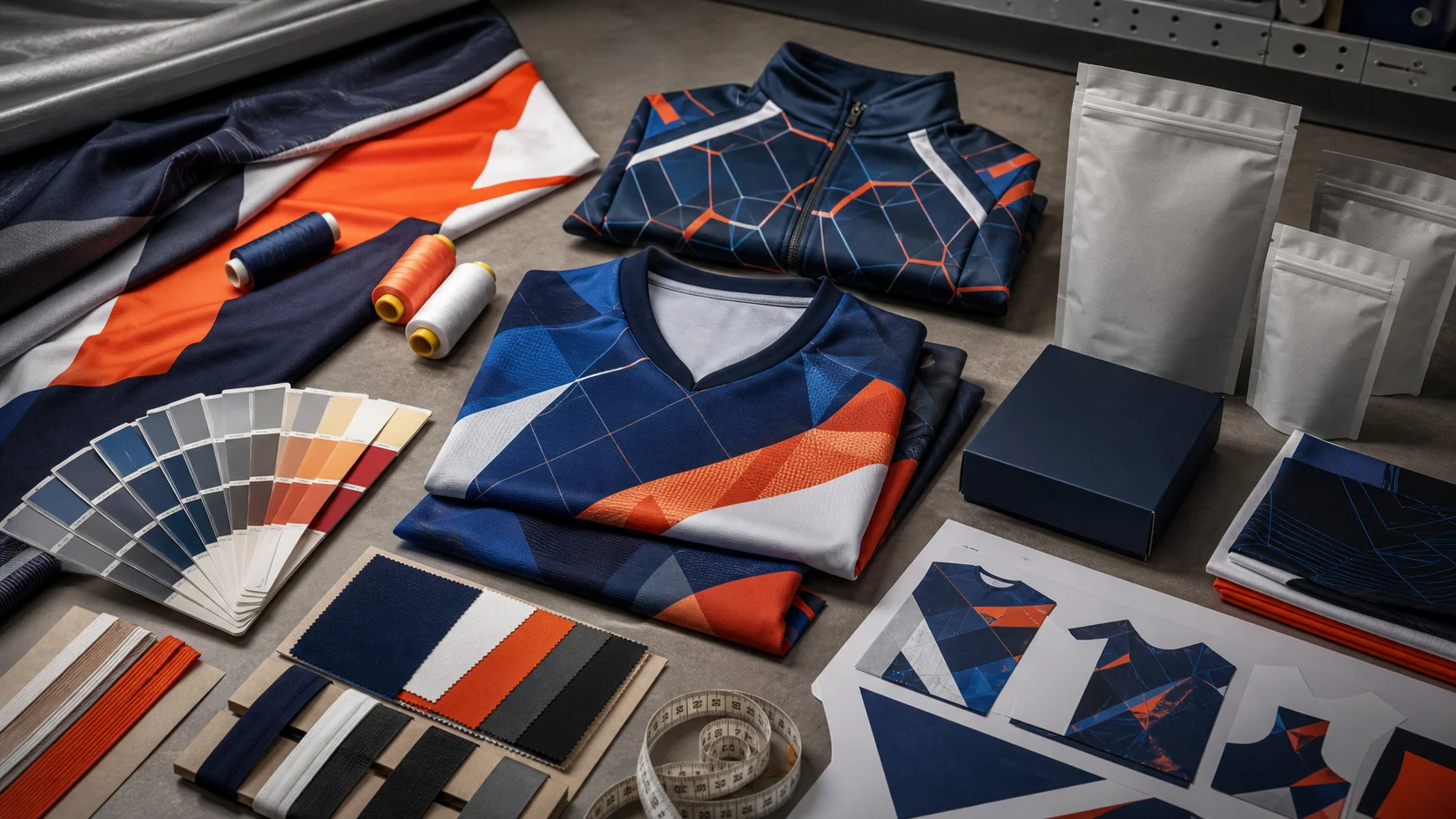
Sports Clubs Win Fans with Custom Sublimation Gear compared by sample evidence, fabric or trim specs, MOQ, AQL terms, cost lines, delivery timing, and...
Fast answer: Sports Clubs Win Fans with Custom Sublimation Gear: Tech Pack, Sample Gate, MOQ, and QC Terms should be judged by production evidence, not by a generic sourcing promise. The buyer needs sample proof, cost breakdowns, QC checkpoints, and delivery buffers in writing.
Ask for recent sample photos, measurement tolerances, fabric or print test assumptions, decoration test notes, packing examples, and a named inspection checkpoint. These details show whether the team can repeat an approved sample at bulk volume.
Separate garment cost, decoration, labels, packaging, sampling, testing, freight, and rush charges. Clear cost lines make it easier to reduce colorways, adjust size depth, or reserve more time for sampling.
How Sports Clubs Win Fans with Custom Sublimation Gear - Custom Clothing manufacturing guide
Custom sublimation fan gear for sports clubs is one of those tools that looks simple on the surface and quietly does a lot of heavy lifting underneath. It gives supporters something to wear, remember, post online, and bring back next season. It also gives a club a visual identity that feels bigger than the stadium, the gym, or the local pitch. I have seen small clubs look far more established the moment they roll out a clean sublimated fan range. A well-executed polyester match jersey or brushed-fleece hoodie can do that, especially when the first bulk run lands in 18 to 22 business days and the club can replenish in 50- to 100-piece drops. Fast.
In the custom clothing world, sublimation has become a serious option for clubs that want bright colors, sharp logos, and long-lasting fan apparel without the heavy, plasticky feel of older decoration methods. For clubs that care about brand consistency, repeat orders, and merch margins, it is hard to ignore. The process is especially useful when the design includes gradients, sponsor blocks, or complex artwork that would be expensive or awkward to produce with embroidery or screen print. On most factory lines, the artwork is printed on 100% polyester or recycled PET tricot using an Epson SureColor F9470 or Mimaki TS55-1800, then transferred through a Klieverik calender at around 190-210 C before cut-and-sew.
Fans do not just buy clothing. They buy belonging. They buy proof that they were there, or that they are part of something bigger than themselves. Good custom sublimation fan gear turns that feeling into a product they can put on immediately. That is why the clubs that treat merch as a real revenue stream tend to win more than shirt sales. They build identity. In real club programs, the strongest sell-through often comes from limited runs priced around $28 to $45 at retail, with factory costs that can sit in the $2.50 to $4.00 per unit range at 500 MOQ for a basic sublimated tee.
Sublimation is a printing method where ink turns into gas under heat and bonds with polyester fibers. That sounds technical, but the practical result is easy to understand: the design becomes part of the fabric instead of sitting on top of it. No thick hand feel. No peeling vinyl edge after a few washes. No cracking across the chest after a season of wear. On a proper production line, the artwork is first mirrored and printed in disperse inks, then heat-activated onto white polyester panels before cutting, so color registration stays cleaner than post-print heat transfer on assembled garments.
For sports clubs, that matters. Fans wear these garments hard. They wash them often. They spill drinks on them. They toss them into gym bags and wear them to matches, school events, and watch parties. Sublimation holds up because the color lives inside the fabric. In a factory setting, this usually means using white or light polyester fabric, typically 140 to 220 gsm for tees and 280 to 320 gsm for hoodies, then printing the artwork before the garment is cut and sewn, or printing cut panels for specific products. Mills in Guangzhou often source 100% polyester birdseye mesh for jerseys, while Dhaka factories doing cut-and-sew will pair it with flatlock stitching on the shoulders and side seams for better stretch recovery.
There is a reason experienced buyers keep coming back to this method. It gives control. Every sleeve, shoulder panel, sponsor box, and trim line can be designed without the usual production limits that come with traditional decoration. If the supplier is set up for it, the same pattern can be built into a micro-mesh body, a brushed-back fleece hoodie, or a double-knit training top without changing the visual system. That flexibility is exactly why clubs use it for season refreshes and supporter drops.
In my experience, clubs that want a premium-looking fan range on a realistic budget often get the best balance from sublimation. The color story is strong, the turnaround is workable, and the product feels modern instead of overbuilt. A well-run factory in Guangzhou, Dhaka, or Ho Chi Minh City can usually sample in 5 to 7 days and move bulk production in 18 to 22 business days once artwork and size breakdowns are approved.
Fans buy with emotion first and logic second. That is the truth most clubs learn the hard way. A supporter may tell you they want quality, but what they are really looking for is a design that feels worth wearing on match day and still looks good at the coffee shop the next morning. Custom sublimation fan gear works because it can carry that emotion visually. The sweet spot is usually a garment that feels like a proper replica but lands under the price of a player-authentic kit, often around $39 to $65 retail for jerseys and $55 to $85 for hoodies.
A club crest on the chest is only the beginning. The bigger wins come from pattern language, color blocking, heritage details, names, and season-specific touches. A fan sees those elements and understands that this is not generic stockwear. It belongs to their club. It belongs to this year. It belongs to them. That is also why clubs with strong merchandising teams often build a seasonal design bible that locks in Pantone references, sponsor clear-space rules, and placement guides before the first sample hits the cutting table.
The best-performing merchandise programs often mix emotional design with practical pricing. A $28 to $45 sublimated fan tee can move very well if the artwork is strong and the club has a real story behind it. Hoodies and jackets sit higher, often in the $42 to $78 range depending on fabric weight, zip style, and finishing. Those numbers are not fantasy. They are the kind of price points I have seen work in real club programs when the presentation is right. In smaller runs of 100 to 300 pieces, clubs often protect margin by using simpler trim packages, self-fabric cuffs, and screen-printed neck labels instead of woven main labels.
A good fan garment is not just a shirt with a logo printed large. That is the lazy version, and frankly it often underperforms. The best sublimated fan gear feels like it came from the club's visual system, not from a generic catalog. It has rhythm. It has repeatable elements. It uses the crest with restraint and confidence. Design teams that understand production usually build with panel breaks in mind so the artwork survives the cut-and-sew process instead of getting lost in seam allowances.
Start with the club colors. Then build around them. Strong stripes, tonal textures, geometric map lines, local landmarks, supporter slogans, and anniversary marks can all give a garment more personality. I have seen a simple navy-and-white design outsell a more complex rainbow-heavy concept because the first one felt true to the club. Taste matters. So does restraint. A factory designer in Ho Chi Minh City or Guangzhou will usually recommend keeping major logos at least 12 to 15 mm away from seam intersections so the final stitch line does not distort the crest.
A mild criticism here: too many clubs overload the garment. They try to fit every sponsor, every slogan, every historical reference, and every possible color onto one shirt. The result is noisy. Fans notice. They may not be able to explain why it feels off, but they feel it. Clean design usually sells better than crowded design. In production terms, it also reduces color separations, which keeps sampling tighter and lowers the risk of misregistration on a multi-panel sublimated body.
There is also a production reason to keep the artwork disciplined. Better design files mean fewer revisions, faster sampling, and cleaner color accuracy. A factory can produce a striking piece much more reliably when the layout is organized before the first sample is made. The best suppliers will ask for vector art, outlined fonts, and separate layers for sponsor marks, then output strike-off prints for approval before committing to the heat-transfer stage.
Custom sublimation fan gear covers more than jerseys. Clubs that think in collections instead of single items usually build stronger merchandise revenue. That is especially true when the club wants year-round sales, not just one match-day spike. The strongest programs often bundle a replica jersey with a tee and a hoodie so the average order value can move from roughly $34 to $82 per basket depending on market and distribution channel.
Hoodies deserve special mention. A well-made sublimated hoodie can become the default item fans wear all season long. A brushed fleece interior, 300 to 320 gsm fabric, and a properly balanced print layout can make the item feel premium without turning it into a luxury product. That balance matters. Clubs do not need to chase the most expensive item. They need the one fans will actually wear. In factories that know the category, you will often see a 3-thread or 4-thread coverstitch on hems, rib cuffs in 2x2 spandex blend, and a double-layer hood with metal eyelets if the price point allows it.
Some clubs also produce women’s cuts, youth fits, and oversized streetwear versions of the same visual system. That is smart. It broadens reach without diluting the brand. It also helps the club serve different buyer groups instead of assuming one fit works for everyone. In real life, it never does. The best factories will grade from youth 8 to 16, women’s XS to 2XL, and unisex S to 5XL, with size sets checked on live fit samples instead of only spec sheets.
Product Typical Factory Cost Retail Range Best Use Fan T-shirt $2.50 to $4.00 at 500 MOQ $28 to $40 Mass sales, giveaways, youth supporters Replica jersey $9.80 to $16.50 $39 to $65 Match day, premium merch, sponsor exposure Hoodie $14.00 to $24.00 $55 to $85 Cold-weather sales, higher margin collections Training top $8.50 to $14.50 $34 to $52 Member gear, practice wear, branded eventsThis is where the conversation gets practical. Design ideas are easy. Production discipline is where clubs either win or lose money. A reliable factory should be able to talk clearly about minimum order quantity, sample timelines, bulk lead times, and fabric options. If they cannot, keep walking. The better factories will also tell you whether they are running their sublimation line with an in-house Epson or Mimaki printer, a Klieverik or Monti Antonio heat calendar, and a Gerber or Lectra cutting table for panel accuracy.
For custom sublimation fan gear, many factories work with MOQs starting around 50 pieces per design, though 100 pieces is often the point where pricing becomes much more efficient. A small run of 30 can be done in some cases, but the unit cost usually climbs fast. That is fine for exclusive drops. It is less ideal for core inventory. At 500 units, a basic sublimated tee can sometimes land in the $2.50 to $4.00 factory range, while a more complex hoodie or zip-up with branded trims and woven labels can move into the mid-teens. Bulk lead times are typically 18 to 22 business days after approval, with sample development taking another 5 to 7 days if the artwork is clean.
Location matters too. Guangzhou is strong for fast-turn sublimation and accessory sourcing, Dhaka is often more competitive for cut-and-sew knitwear and higher-volume jersey programs, and Ho Chi Minh City can be a solid middle ground when a club wants tighter quality control and better communication cadence. If a supplier can show you WRAP, BSCI, GOTS, or OEKO-TEX certificates, that is a real plus, but the certificate should match the actual factory and product category, not just the trading company name on the email signature.
Shipping and duty also affect real cost. A jersey that costs $11.80 at factory can land very differently depending on whether it ships by air, consolidated sea freight, or direct courier. Clubs that order on a predictable seasonal calendar usually save money by booking production 6 to 8 weeks before a launch date so they are not forced into rush freight. That scheduling discipline is often the difference between a profitable merch drop and a margin leak.
Quality is not just whether the colors look bright in a photo. It is how the item behaves after wear, wash, and stretch. Good sublimated gear should keep its edge after at least 20 to 30 home washes on a normal cycle. The print should remain crisp, the seams should sit flat, and the garment should keep its shape without twisting. If the collar starts waffling after the first wash, or if the side seams torque, the factory has likely skimped on fabric recovery or thread tension.
Ask for a pre-production sample and check the build, not just the print. Look at the shoulder seams, armhole shape, and hem finish. A proper sample should show consistent stitch density, clean overlock edges, and color that matches the approved artwork under daylight and store lighting. If possible, ask the supplier which thread they are using. For performance garments, polyester core-spun thread or high-tenacity spun polyester is usually safer than cheap cotton-blend thread.
There are also certification signals worth asking for. OEKO-TEX Standard 100 is useful for fabric and trim safety, GOTS matters when organic cotton blends are part of the program, and WRAP or BSCI can indicate better labor compliance structures. None of these replaces a factory audit, but they do separate serious suppliers from the ones improvising their paperwork.
The most common mistake is treating fan merch like a one-off novelty instead of a structured product line. Clubs often approve artwork too late, skip fitting rounds, or try to launch without a real size chart. That is how you end up with boxes of merchandise that do not match demand. A better approach is to lock the range 60 days before the event, sample 30 days out, and leave enough time for corrections before the launch window.
Another common problem is choosing the wrong fabric for the market. A heavy brushed fleece hoodie might sell well in Melbourne or Manchester, but it can sit in stock in warmer regions if the club does not think through climate and fan behavior. Likewise, a very lightweight tee may feel cheap if the target buyer expects something closer to a 160 gsm club tee. Matching product weight to local expectations matters more than most people realize.
Clubs also make mistakes with branding hierarchy. If the sponsor dominates the front, the crest gets crowded out and supporters lose emotional connection. If the garment looks too generic, it does not feel collectible. The best-selling club products usually keep the crest visible, the sponsor integrated, and the design story anchored to something local such as a stadium detail, city map line, or anniversary mark.
The right supplier is not just the cheapest one. It is the one that understands club merchandise, handles artwork revisions quickly, and can keep repeat orders consistent across seasons. A good team will ask about size curves, sale channels, expected delivery dates, and whether the club needs private label packaging or just bulk polybags. They will also know how to handle reorder shading so the second production run matches the first.
Ask very specific questions. What is the confirmed MOQ per colorway? Which fabric mills are they using? Can they source recycled polyester, brushed fleece, or interlock in the same shade family? Do they have machine embroidery in-house for small crest applications, or is everything sublimated? Can they provide audit documents for WRAP, BSCI, GOTS, or OEKO-TEX if the buyer asks? These are the kinds of answers that reveal whether the supplier is a real manufacturing partner or just a middleman.
In practical terms, clubs often get the best results from suppliers that can handle both sampling and bulk in one region. Guangzhou is often strong for speed and trim sourcing, Dhaka for volume and competitive knitwear pricing, and Ho Chi Minh City for balanced quality and communication. The right fit depends on whether the club values lowest landed cost, fastest turnaround, or tighter construction control.
If the supplier is worth working with, they will be comfortable discussing seam allowances, color tolerance, and replacement policy up front. That transparency is more valuable than a polished sales deck. It saves everyone time and keeps the merch program from becoming a guessing game.
Get a free quote from Fabrikn — your trusted B2B clothing manufacturer with 10+ years of experience. MOQ as low as 200 pieces.
Get a Free Quote →How many pieces should a club order first? For most fan programs, 100 to 300 pieces is a sensible first run because it keeps unit cost manageable while limiting overstock. A 50-piece test order can work for a special drop, but the pricing is usually less efficient.
How long does production usually take? Typical bulk production is 18 to 22 business days after sample approval, with 5 to 7 days for initial sampling if the factory has the fabric in stock and the artwork is final.
Which fabrics work best for sublimation fan gear? 100% polyester birdseye mesh, interlock, pique, and recycled PET blends are common. For hoodies, many factories use 300 to 320 gsm brushed fleece with a polyester face for cleaner color transfer.
What certifications should clubs ask for? OEKO-TEX Standard 100 for fabric safety, WRAP or BSCI for social compliance, and GOTS when organic cotton content is part of the program. Always verify that the certificate matches the actual factory and product scope.
Can sublimation work for premium-looking club merch? Yes. When the artwork is disciplined and the supplier uses proper heat transfer, cut-and-sew, and stitch finishing, sublimation can look highly premium without the weight or cracking issues that come with heavy plastisol prints.
Use these related guides to compare specs, costs, quality checks, and buyer decisions before making the final call.