
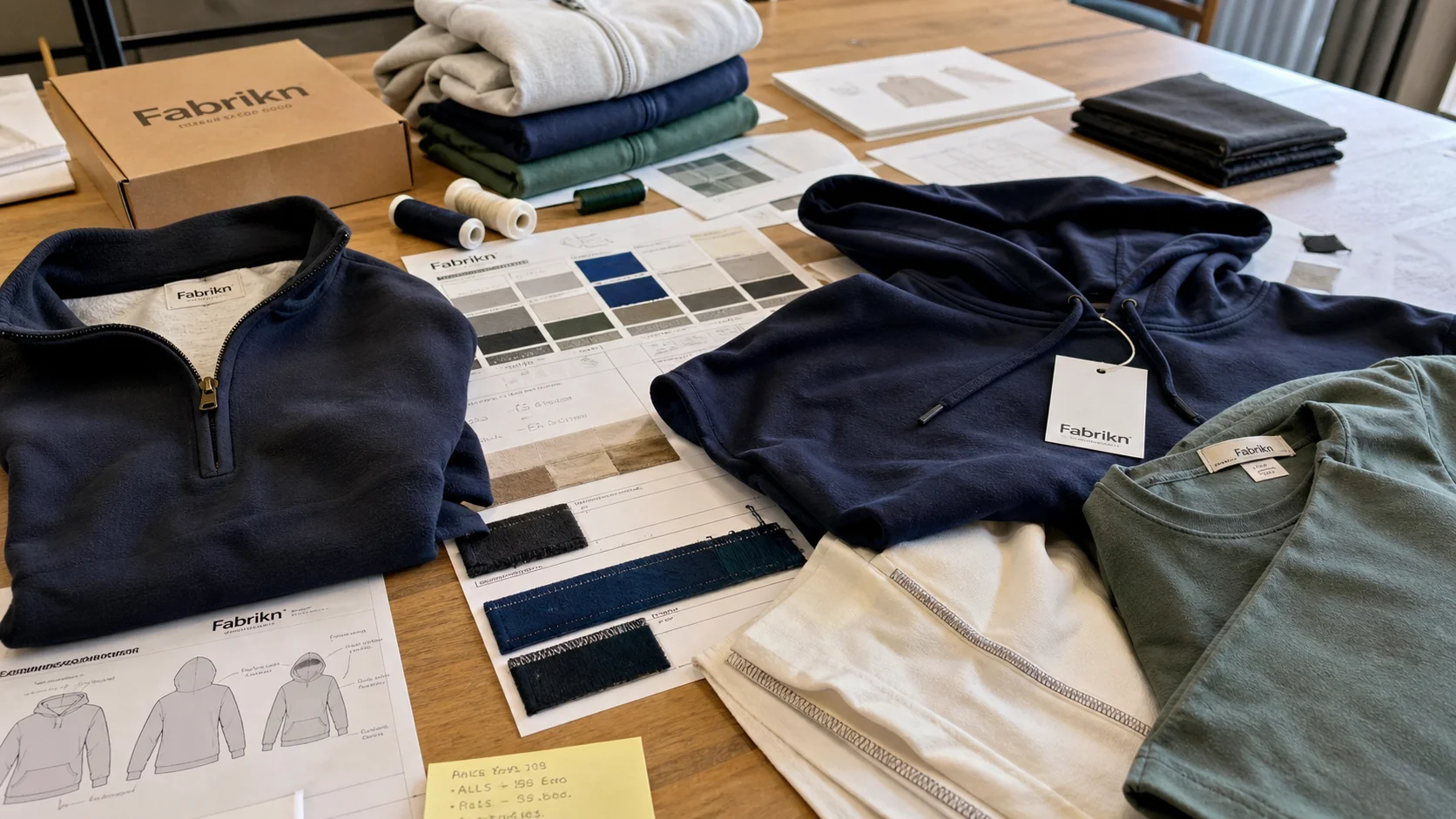
Much Does Custom Hoodie Manufacturing Cost compared by sample evidence, fabric or trim specs, MOQ, AQL terms, cost lines, delivery timing, and rework...
Fast answer: Much Does Custom Hoodie Manufacturing Cost: Sample Fit, Trim, AQL, and Delivery Risk should be judged by production evidence, not by a generic sourcing promise. The buyer needs sample proof, cost breakdowns, QC checkpoints, and delivery buffers in writing.
Ask for recent sample photos, measurement tolerances, fabric or print test assumptions, decoration test notes, packing examples, and a named inspection checkpoint. These details show whether the team can repeat an approved sample at bulk volume.
Separate garment cost, decoration, labels, packaging, sampling, testing, freight, and rush charges. Clear cost lines make it easier to reduce colorways, adjust size depth, or reserve more time for sampling.
A hoodie can look ordinary on a hanger and still behave like two different products on the factory floor. When people ask how much does custom hoodie manufacturing cost, start with the machinery, the fabric stack, and the order size—not the retail tag. Not the retail tag. One plain fleece style came out at $6.80 ex-factory; another, sold at retail, reached $18.40 before freight. That gap is why buyers need a manufacturing breakdown, not a glossy quote. On a Guangzhou run I watched a Gerber Paragon 3D automatic cutter and Juki single-needle sewing lines slice through OEKO-TEX Standard 100 ring-spun cotton and GRS-certified recycled polyester sourced from Dhaka mills before the pieces hit the Kornit Atlas DTG press.
The range is not random. And blank-heavy basics, decorated mid-tier runs, and premium cut-and-sew orders sit in different price bands. A 300 GSM cotton-poly pullover with one small chest print can land near $8 to $13 at 1,000 pieces. Brushed fleece, an oversized fit, enzyme wash, multiple prints, custom zips, and branded packaging can lift that to $17 to $28. A premium made-from-scratch program with heavy yarn-dyed fleece, dense ribbing, and strict compliance testing can push beyond $30. In Dhaka's Gazipur district, a 380 GSM French terry batch runs through a Galaxy enzyme washer, a Hydro-Force brushing table, and finally a belt dryer before each hooded body moves to final boarding, which keeps shrinkage below 3% and makes dye lots traceable back to GOTS-certified fiber farms.
Order size moves the number fast. But 100 units often priced 30% to 70% higher per piece than 1,000-plus units because the setup load barely changes. A cutter still lays fabric. A printer still burns screens. QC still checks shrinkage, pilling, and seam alignment. The small order just has less volume to absorb the fixed costs. At 500 MOQ, a Turkish supplier in Istanbul that sources custom woven labels and metallic snap buttons charges an additional $2.50-4.00 per unit for those trims alone, while the same trims drop to $1.10 to $1.60 at 2,000-piece runs from Guangzhou or Ho Chi Minh City.
Gather the dull numbers first: fabric cost per kilo, cutting cost per piece, decoration setup, packaging, freight. The moment a supplier sends one line with no breakdown, you’re only halfway through the quote. I’ve seen low prices hide sampling charges at $40 to $120 per round, yarn-dyed fabric surcharges of $0.80 to $2.20 per piece, and testing costs that add $150 to $600 per style. On the floor I compare how a 4-head M&R Gauntlet screen-print machine ties up four colors and a flocking station versus how a Technos Miro for embroidery and a heat-press for reflective decals flows; those capital costs can be amortized only if the quantity justifies it. I have suppliers quote the cost for a WRAP- and BSCI-compliant inspection, and I ask whether they share the lab report for the GOTS or OEKO-TEX Standard 100 stamp so I’m not left waiting for a third-party test.
Here’s the part many buyers miss. In Vietnam or Portugal, labor can run 15% to 35% higher, yet the final cost sometimes lands lower because defect rates are tighter and rework is rarer. A hoodie that ships on time, passes inspection, and avoids air freight is cheaper than a bargain piece that comes back twisted, shaded wrong, or split at the seams. I’ve watched brands save money by paying more upfront. A 40-foot container from the Ho Chi Minh City port to the Port of Los Angeles typically takes 18-22 business days when booked through a consolidator, so slipping the booking by a week can trigger air freight surcharges that climb to $2.50 to $6.00 per unit.
That is the core thesis: cheapest quote, not always cheapest hoodie.
For a supplier benchmark, start with custom hoodie manufacturing specs that clearly separate fabric, trims, decoration, and delivery terms, and insist the binder cites GOTS, OEKO-TEX Standard 100, WRAP, BSCI, and GRS certificates for the yarn and finishing partners. Otherwise, you’re comparing apples to a half-finished pattern.
Sample runs cost the most per unit, and they should. A fit sample or sales sample can run $60 to $180 because the manufacturer may cut one-off markers, source a small fabric lot, and revise the pattern once or twice. Many factories use an Eastman spreader with a manual stacker and a Makingle computerized marker to optimize just 4.2 meters of fabric. The small run still requires pressing, custom poly bags, and a final QC that uses a digital seam gauge; all those smaller runs add setup time but do not yet enjoy economies of scale. For 100 to 299 pieces, I usually see production pricing in the $12 to $24 range for a simple pullover, depending on finish. At 300 to 999 pieces, that often drops to $8.50 to $17. Above 1,000 units, efficient bulk programs can land between $6.50 and $14 if the spec stays disciplined.
Fabric choice matters as much as quantity. Cotton-poly fleece is usually the lowest-cost route because yarn supply is broad and shrinkage is easier to control. A 320 GSM cotton-poly fleece hoodie can be materially cheaper than a 500 GSM heavyweight brushed fleece version, even before decoration. Pure cotton fleece tends to cost more because it absorbs more dye, can shrink harder, and often needs stricter finishing. French terry sits in the middle, with a cleaner handfeel and less bulk. And recycled blends can be cost-neutral or slightly higher, depending on fiber availability and certification—sometimes a Dhaka spinner will charge an extra $0.50 to $1.20 per kilo for GRS-certified recycled polyester staple fiber, which translates into $0.15 to $0.35 per hoodie.
Construction changes the bill quickly. Ribbing quality, drawcords, zipper upgrades, kangaroo pocket reinforcement, and double-needle stitching each add cost. I’ve seen a better rib cuff add $0.35 to $0.90 per hoodie and a metal zipper upgrade add $0.75 to $1.80. That is before concealed bartacks, brushed pocket bags, or a lined hood. These details mean the factory needs an extra 2.4 seconds per stitch on its Juki DDL-8700 single-needle lines, and the button-fly attachments often require a dedicated conveyor and torque-controlled snap press.
Blank-manufactured hoodies are cheapest because the factory is selling an existing base style with limited changes. Screen-printed hoodies add setup fees and per-color charges; a six-color M&R Gauntlet press can require $50 to $175 per color for screens plus $0.30 to $1.10 per unit for ink, depending on water-based or discharge processes. Embroidered hoodies add stitch-count pricing, and dense chest logos can be surprisingly pricey. Fully cut-and-sew hoodies, especially private label clothing services with custom panels and labels, are the highest-cost option because they require separate pattern work, fabric allocation, and more QC checkpoints. If you need that route, private label clothing services usually make the most sense when you can commit to 300 pieces or more, because the patterning team in Ho Chi Minh City or Istanbul can amortize the CAD/CAM work only above that point.
GSM is where many new buyers underestimate the jump. A 300 GSM hoodie might use 1.6 to 1.9 meters of fabric, while a 500 GSM heavyweight version can push well above 2.2 meters, which raises both material and cutting costs. Thicker fabric also slows sewing speed; a 500 GSM panel can reduce throughput on automatic chainstitch machines to 4.2 seconds per stitch versus 3.1 seconds for lighter fleece. More seconds per seam become more dollars per unit.
China still offers the broadest scal
A strong brief makes the supplier's job narrower and the quote more reliable. For how much does custom hoodie manufacturing cost? price, include the target customer, sales channel, expected order quantity, size range, decoration needs, packaging requirements, and delivery market. Then call out the details most likely to affect the result, especially MOQ, line capacity, and pattern control.
The brief should also explain what cannot change. Some brands care most about hand feel, some about price, some about launch timing, and some about retail compliance. When those priorities are not written down, suppliers tend to optimize for whatever is easiest to quote. Clear priorities help the factory make better tradeoffs before the first sample is cut or printed.
Ask the supplier to respond with assumptions, not just a price. A useful reply states MOQ, sample route, production capacity, inspection plan, packing method, and freight handoff. If the answer is vague, the project may still work, but it needs a tighter pre-production stage before money and calendar pressure build up.
The best time to catch problems is before the pre-production sample is approved. Check measurements, color, placement, material behavior, shrinkage, construction, labels, and packaging in the same review instead of approving each item in isolation. Many bulk issues are not caused by one dramatic mistake; they come from several small unchecked assumptions.
For how much does custom hoodie manufacturing cost? price, pay special attention to QC checkpoint, export packing, and communication rhythm. These details often look minor in an email but become expensive once cutting, printing, sewing, packing, or shipping begins. A simple checklist with owner, due date, and approval status keeps the brand team and factory aligned.
Bulk production should not start until the supplier can explain how the approved sample becomes a repeatable production standard. That means reference sample storage, line instructions, inline checks, final inspection, and defect handling. A factory that can describe this process clearly is usually safer than one that only promises speed.
Price differences are useful only when the quotes cover the same work. Compare sample cost, material source, trims, decoration, packaging, testing, inspection, and freight assumptions. A low unit price can become expensive if it excludes items the brand needs before launch.
Timeline promises deserve the same scrutiny. Ask what happens if the first sample needs revision, whether materials are in stock, when the production slot is reserved, and how export packing is handled. The most reliable supplier is often the one that gives a realistic calendar instead of the fastest optimistic answer.
Before making the final decision, write down the specification, approval owner, delivery expectation, and the one or two risks that would cause the most trouble if missed. For how much does custom hoodie manufacturing cost? price, this usually means checking MOQ, line capacity, pattern control, and the support process after the order is placed.
This last review does not need to be complicated. It simply makes the decision easier to repeat, easier to explain, and easier to verify when the finished product or jewelry arrives.
One useful way to pressure-test the decision is to ask what would happen if the order had to be repeated in six months. The answer should still be clear: the same MOQ, the same line capacity, the same acceptance standard, and the same communication path. If a second order would depend on memory or guesswork, the first order is not documented well enough yet.
Another useful check is to separate preference from requirement. Preference is the look, wording, or finish the brand likes. Requirement is the measurement, tolerance, certificate, material, or delivery condition that cannot fail. Good buying decisions keep both visible, so the final choice is not pushed around by the last email, the cheapest quote, or the prettiest sample photo.
Finally, ask who owns each approval. A project with one accountable owner for sample review, one owner for final content or artwork, and one owner for delivery sign-off usually moves faster than a project where every decision is shared loosely across a team. Clear ownership reduces delays and makes the finished result easier to judge.