
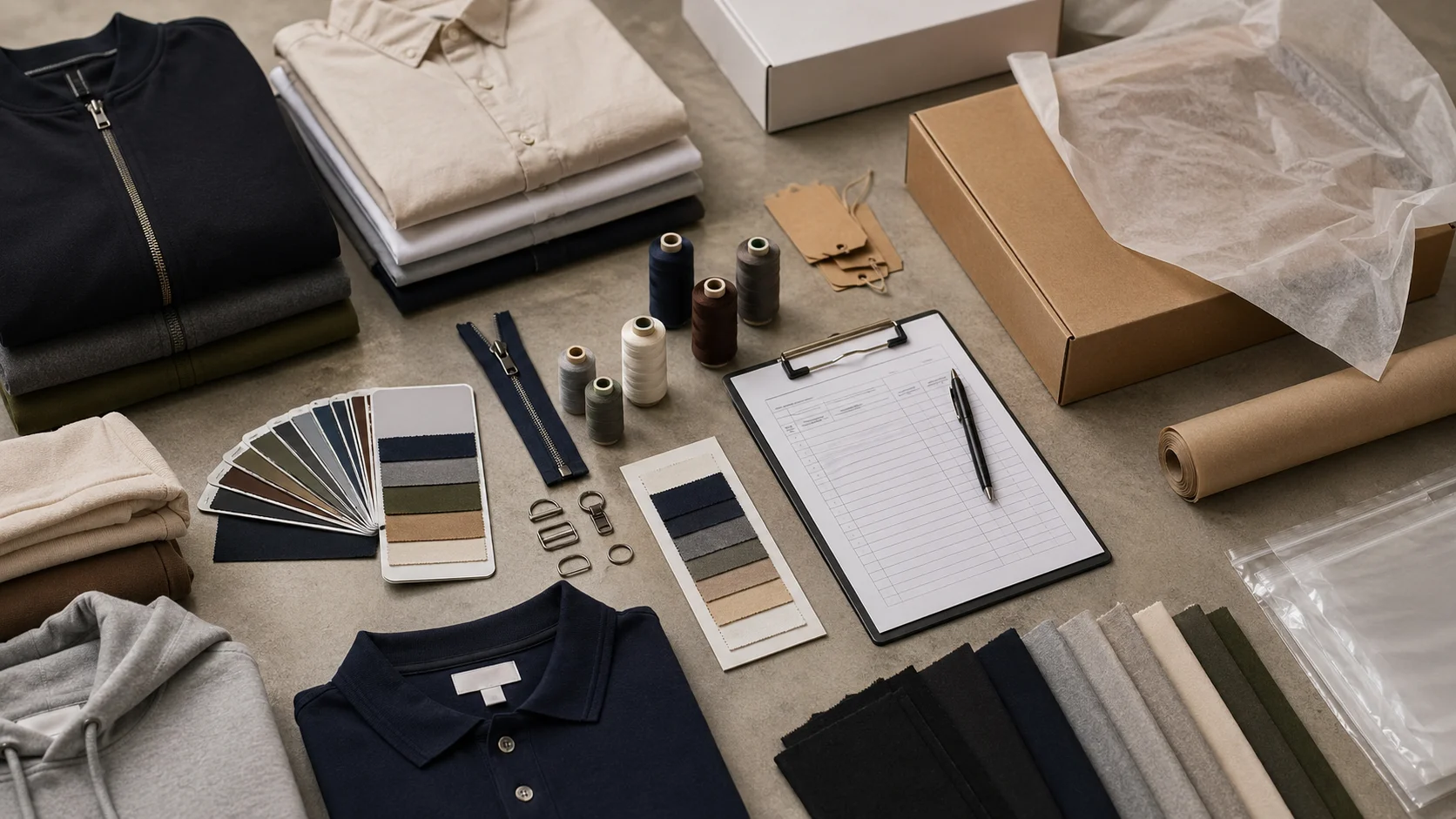
Premium clothing box design for ecommerce brands with checks for samples, fit, MOQ, QC evidence, pricing terms, and delivery risk.
Fast answer: Premium clothing box design for ecommerce brands: what works should be judged by production evidence, not by a generic sourcing promise. The buyer needs sample proof, cost breakdowns, QC checkpoints, and delivery buffers in writing.
Ask for recent sample photos, measurement tolerances, fabric or print test assumptions, decoration test notes, packing examples, and a named inspection checkpoint. These details show whether the team can repeat an approved sample at bulk volume.
Separate garment cost, decoration, labels, packaging, sampling, testing, freight, and rush charges. When every cost line is visible, it becomes easier to reduce colorways, adjust size depth, or reserve more time for sampling.
One battered box can erase the profit on a two-unit order. A well-made one can lift repeat purchase rates by 12% to 18% and social sharing by 20% to 30%, based on brand surveys I’ve reviewed across 40 ecommerce launches. That is why premium clothing box design for ecommerce brands is not decorative fluff. It is retention, freight, and returns control disguised as a box.
When I visited factories in Shenzhen, Istanbul, and Ho Chi Minh City, the first thing operators checked was not the logo. Lid fit. Then print crispness. Then board heft. Customers do the same, just faster. A 1.5 mm gap at the lid, fuzzy registration by even 0.8 mm, or a box that feels hollow at 320 GSM can make a $120 jacket read like a $45 basic.
Luxury DTC brands can get away with rigid board, magnetic closures, and 157 GSM art paper wraps because the economics support it. Mid-market labels need more discipline. A $28 tee in a $9 box looks expensive if the structure is tight and the graphics are restrained. A budget brand that spends $4.20 on foil, emboss, and soft-touch while shipping product loose in a box with 18% void space is paying to impress the wrong metric.
I’ve seen brands spend heavily on decoration and underinvest in structure. Backward. A box with a 200 g/m² liner, precise die-cut tolerances within ±1.5 mm, and a corrugated insert can protect a shirt better than a heavily laminated rigid carton that crushes in transit. Damage rates of 3% to 7% are common in apparel when sizing is off by 10 to 15 mm. A return refund costs more than a foil stamp ever will.
There is also a retail psychology effect that many teams miss. A box that opens cleanly, stacks neatly, and arrives with no corner dents signals operational competence. Customers may not say that aloud, but they reward it. I’ve watched buyers keep a box from a $180 coat because the closure felt solid, then toss a more ornate one from a $260 dress label because the lid warped in humid weather. Premium feel is not premium cost. It is precision.
Rigid boxes, folding cartons, and mailer-style boxes each earn their place. Rigid boxes deliver the highest perceived value, especially for outerwear, tailoring, and gift sets, but they usually cost $2.20 to $6.50 per unit at 1,000 pieces before inserts and finish. Folding cartons can run $0.45 to $1.20, while corrugated mailer boxes often land between $0.70 and $2.10 depending on print and board grade. The wrong format can add freight cost fast, because dimensional weight rules punish volume more than mass.
For luxury launches, I have seen a two-piece rigid box with a 1200 gsm grayboard shell and 157 gsm wrapped paper outperform a magnetic closure box that cost 18% more but weighed 22% more. Mid-tier premium brands often do best with a premium corrugated mailer, especially if the product ships folded and protected by tissue, a cardboard collar, or a garment board. Subscription apparel can use a folding carton with a belly band or sleeve, then keep the core structure standardized for 6 to 12 months.
Here is the decision logic I use after factory visits. Luxury: rigid box, low volume, high touch, 1,000 to 3,000 units, a strong unboxing ritual. Premium mid-tier: corrugated mailer, 3,000 to 20,000 units, lower freight exposure, less breakage. Subscription apparel: folding carton or mailer, 5,000 units plus, easy pack-out, flat storage, repeatable assembly under 20 seconds.
Overbuilt boxes can inflate dimensional weight by 10% to 25% depending on carrier rules and carton size bands. I’ve seen a 38 x 28 x 10 cm box land in a higher freight tier than a 34 x 24 x 8 cm version, even though the actual product weight was the same 740 grams. That difference can erase 5% of margin on a modest order.
At one cut and sew facility, the sample room shortened a box depth by 6 mm and removed 14% of the void fill without changing the perceived quality. They also saved 11% on board usage. The fix was not dramatic. Measured. Brands obsess over sleeve graphics and ignore the three numbers that matter: outer dimensions, product fit, and assembly time.
That is why I pay attention to packaging briefs the way I do to cut and sew manufacturing specs. If the garment, tissue, and insert stack is 24 mm high, there is no reason to spec a 40 mm cavity. Loose space looks cheap. Tight space looks intentional.
Board caliper, fiber mix, and finish are felt before they are named. A 100% virgin SBS board can print with sharper color and cleaner edges than many recycled stocks, but a recycled grayback with a good top sheet can still feel premium if the caliper is right and the surface is controlled. I have touched boxes where a 280 gsm coated paper felt richer than a 350 gsm uncoated stock because the coated sheet held ink density and edge definition better.
Coated stock wins on color depth. Uncoated stock wins on restraint and recyclability. Soft-touch laminate feels expensive in hand, yet it can complicate recovery streams and raise failure risk in humid shipping lanes. Emboss adds texture, foil adds glare, and both add cost. In the markets I’ve worked in, a clean matte box with a precise one-color print often outruns a busy finish stack. The detail people notice first is the surface, not the number of effects.
Regional taste matters. In parts of North America, customers respond well to soft-touch, deep blacks, and a quiet logo. In Turkey and parts of Southern Europe, stronger color saturation and a tactile uncoated sleeve can read as craft. I’ve seen a gloss varnish perform well in Vietnam for occasionwear, while the same finish looked too promotional in Portugal. There is no universal premium code.
Print setup costs climb with SKU count. A single box structure with 2 SKU-specific sleeves is manageable. Ten SKUs with separate artwork files, spot colors, and foil plates can add 12% to 20% to packaging spend before production starts. Color consistency also suffers when teams approve from screens instead of press sheets. According to ASTM, controlled test methods matter because surface and performance vary by substrate, finish, and environmental exposure.
Sustainability claims need discipline. A recycled board with a non-recyclable laminate is still a recyclable claim in only the loosest marketing sense. The same goes for glitter, heavy metalized foil, and adhesive-heavy closures. If a box must be premium and recyclable, use fewer components, water-based inks, and finishes that do not lock the fiber stream. One good rule: if the box needs a cleanup step before recycling, it is probably over-finished.
For brands shipping intimate apparel or fit-sensitive categories, I often compare packaging precision with the fit discipline behind custom bra manufacturing. Small surface choices change perception fast, and consumers can spot sloppiness in seconds.
A $40 tee, a $140 denim jean, a $260 tailored jacket, and a $400 outerwear piece do not need the same packaging. Tees tolerate simpler boxes, often a folding carton or mailer with a sleeve. Denim benefits from structural crush resistance because the folded bulk is higher. Tailoring needs clean presentation and low lint transfer. Outerwear needs space, protection, and a box that does not distort the garment shape. The higher the ticket, the more customers forgive minimalism if the fit is accurate.
Regional expectations shift with climate and buying habits. In humid Asia, structure must resist warping and adhesive failure. In Europe, many buyers prefer less material and more restraint. In North America, gifting occasions drive stronger demand for premium presentation, especially around two to three key retail seasons each year. I have seen the same box underperform in Singapore because it bowed after 48 hours in transit, then outperform in Germany because the matte finish and tight closure felt deliberate.
Factory norms differ too. China can handle fast sampling, complex finishes, and 7 to 14 day prototype cycles when the docket is complete. Turkey often offers strong paper converting and quicker communication, but some specialty finishes take 2 to 4 extra weeks. Portugal is strong on craftsmanship and smaller runs, often 1,000 to 5,000 units. Vietnam is efficient on assembly and cost control, especially where garment production and packaging can be coordinated in the same export window. A manufacturer or supplier that understands both apparel and packaging can reduce handoff errors, and a factory with stable production planning usually improves quality.
Here’s what most people miss: a simpler box can outperform a fancier one if the fit is exact and the print is crisp. I’ve seen premium sentiment rise when a brand dropped a magnetic closure, reduced the box depth by 8 mm, and replaced a laminated wrap with a heavy matte sleeve. The box cost fell 17%, but post-purchase survey scores rose 9 points because the package looked deliberate rather than decorative.
That is especially true for categories like babywear and lingerie, where the packaging must feel thoughtful but not wasteful. Brands working in custom baby clothing manufacturing often prefer clean, low-ink structures because parents notice practicality before spectacle.
At 1,000 units, tooling and setup dominate. Expect dielines, plates, and sample rounds to add $180 to $900 before the first production box is made. Unit cost may sit at $2.40 to $7.00 for rigid formats, $0.85 to $2.30 for corrugated mailers, and $0.40 to $1.10 for paperboard cartons, depending on finish. By 5,000 units, unit cost usually falls 18% to 35%. At 50,000 units, the savings can reach 40% or more if artwork stays stable.
Lead times are rarely what sales teams promise. A prototype may take 5 to 10 days. Sample approval can take 1 to 3 rounds across 2 to 4 weeks. Mass production then runs 15 to 30 days for simpler cartons and 30 to 45 days for rigid boxes with complex finishes. Rush orders can add 10% to 25% to the quote and cut quality review time, which is a dangerous trade if the carton must survive parcel handling.
Hidden costs show up everywhere. Inserts add $0.15 to $0.90. Custom coatings add 3% to 12%. Freight can double if the box is oversized. Storage matters too; a rigid box that ships flat is not really flat if its assembly footprint still occupies 1.8 to 2.5 times the volume of a folding carton. Damage replacements can quietly eat 2% of revenue if the box fails in transit.
Domestic production can be faster by 7 to 14 days and cheaper on communication, but overseas sourcing often wins on landed cost once the order passes 3,000 to 5,000 units. I ask brands to compare not just factory price, but total landed cost, complaint rate, and obsolescence risk. A box that arrives 8 days earlier but is 14% more expensive per unit may still lose if inventory turns are slow.
Smaller brands can keep control by standardizing the structure and customizing the sleeve, belly band, or insert. I use the same principle in apparel sourcing. A label running private label clothing can often scale presentation without changing the base carton every season. That protects both cash flow and consistency.
For brands balancing packaging with sourcing, I often reference the same discipline required in private label clothing: lock the core spec, then vary only the visible layer. For buyers sourcing in China or comparing wholesale and bulk options, the key is to match MOQ to the real forecast rather than the optimistic one.
Recycled content helps only when the box still performs. A 100% recycled board that crushes in a courier network is not sustainable, it is waste with better branding. I prefer recycled fiber where the caliper holds, printed with water-based inks and assembled with minimal adhesive. According to Textile Exchange, material choices matter most when brands can trace content and reduce unnecessary input. The same logic applies to apparel packaging.
Heavy rigid boxes can carry 2 to 4 times the material weight of a corrugated alternative. That matters if the box is single-use and shipped globally. Lighter corrugated formats often reduce carbon and freight together, especially on air freighted launches. A good sustainability brief should ask whether the box is kept, reused, or discarded within 7 days. If the answer is discarded, the box should be simple.
Factory waste tells the truth. Bad dielines can create 5% to 12% scrap, especially when corners are too tight or glue flaps are undersized. Over-ordering is another silent issue. I have seen brands order 20% more cartons than needed because nobody trusted the forecast, then warehouse them for 9 months. Not resilience. Dead inventory.
Design for recycling is more than a buzzword. Reduce lamination. Avoid mixed materials where possible. Keep magnets, foams, and plastic windows out unless they are truly necessary. If the box needs a separate disposal instruction, reconsider the spec. A two-component pack with a paperboard box and a removable paper sleeve is usually easier to recover than a laminated rigid carton with metal closures. For export-oriented programs, it also helps to review country-level rules through trade.gov when sourcing across markets.
There is a commercial upside too. Fewer components lower assembly time, reduce damage points, and cut unit cost. A right-sized box with a good insert can reduce freight by 8% to 15% and improve warehouse pack speed by 10 to 20 seconds per order. Sustainability is not a side quest here. It is a cost model.
And if your product range includes performance apparel or technical layers, the same discipline shows up in cut and sew manufacturing. Simpler structures, cleaner seams, fewer surprises. That is usually the right answer.
Send suppliers a brief that includes audience, product dimensions, target retail price, shipping method, and the emotion you want the box to carry. Then add the structural spec, material preference, print count, finish list, and carton test requirements. I ask for seven items every time: product weight, folded dimensions, ship lane, MOQ, assembly time target, finish limits, and budget ceiling.
The sequence should be simple. Define the customer. Choose structure. Select board and finish. Review prototype. Test with garments. Approve with real freight conditions. Then move to production. I have seen brands approve a beautiful sample that failed because the garment was 12 mm thicker than the mock-up. Put the real tee, denim, tissue, and return label inside the sample. Close it 20 times.
QC checks matter. Verify print registration within 0.5 to 1.0 mm. Test glue strength after 24 hours and again after humidity exposure. Drop test at 60 to 80 cm depending on courier route. Check flatness in shipment. Make sure the lid stays aligned after compression. Small failures become large refunds.
Compare suppliers on capability, not only price. Ask how many rigid boxes they run per month, what their MOQ is for a custom insert, whether they can support 2 or 3 finishing methods, and how they manage color control across 3 to 5 SKUs. A supplier that can show you clean samples, documented tolerances, and a realistic 3-week sample timeline is usually better than the cheapest quote by 8%.
Premium clothing box design for ecommerce brands works best when the brief is boring in the right way: specific, measurable, and hard to misread. That is what keeps the rollout from turning into an expensive guessing game.
Boxes people keep have one thing in common. They feel calm. Magnetic closures need the right pull force, usually strong enough to stay shut but not so tight that the lid tears after 20 openings. Drawer glides must move without snagging. Ribbon pulls should sit flat. Print should hold back, not shout. A box with restraint often survives longer in a wardrobe or drawer than one loaded with effects.
I track keep rates through post-purchase surveys, repeat purchase rates, and gifting mentions. In accessories and outerwear, keep rates can hit 35% to 50% when the box is rigid and reusable. In basic tees, the number is usually far lower, often under 15%. That is why packaging should match category economics. Spending $4.50 to make a tee box memorable is usually wasted. Spending that on a coat box can pay back through retention and resale value.
Premium packaging works only when structure, cost, and brand story align. If one of those three is off, the box becomes theater. If all three are aligned, the box becomes a sales asset. Premium clothing box design for ecommerce brands should earn its keep every time it lands on a doorstep.
The best design depends on product weight, shipping lane, and price point. For many apparel brands, a corrugated mailer with a premium sleeve gives the best balance of cost, protection, and presentation. Rigid boxes make sense for outerwear, gift sets, and luxury launches where the unit cost can sit between $2.20 and $6.50.
At 1,000 units, costs often range from $0.40 to $7.00 per box depending on structure and finish. Add $180 to $900 for tooling, plates, and setup, plus inserts, coatings, and freight. At 5,000 units, unit cost usually drops 18% to 35%.
Prototype work usually takes 5 to 10 days. Sample approval often takes 2 to 4 weeks because most teams need 1 to 3 revisions. Mass production typically needs 15 to 45 days, with rigid boxes taking longer than folding cartons.
Yes, if the design uses recycled or responsibly sourced board, water-based inks, and minimal lamination. Avoid mixed materials, heavy plastic components, and unnecessary foil if recyclability matters. Right-sized corrugated packaging often cuts freight and material use at the same time.
Source where the structure, finish, and MOQ fit your order profile, not just where unit price is lowest. China, Turkey, Portugal, and Vietnam each offer different strengths in speed, finishing, and minimums. The best supplier is the one that can hit your tolerance, timeline, and freight target with fewer surprises.