
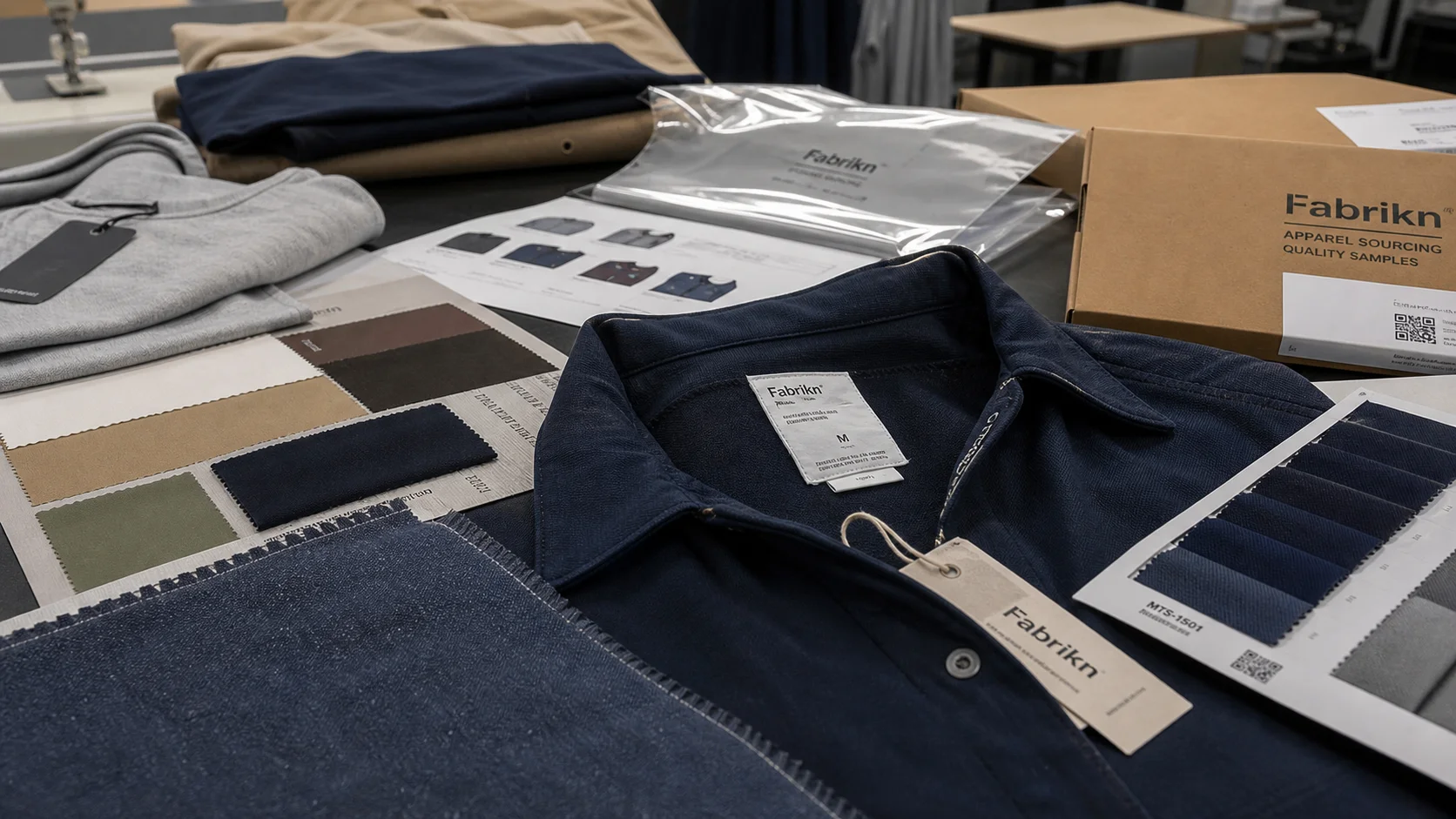
Premium Fashion Ecommerce Packaging with checks for samples, fit, MOQ, QC evidence, pricing terms, and delivery risk.
Fast answer: Premium Fashion Ecommerce Packaging: Finish, Inserts, Cost, and Conversion should be judged by production evidence, not by a generic sourcing promise. The buyer needs sample proof, cost breakdowns, QC checkpoints, and delivery buffers in writing.
Ask for recent sample photos, measurement tolerances, fabric or print test assumptions, decoration test notes, packing examples, and a named inspection checkpoint. These details show whether the team can repeat an approved sample at bulk volume.
Separate garment cost, decoration, labels, packaging, sampling, testing, freight, and rush charges. When every cost line is visible, it becomes easier to reduce colorways, adjust size depth, or reserve more time for sampling.
Seven seconds is generous. In premium packaging ideas for fashion ecommerce, value gets judged almost instantly, long before a customer feels the fabric. In factory audits across eight countries, I watched one brand lose margin because a $68 knit arrived in a floppy poly mailer, while a competitor shipped a $42 shirt in a rigid mailer with a single tissue wrap and still got called “luxury.” First impressions are an economic event. In ecommerce, packaging often speaks before fabric, fit, or stitching gets a turn.
No store lighting. No sales associate. No tactile comparison rack. Packaging fills that gap, and it does it fast. A box with a clean edge and a 120 GSM tissue wrap can make a mid-market piece feel pricier than it is. Denim brands that moved from basic polybags to reinforced cartons saw repeat purchase intent rise, while damage claims fell by 18% to 27% over two seasons. Not branding theater. Cash flow.
Category matters, and the differences are obvious once you’ve seen enough returns come back through a warehouse. Denim shipped in a thin mailer arrives creased, with broken buttons and a cheap impression. Knitwear needs structure, not bulk; tightly folded 320 GSM French terry can still look polished in a well-sized carton. Accessories are harsher still. A scratched buckle or bent chain can wipe out a $120 sale in a week. At the doorstep, packaging becomes the silent brand statement.
Less can look more expensive. A crisp FSC sleeve over a right-sized carton often feels sharper than a heavy box stuffed with inserts nobody reads. I’ve seen that in Portugal and Japan, where restraint signals confidence. The best premium packaging ideas for fashion ecommerce aren’t about piling on paper. They’re about control, proportion, and knowing when to stop.
Material choice is where good intentions meet factory reality. A rigid box gives instant weight and ceremony, but it can be a poor fit for low-margin basics and may add 12% to 22% to shipping cubic volume. Corrugated shippers hold up better in transit, while an FSC paper sleeve can carry branding without excess material. For shoes, the strongest setup is often a rigid insert inside a corrugated shipper. For handbags, use a reusable dust bag, tissue, and a sturdy carton. Jewelry needs anti-tarnish film, a small insert card, and a box that keeps movement under 2 cm.
Hands notice quality before eyes do. Matte finishes. Soft-touch coating. Debossed logos. Fabric inserts. Any of them can raise perceived value without making the package bulky. In factories I visited in Dongguan and Ho Chi Minh City, 250 GSM paperboard with embossing beat a glossy 300 GSM box in buyer tests. Weight matters too, but only up to a point. Too heavy feels costly. Too light feels disposable.
Sustainability is messier than the marketing decks suggest. Recycled content does not automatically help if the box needs plastic lamination that blocks recycling. Dark inks can complicate recovery streams. Mixed-material closures confuse consumers, and confusion sends packages to landfill even when the supplier calls them eco. According to OEKO-TEX, U.S. Commercial Service trade guidance, and guidance from ISO, material claims need precise definitions and documented testing, not vague slogans.
Regional patterns show up quickly in sourcing. Asia often leads on custom finishing, foil, embossing, and tight tolerances at scale. Europe is usually stronger on certified paper systems and supply-chain documentation. North America gives brands faster short-run flexibility, especially when they want to test 300 to 1,000 units before a larger launch. For premium packaging ideas for fashion ecommerce, the smartest path is rarely the fanciest spec. It’s the one that survives production, shipping, and recycling without creating a headache.
Packaging spend should follow order value, not ego. Under $50 basket? I usually keep packaging at 1% to 2% of AOV. That gives you roughly $0.50 to $1.00 to work with, which is enough for a branded mailer, one tissue wrap, and a clean insert. At $50 to $150 AOV, 1% to 3% is sensible, especially when the packaging has to protect and present at the same time. For luxury capsules and limited editions, 3% to 8% is common because the box becomes part of the product story.
Mid-market brands often burn money in three places. Oversized boxes push dimensional weight up by 15% to 40%. Printed inserts get tossed unread. Custom boxes for basic tees chew through margin when the product itself carries only a 55% gross margin. I’ve seen a brand spend $2.80 on a box for a $24 top, then wonder why CAC felt brutal. The math is right there.
Higher price points justify details that would look out of place on entry-level goods. Magnetic closures, ribbon pulls, double-boxing for jewelry, structured lids — all of it can make sense for a $220 handbag or a $380 coat. The package should feel like it belongs beside the garment price. Brands building a sharper private-label offer often pair private label clothing services with packaging systems made for repeatable brand control, not one-off spectacle.
Simple rule: complexity only rises when AOV, margin, and return risk rise together. If AOV sits below $40 and return rates stay under 8%, stay restrained. If AOV is above $120, gross margin is over 60%, and returns are driven by premium categories like denim or outerwear, then spend more on presentation. That keeps the premium packaging ideas for fashion ecommerce tied to unit economics, not wishful thinking.
Supplier quotes can mislead. I compare vendors on unit cost, tooling fee, MOQ, lead time, finish options, and damage rate. A box at $0.72 with a $1,200 die setup and a 5,000-unit MOQ can be worse than a $1.05 stock structure with no tooling and a 500-unit MOQ, especially if the launch only needs 1,000 units. Total landed cost matters more than box price by itself.
Regional sourcing patterns are familiar, but not identical. China offers the widest range of scale and finish variety, from foil stamping to magnetic closures. Portugal and Italy usually deliver a more artisanal feel, with tighter attention to paper grain, stitching, and color control. U.S. suppliers tend to be better for speed and small runs, especially 250 to 750 units when a brand is testing packaging before a seasonal drop. At plants I visited in all three regions, the cheapest quote often hid a longer packing labor cycle and a higher reject rate.
Lead times break into bands. Stock components can land in 10 to 15 days. Custom print usually takes 30 to 45 days. Structural development — a new rigid box or shaped insert — can take 60 days or more. Brands that skip the timing check end up airfreighting cartons at $1.80 to $3.50 per unit just to make a launch date. Expensive panic.
Use a weighted matrix. I score unit cost at 30%, finish quality at 20%, MOQs at 15%, lead time at 15%, damage rate at 10%, and compliance documentation at 10%. Then I ask for sample drops and unboxing video evidence from three SKUs. If a supplier can’t show a crease-free shirt pack, a scuff-free shoe pack, and a clean jewelry insert, I move on. The right partner should support cut and sew manufacturing workflows without treating packaging as an afterthought.
Returns are where packaging proves its worth. A crushed collar, scuffed hardware, or wrinkled hem can trigger a return even when the garment is technically fine. I’ve seen outerwear sent back because the hood lost shape in transit, and handbags returned because chain straps rubbed against the exterior. Better packaging cuts those misses before they hit customer service.
Fit matters as much as material. Fold a shirt too tightly and the placket keeps the crease. Pack a knit in a carton that’s too large and it slumps, shifts, and rubs. Shoes need structure around the toe box and heel. Bags need dust protection and spacing so hardware doesn’t scratch. Jewelry needs anti-tarnish film and a small, stable insert. Testing should include drop testing from 80 cm, compression checks for 24 hours, moisture exposure, and unboxing simulations with 10 to 20 test customers.
Better dunnage can lower total cost by cutting reships and support tickets. I’ve seen a slightly stronger insert cost $0.18 more and reduce replacement claims by 6% to 9% in some categories. That matters when a reship runs $6 to $14 in labor, freight, and service time. Cheap packaging often becomes the most expensive packaging after the first wave of returns.
Use product-specific logic. Knitwear should be crease-controlled, not overstuffed. Shoes need rigid corners and a dust-resistant outer. Accessories need anti-scratch separation. If the assortment mixes categories, start with the one carrying the highest damage risk or the highest return cost. Usually shoes, handbags, or tailored pieces. Not basics.
Sustainability only works when it’s measured. I track grams of packaging per shipment, recycled content percentage, recyclability by region, and damage rate. A package weighing 140 grams that protects a $180 jacket better than a 210-gram system is the better environmental choice, freight included. Data from Textile Exchange shows how much scrutiny material claims get now, and packaging deserves the same discipline.
The gap between claim and reality is wide. Compostable mailers often end up in landfill because local waste systems don’t accept them. Dark inks can interfere with paper recycling. Mixed closures create confusion at the bin. I’ve watched teams celebrate eco packaging while the returns center printed more replacement labels and more outer cartons because the original pack arrived crushed. That isn’t progress.
Premium doesn’t have to mean more material. In several audits, brands cut packaging weight by 15% to 30% by shrinking carton dimensions, switching to thinner but stiffer paperboard, and removing one redundant insert. Perceived luxury stayed intact because the structure improved, the print got cleaner, and the fit tightened up. A 320 GSM card insert can outperform a heavier but sloppy one if the design is right.
Track four numbers every month: packaging weight per order, damage rate, reuse rate for reusable components, and repeat purchase after a strong unboxing experience. If repeat purchase rises by even 3 points while packaging weight falls by 20%, the business case is hard to ignore. Premium packaging ideas for fashion ecommerce should feel expensive in the hand and efficient in the ledger.
Start with brand intent. Decide whether the package should feel minimal, giftable, protective, or collectible. Then choose one hero format and test it on a small SKU set of 3 to 5 products, not the whole catalog. I like running pilots on a denim style, a knit, and one accessory because those categories expose different failure points fast.
Get the right people in the room early: design, operations, finance, sustainability, and fulfillment. Packaging is not just a creative choice. It changes freight, labor, warehouse space, and claims. Finance cares about cents per unit. Fulfillment cares about pack speed. Sustainability cares about recyclability by market. Design cares about the unboxing sequence. All of them are right.
Run A/B tests on two unboxing versions and compare repeat purchase, review volume, and damage claims over 30 to 60 days. Keep the sample size honest. A test on 100 orders shows a trend; 500 orders gives much cleaner data. Build a checklist for artwork, dielines, inserts, sustainability claims, and vendor approvals. If you need faster support on the rollout, you can contact Fabrikn for a free quote on custom packaging and apparel production and compare supplier options before committing to a 3,000-unit MOQ.
Not perfection. Risk reduction. That’s the goal before a large order goes out the door. Make version one small, measured, and easy to revise. If the packaging fails in a pilot, you save thousands. If it works, scale with confidence and keep refining your premium packaging ideas for fashion ecommerce as the brand grows.
The strongest setups usually use a right-sized corrugated shipper, FSC paper sleeve, tissue wrap, and one structured insert. For higher-value items, add a rigid box or reusable dust bag. The best system protects the product, supports the brand, and keeps packaging spend near 1% to 3% of AOV for most mid-market orders.
Most brands spend $0.50 to $1.00 per order for baskets under $50, $1.00 to $3.50 for mid-market orders, and $4.00 to $12.00 for luxury capsules. Exact cost depends on MOQ, finishes, and shipping size. Oversized boxes and complex inserts can push costs up fast.
Stock components can be ready in 10 to 15 days. Custom print usually takes 30 to 45 days. If you need a new structural box, insert, or special finish, plan for 60 days or more. Add extra time for sampling, approvals, and freight delays.
Yes. Better packaging reduces crushed collars, scuffed hardware, creased knits, and damaged accessories. In factory audits, improving inserts and carton fit cut damage-related claims by 6% to 18% in some categories. The biggest gains usually come from shoes, handbags, and tailored garments.
Use fewer materials, right-size cartons, and choose paper-based components with verified recycled content. Track grams per shipment, damage rate, and recyclability by region. Avoid mixed materials and unverified compostable claims unless local waste systems can actually process them.