
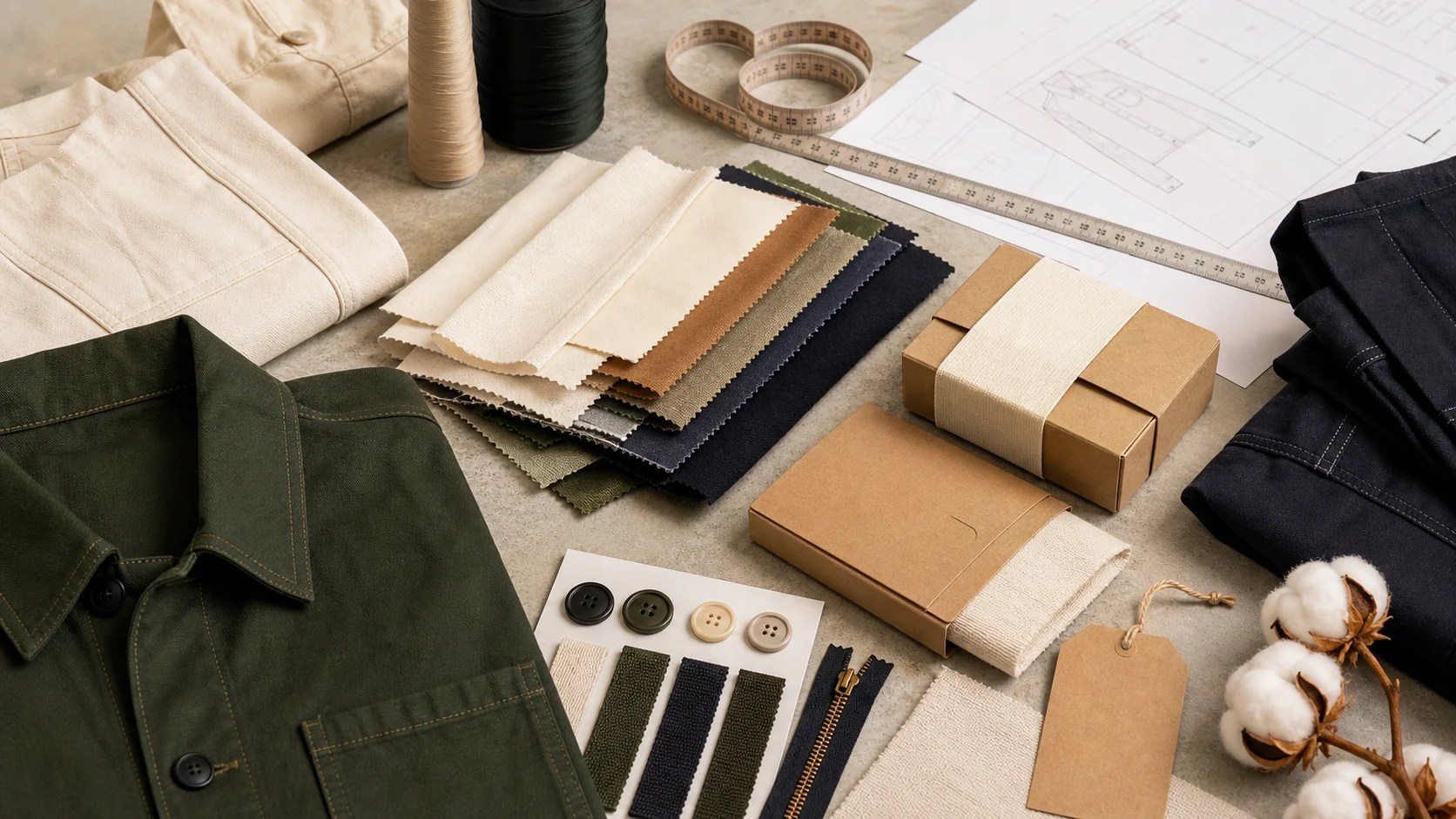
Recycled Cardboard Apparel Boxes with checks for samples, fit, MOQ, QC evidence, pricing terms, and delivery risk.
Fast answer: Recycled Cardboard Apparel Boxes: Board, Print, and MOQ should be judged by production evidence, not by a generic sourcing promise. The buyer needs sample proof, cost breakdowns, QC checkpoints, and delivery buffers in writing.
Ask for recent sample photos, measurement tolerances, fabric or print test assumptions, decoration test notes, packing examples, and a named inspection checkpoint. These details show whether the team can repeat an approved sample at bulk volume.
Separate garment cost, decoration, labels, packaging, sampling, testing, freight, and rush charges. When every cost line is visible, it becomes easier to reduce colorways, adjust size depth, or reserve more time for sampling.
A bad carton can turn a polished collection into damaged stock before the clothes even reach a customer. A recycled cardboard apparel box supplier sits inside the product, the freight plan, and the first impression.
For apparel brands, the wrong carton can create damage that travels all the way from the factory to the review section. A recycled cardboard apparel box supplier helps balance protection, presentation, and cost before the first shipment leaves. That balance is especially important when buyers are scaling from wholesale test runs to bulk production.
In Vietnam and Portugal factories, the gap between a good box and a bad one came down to small numbers: 1.8 mm board versus 2.5 mm board, water-based glue versus hot-melt with uneven set times, and print tolerances of 2 mm that looked fine on screen but sloppy on shelf. A box can protect a $28 T-shirt or embarrass a $180 knit set.
Mass-market brands take lighter board, simpler one-color prints, and 500-piece MOQs because they ship volume and chase cost. Premium brands in Japan, France, and the GCC want sharper corners, lower odor, and better ink coverage even on recycled stock. That gap matters. A $0.38 box can be fine in one market and a disaster in another.
Freight efficiency matters too. A fold-flat apparel carton that packs 20% more units per master case can save real money on ocean shipping and warehouse labor. One run in Turkey cut outer-carton volume by 14% after the box height dropped from 38 mm to 32 mm. Not branding. Logistics.
Recycled content, presentation, and unit cost rarely move together. Push for 100% recycled board, soft-touch lamination, foil, and a rigid setup, and the price climbs fast. Strip everything back, and the box stops feeling premium. Brands using private label clothing services often find packaging shows up in reviews faster than the garment spec sheet does.
Recycled board is not one material. It is a family of materials, and fiber origin changes everything. Post-consumer recycled content comes from used paper and packaging recovered after sale. Pre-consumer recycled content comes from manufacturing scrap before it reaches a consumer. Post-consumer board usually carries a duller gray cast and more fiber variation, while pre-consumer board can look cleaner and print more evenly.
A recycled cardboard apparel box supplier may work with a manufacturer, a converter, or a vertically integrated factory, and the upstream source affects consistency. Board in Guangdong, northern India, and Spain has carried the same recycled percentage and behaved very differently. One supplier used 350 GSM recycled chipboard with excellent stiffness and a smooth outer liner. Another used a cheaper mix that bowed after 48 hours in 70% humidity. The difference showed up in compression tests, not brochures.
According to FSC, ISO, and OEKO-TEX guidance, chain-of-custody and quality control are not decorative paperwork. They are the proof trail. I ask for recycled content declarations, pulp source documentation, moisture readings, and basis-weight charts. A supplier who cannot show lot-by-lot consistency is usually hiding an upstream sourcing problem.
Quality control starts before the die-cutter wakes up. Factory teams should test board calipers, surface smoothness, ink adhesion, and odor. Odor sounds minor until garments absorb it during a 25-day sea transit. I have rejected boxes with a chemical smell strong enough to linger on cotton jersey after 72 hours in a warehouse.
Regional sourcing changes lead times and certifications. European mills often offer tighter documentation and faster FSC paperwork, but their board can cost 12% to 18% more than comparable Asian supply. South Asian mills may hit lower unit prices, yet a missing moisture report can slow approval by 1 to 2 weeks. If your team also needs cut and sew manufacturing, line up packaging sourcing with garment production so both hit the same shipment window.
Price bands change more than buyers expect. For standard recycled apparel mailers, offshore factory quotes land around $0.22 to $0.45 per unit at 5,000 pieces, then rise to $0.55 to $0.95 at 1,000 pieces. Regional suppliers in Europe or North America often sit at $0.65 to $1.40 depending on board grade, but they can cut air freight, reduce damage, and speed revisions. The cheapest quote on paper is not always the cheapest on the invoice.
A recycled cardboard apparel box supplier working at wholesale or custom volume will often adjust pricing around board grade, finishing, and regional production capacity. MOQ traps packaging budgets. A factory may offer 3,000 pieces for a basic fold-flat carton, then add embossing and foil and the true minimum jumps to 5,000 or 10,000 because of plate setup. Tooling fees usually run $120 to $450 for a simple die, and special window cuts can add another $80 to $200. Small numbers. Then three revisions and a second sample run show up.
Lead time is not just production time. It includes artwork approval, plate making, board procurement, and correction cycles. Sample turnaround can be 5 to 10 days. Production may take 3 to 4 weeks. Ocean freight adds 18 to 35 days, while regional trucking may take 2 to 7 days. Landed cost shifts hard when carton volume, pallet count, and import duty enter the math.
The lowest quote often brings the highest reject rate. On one factory visit in Ho Chi Minh City, a supplier priced 11% below competitors but scrapped 8% of cartons for color drift and glue failure. A nearby regional plant was $0.07 higher per box yet corrected artwork in 48 hours and held reject rates under 1.5%. Cheap boxes can turn expensive fast when the first 2,000 units are unusable.
Special finishes change the math. Soft-touch coating adds $0.08 to $0.16. Foil stamping can add $0.12 to $0.30. Inserts add $0.05 to $0.25 depending on board weight. A window cut may look premium, but it weakens compression and can push breakage higher during export. Price the full spec, not the fantasy version. If speed matters, you can get a free quote and compare material, tooling, and freight line by line.
Structure should follow product type, not habit. Mailer boxes work well for shirts, socks, and accessories because they survive parcel handling and stack cleanly at 20 to 24 units per outer carton. Rigid lids suit luxury sets and gifting, though they raise freight cost quickly. Fold-flat cartons are efficient for denim and knitwear. Sleeve packs fit visual merchandising, but they offer less crush resistance than a proper hinged box.
For e-commerce shipping, I ask for a box that resists 25 to 35 kg compression in warehouse stacking and survives a 1-meter drop in transit. That does not mean the carton must be overbuilt. It means the board caliper, glue line, and score depth need to work together. A 320 GSM French terry hoodie does not need the same packaging as a cashmere cardigan, but both need corners that stay square after handling.
Print finish is where recycled substrates either shine or look cheap. Uncoated kraft, soy inks, and restrained two-color graphics usually age better than bright flood coats on rough board. Muted tones hide fiber speckle. Heavy solids do not. I prefer black, deep green, warm gray, or one accent color over full coverage if the board is visibly recycled. Keep the print honest. Recycled should not pretend to be virgin bleached stock.
Size optimization matters more than most brands admit. Reducing void fill by 15% can cut freight waste and make the unboxing feel intentional rather than stuffed. Ask for technical drawings, board calipers in millimeters, and load-test data before approving art. If the supplier cannot share a flat dieline, a folding sequence, and a simple compression spec, the box is still a prototype, not a production item. I also ask suppliers to send a sample pack from their catalog range so I can compare finishes side by side.
Documents come first. I want ISO certificates, FSC chain-of-custody proof, recycled content declarations, and lab test reports for compression, moisture, and ink rub. If a supplier hedges on document dates, that is a warning. Certifications older than 12 months without renewal records deserve scrutiny. A clean PDF is not enough; the paperwork must match the production line.
On the factory floor, I look at storage humidity, stack height, and finishing rooms. Board stored at 65% to 75% humidity can curl before cutting. Glue stations should be tidy, not dripping. Cartons should stack evenly on pallets of 80 to 120 units without edge crush. I also watch for print mismatch between the proof and the final sheet, because that is where brand damage starts.
Labor and waste questions matter as much as quality. Ask how adhesive waste is handled, whether trimming scrap is reused, and what the plant does with rejected sheets. Ask about shift length, protective equipment, and energy use. A supplier that burns through power and hides scrap is rarely disciplined on the parts you cannot see. Short audits prevent long reputational problems.
If you are sourcing from China, ask whether the factory or trading company manages production directly and how many lines are dedicated to packaging versus other items. A clear answer is a good sign. A vague one usually means the supplier is coordinating multiple subcontractors and losing control of quality and timing.
Start with a precise brief. List dimensions in millimeters, target recycled content, finish, print colors, delivery terms, and required test standards. Include whether the box ships flat or assembled, whether it holds one garment or a full set, and whether the outer shipper is part of the quote. A vague RFP invites vague pricing.
Then compare samples on the same table. Measure board thickness, corner crush, print alignment, and odor. Run a pilot order of 300 to 1,000 units before scaling to 5,000 or 20,000. Test boxes through transit, warehouse stacking, and a 48-hour humidity check before full approval. You can get a free quote once the sample spec is locked.
Quotes should be compared like-for-like: same board grade, same recycled claim, same coating, same insert, same freight term, same delivery window. Build a scorecard with four columns: quality, sustainability, responsiveness, and landed cost. Weight them according to your channel. A wholesale brand may care more about cost and pallet density; a luxury label may care more about finish and box feel. Brands have saved 9% simply by changing the spec before negotiating price.
For additional market benchmarks, check the U.S. International Trade Administration for importing basics and supplier due diligence. For sustainability standards, Textile Exchange also publishes useful material guidance at Textile Exchange.
Start with proof, not promises. Ask for recycled content declarations, FSC chain-of-custody, compression test results, and a sample made on the same board grade you plan to order. In my audits, suppliers that can document all four usually deliver more consistent runs.
For standard apparel mailers, I usually see $0.22 to $0.45 at 5,000 pieces and $0.55 to $0.95 at 1,000 pieces. Premium finishes like foil, embossing, or soft-touch coating can add $0.08 to $0.30 per unit. Freight, tooling, and duty can add another 10% to 35% to landed cost.
Samples usually take 5 to 10 days. Production often takes 3 to 4 weeks, then shipping adds 2 to 35 days depending on trucking or ocean freight. Custom artwork revisions can extend the timeline by 1 to 2 weeks if plates or dies need to be remade.
Yes, most can. Ask for a dieline, board caliper in millimeters, and a print proof before approval. Keep the design efficient: two to three ink colors, one coating at most, and a size that fits your garment without 15% or more unnecessary void space.
Ask about recycled fiber source, minimum order quantity, tooling fees, compression strength, odor control, and rejection rate. Also ask for labor, waste, and energy practices. A factory that answers clearly before the order usually performs better after the deposit clears.