
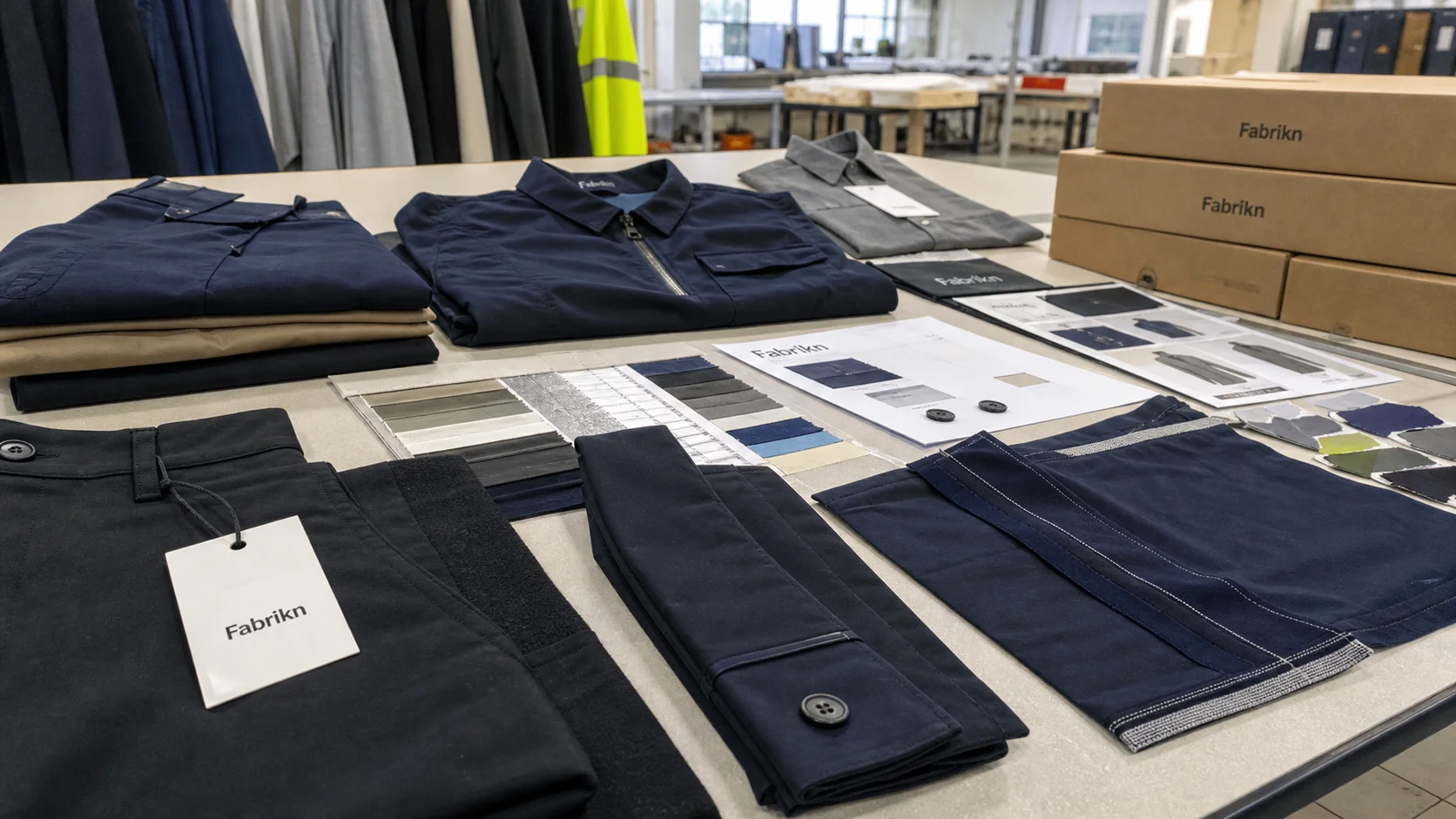
Recycled Cardboard Apparel Boxes with checks for samples, fit, MOQ, QC evidence, pricing terms, and delivery risk.
Fast answer: Recycled Cardboard Apparel Boxes: Board Grade, Inserts, Print, and Freight should be judged by production evidence, not by a generic sourcing promise. The buyer needs sample proof, cost breakdowns, QC checkpoints, and delivery buffers in writing.
Ask for recent sample photos, measurement tolerances, fabric or print test assumptions, decoration test notes, packing examples, and a named inspection checkpoint. These details show whether the team can repeat an approved sample at bulk volume.
Separate garment cost, decoration, labels, packaging, sampling, testing, freight, and rush charges. When every cost line is visible, it becomes easier to reduce colorways, adjust size depth, or reserve more time for sampling.
Packaging failures can quietly erase 2-4% of a seasonal launch budget through returns, rework, and damaged goods. I’ve seen that cost hide in plain sight, especially when a brand treats a recycled cardboard apparel boxes supplier as a last-week afterthought instead of a margin decision. A $1.20 box can create $6.00 in damage if it crushes in transit, scuffs a satin shirt, or forces a re-pack at the warehouse.
When I visited factories in Vietnam, Poland, and Mexico, the contrast was stark. One plant quoted $0.38 per folding carton at 10,000 units, but its warp rate hit 7%. Another charged $0.52 and held defects below 1.5%. The second supplier looked expensive on paper. On landed cost, it was cheaper, because fewer boxes were scrapped, fewer cartons were reworked, and freight density improved by 8-12% thanks to flatter nesting.
Recycled board content matters, but so does how the box is built. A 350 GSM recycled kraft mailer with a simple tuck lock can ship more efficiently than a thick rigid box wrapped in laminated art paper. Print method matters too. Offset printing often gives cleaner solids on premium apparel boxes, while flexo can cut cost for high-volume mailers by 10-18%. Warehouse handling changes with structure as well. A rigid lid-and-base box may look luxurious, yet it takes more cube per pallet and more labor per pack.
Premium apparel brands and discount retailers are buying different outcomes, not just different boxes. Luxury labels want shelf impact, tactile weight, and resale value. Discount chains want fast filling, low cube, and damage resistance. I’ve watched both groups overpay for the wrong spec. A brand selling a $220 wool coat can justify a rigid drawer box with magnetic closure and foil stamp. A retailer moving $18 tees should not. That kind of mismatch burns cash.
There is another layer. Apparel boxes influence unboxing, resale value, and trust. On resale platforms, a clean original box can lift perceived value by 5-15% for sneakers, handbags, and limited-run streetwear. That is not marketing fluff; it is a practical signal that the garment was stored and shipped well. Buyers notice clean edges, tight corners, and consistent print registration. They also notice sloppy glue lines. The box tells the truth before the product does.
In premium programs, I see 2 mm grayboard, 157 GSM art paper wraps, and embossing used with restraint. In discount programs, I see 300-350 GSM folding cartons, 1-color print, and minimal finishing. Both can be right. The mistake is applying luxury specs to a replenishment program or, worse, cutting too far and creating returns. I’ve watched a brand save $0.09 per unit on board and lose $1.40 per unit in damage claims. That is not efficiency.
For brands that also handle apparel production, box specs should align with the garment. Heavy French terry at 320 GSM needs firmer support than a featherweight viscose blouse. If you source both product and packaging, ask how the carton will interact with folding, polybagging, and SKU mix. My experience working with a brand that used private label clothing services taught me that packaging decisions made after production planning always cost more.
A recycled cardboard apparel boxes supplier does far more than print and ship cartons. The real job starts with paper sourcing, board selection, converting, die-cutting, printing, finishing, carton packing, and export preparation. The best factories also manage proofing, compression testing, and pallet design. The weakest ones just pass along a spec sheet and hope the shipment survives 3,000 kilometers of handling.
Board type drives performance. Recycled kraft is common for mailers and folding cartons because it is cost-effective and strong. Greyboard, usually made from compressed recycled pulp, is the backbone of rigid apparel boxes. SBS liners are useful when a brand needs brighter print surfaces, even if the core includes recycled content. Corrugated inserts add structure for folded knits, socks, or gift sets. I’ve seen 1.5 mm greyboard outperform thicker-looking but poorly glued alternatives.
Recycled content is measured differently across factories. Some report fiber composition by weight, others by finished board content, and a few blur the difference entirely. That matters. 100% recycled is not always the best fit if the box needs sharp creasing or high-end print fidelity. In many cases, 70-85% recycled content performs better because it balances stiffness, surface smoothness, and tear resistance. According to ISO standards on environmental claims, wording must be specific enough to avoid misleading buyers.
Box style should match the merchandise, not the mood board. Shirts often ship well in folding cartons or mailer boxes sized around 11 x 14 x 2 inches. Lingerie benefits from slim drawer boxes with lighter board and cleaner print. Knitwear needs more crush resistance, usually a mailer or rigid box with a corrugated insert. Luxury goods can justify rigid apparel boxes with magnetic closures, but the upgrade should be deliberate, not decorative noise.
In cut and sew programs, packaging often follows the same logic as the garment line. If you already coordinate fabric, trim, and labeling through cut and sew manufacturing, the box should sit in the same planning cycle. It is cheaper to align dimensions before production than to compress a finished sweater into a box that was clearly designed for a T-shirt.
Unit price means very little until freight, duty, waste, and delay are added. I’ve seen brands celebrate a $0.29 box from Asia and discover the landed cost was $0.61 after ocean freight, inland trucking, customs handling, and repacking. The same box made closer to market might quote $0.47, yet land at $0.53 because the supply chain is shorter and defect rates are lower. That gap is where many sourcing teams lose discipline.
At 1,000 units, small orders are often 20-40% more expensive per unit because setup fees and board waste get spread across fewer boxes. At 5,000 units, the curve starts to flatten. By 10,000 units, print plates, die cuts, and finishing setups are easier to absorb. At 50,000 units, pricing usually tightens again, but only if the supplier can run efficiently and maintain consistent board supply.
Here is a practical range I have seen across factory visits, assuming a standard apparel box, 1-2 color print, and no special hardware:
These ranges shift fast if you add foil stamping, soft-touch lamination, magnetic closures, or interior inserts. A rigid box with foil can add $0.18-0.65 per unit, and soft-touch lamination can add another $0.06-0.14. Box size matters too. A larger footprint raises board use by 12-25% and often increases export cube. For brands shipping seasonally, that can mean more pallets, more warehouse labor, and more breakage risk.
Region also affects timing. Asia may need 25-45 days for production plus 18-32 days for shipping. Eastern Europe may ship in 12-20 days within nearby markets. North America can turn simple folding cartons in 7-15 days, but board costs are usually higher. If you need pricing discipline and steady ordering, it helps to get a free quote with exact dimensions, finish, and destination port so the supplier can compare true landed cost, not just factory pricing.
MOQ is not just a number. It shapes waste. A supplier offering MOQ 500 pieces may seem flexible, but the quote often includes higher tooling recovery, slower press time, or excess board trim. At MOQ 5,000 or 10,000, the factory can plan imposition better and reduce waste by 3-8%. Tooling also matters. A custom die can cost $120-450, and complex magnetic structures can add $80-200 in setup before the first box is made.
I pay attention to export packaging as much as the box itself. A supplier that packs 200 cartons per master carton may save space, but if compression damage appears on arrival, the savings vanish. The best factories send sample master cartons, pallet diagrams, and gross weight data before production begins. If the supplier cannot tell you how many boxes fit in a 40HQ container, the quote is incomplete.
I start with documents, then I touch the sample. Ask for FSC chain-of-custody where relevant, recycled content declarations, ISO 9001 for process control, and any print-safety or migration reports needed for your market. For some retail channels, especially gift and intimate apparel, you may also need ink compliance or odor testing. Data from WRAP is useful for buyers who need to check social compliance claims alongside packaging records.
A good factory profile should include monthly capacity, machine list, in-house versus outsourced finishing, and defect rate over the last 3 months. I want to know if die-cutting happens on-site or at a subcontractor, because handoffs create delays and quality drift. Ask what percentage of output is inspected at final QC. If the answer is vague, treat it as a warning sign.
Samples can lie. A sample box is often heavier, more carefully glued, and better printed than production will be. I check for warp by leaving samples stacked for 48 hours in a warm room. I test glue failure at the flaps, feel for sharp edges, and look for color drift across panels. Compression strength matters too. A box that collapses under 6-8 kg of stacking pressure may be fine for retail display but not for export cartons.
Misleading recycled claims are common. “Recycled content” without chain-of-custody proof is marketing, not evidence. So is a spec sheet that lists 100% recycled board but uses virgin-coated liners in production. I have seen that happen in more than one factory. The paperwork looked clean. The boxes did not. Good suppliers welcome scrutiny. Bad suppliers hope you will not notice the difference between a sample run and a 20,000-unit order.
Lead times vary by box type and by how disciplined the plant is. Folding cartons usually need 7-14 days for samples and 15-25 days for production. Mailer boxes often run 10-18 days for samples and 20-30 days for production. Rigid apparel boxes are slower: 12-20 days for samples and 25-45 days for production, especially if magnets, ribbons, or foil are involved. Those numbers can shift by 1-2 weeks if artwork approval drags.
Rush orders tend to add 10-25% to cost because the factory compresses drying, finishing, and packing windows. That compression raises error rates. Gluing becomes uneven. Lamination bubbles appear. Registration slips. A plant that quotes faster is not always better. I’ve visited slower factories with tighter process control that delivered on time more often than high-speed plants that kept missing vessel cutoffs. Proximity to inland freight, plate-making speed, and warehouse loading capacity can matter as much as line speed.
The plant that schedules conservatively often beats the faster one on actual delivery. I have seen a 28-day factory beat a 16-day factory because the slower supplier owned its drying time, checked cartons in batches of 200, and loaded pallets before the truck arrived. Speed without control is just expensive chaos.
The greenest box is the one the recycler can actually process. Water-based inks are easier on recovery streams than heavy UV coatings. Minimal lamination helps too. Removable labels, paper-based seals, and simple die-cuts usually outperform mixed-material builds. According to Textile Exchange, brands that align material choices with verified sustainability standards can reduce confusion in supplier audits. I would rather see one good print pass than three decorative layers that complicate recovery.
Structural design can save 8-15% of board use without making a box look cheap. A tighter wrap allowance, smaller lip depth, and better fold geometry can reduce waste while keeping crush strength intact. I have seen a 2 mm reduction in wall depth save 6 tons of board across a 100,000-unit program. That is real material, not brochure language.
Premium brands often lean on embossing, spot UV, and soft-touch lamination. Those details can feel expensive because they are. They also make recycling harder when overused. Mass-market boxes usually do better with 1-color print, paper seals, and crisp structure. Sustainability claims are strongest when the box is mono-material, clearly labeled, and easy to flatten. They become marketing noise when a supplier adds recycled board but wraps it in plastic film and calls it responsible.
Start with a clean brief. Send dimensions, board preference, recycled-content target, finish, closure type, annual volume, and destination port. Add artwork files, carton count per master case, and whether the boxes must survive long-haul export or domestic fulfillment. If you want a faster response, include your target landed cost and timeline. You can also browse our apparel packaging product catalog to compare box styles before sending an RFP, which helps a recycled cardboard apparel boxes supplier quote the right construction instead of guessing.
Then score each recycled cardboard apparel boxes supplier on five things: price, quality, sustainability proof, communication speed, and repeat-order capacity. Price matters less than repeatability. A supplier that delivers 98% on-time on the first order and 96% on the second is more valuable than one that underquotes by 12% and misses every deadline. I would rather have clean, boring consistency than dramatic savings that collapse on production week.
I recommend a pilot run of 500-2,000 units before scaling. That is enough to test print, assembly, palletization, and shipping performance without tying up too much cash. Review the first samples against production cartons, not against the mood board. Track assembly time per carton, damage on arrival, and dimensional variance. If the supplier cannot hold tolerances within 1-2 mm, larger orders will only magnify the problem.
Place the pilot, inspect the results, then renegotiate based on actual defect data. That is how I have seen brands protect margin and avoid expensive surprises. If the recycled cardboard apparel boxes supplier survives the pilot with low waste and clean communication, you have something worth scaling. If not, move on quickly. Bad packaging partners cost more than bad quotes.
A recycled cardboard apparel boxes supplier sources board, converts it into boxes, prints and finishes the cartons, and packs them for shipping. Good suppliers also handle die-cutting, QC, palletization, and export documentation. Many buyers only see the unit price, but the real value sits in process control and defect prevention.
For standard apparel boxes, I see roughly $0.45-0.85 at 1,000 units, $0.24-0.48 at 5,000, $0.18-0.36 at 10,000, and $0.12-0.28 at 50,000 in lower-cost regions. North America and Eastern Europe often run higher, especially with rigid construction or premium finishing. Freight, tooling, and waste can shift landed cost by 15-35%.
Folding cartons usually take 15-25 days in production after sample approval. Mailer boxes often need 20-30 days, and rigid apparel boxes can take 25-45 days. Add 7-20 days for sampling and artwork approval, then factor shipping time based on region.
Ask for recycled content declarations, FSC chain-of-custody where relevant, and a factory profile that identifies the board mill or paper source. Check whether the percentage refers to fiber content by weight or finished board content. If the supplier cannot explain the method in writing, treat the claim cautiously.
Yes, but the spec has to match the brand position. Luxury programs often use 1.5-2 mm greyboard, 157 GSM wraps, foil, or embossing, while still keeping recycled content in the core. The box should feel premium without relying on excessive lamination or mixed materials that complicate recycling.