
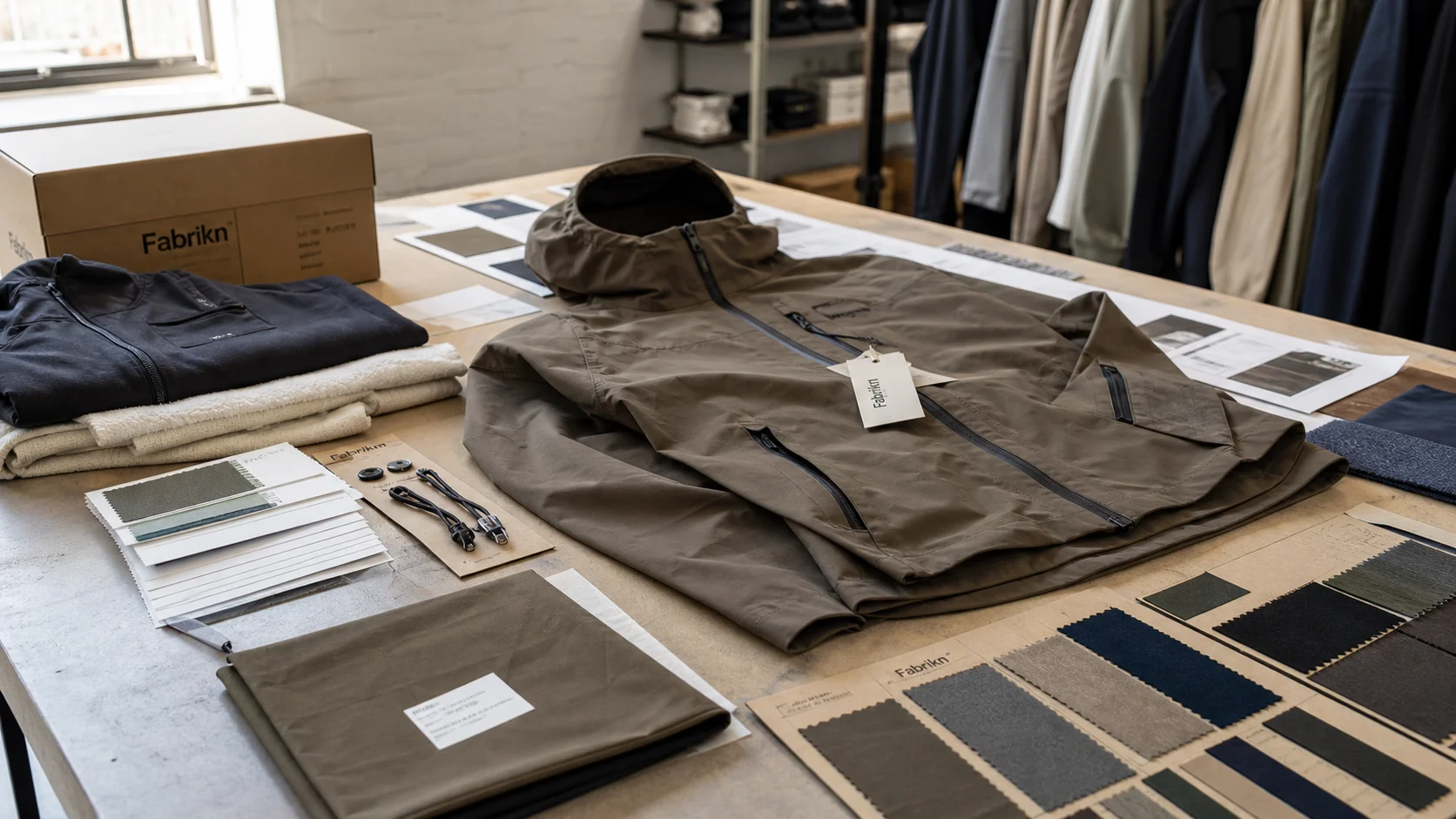
Information Goes on Clothing Care Labels compared by sample evidence, fabric or trim specs, MOQ, AQL terms, cost lines, delivery timing, and rework...
Fast answer: Information Goes on Clothing Care Labels: Spec Files, Packing Method, and Landed Cost should be judged by production evidence, not by a generic sourcing promise. The buyer needs sample proof, cost breakdowns, QC checkpoints, and delivery buffers in writing.
Ask for recent sample photos, measurement tolerances, fabric or print test assumptions, decoration test notes, packing examples, and a named inspection checkpoint. These details show whether the team can repeat an approved sample at bulk volume.
Separate garment cost, decoration, labels, packaging, sampling, testing, freight, and rush charges. Clear cost lines make it easier to reduce colorways, adjust size depth, or reserve more time for sampling.
A two-cent label mistake can turn into a return-rate headache before the carton even cools. In one export factory, the labels were printed cleanly, stitched straight, and packed by the thousand, yet half of them landed on the wrong size run. In another, a washing icon approved for a cotton tee went onto a rayon blend that twisted after the first cold wash. Finished? Not even close.
That split between “looks right” and “is right” is exactly why what information goes on clothing care labels matters so much. For a manufacturer, factory, or supplier, the label is not decoration. It sits inside product performance, consumer trust, and—across many markets—legal compliance. Whether you are handling production for custom wholesale bulk orders from China or a smaller local run, basics and activewear make the risk obvious fast: shrinkage can hit 3-8%, color bleed can trigger complaints within seven days, and the label becomes a control document, not an afterthought.
Premium brands miss it too. Their labels usually carry more detail, often 5-7 lines of text instead of 2-3, plus fiber percentages, country of origin, and importer details. Still, failures keep showing up when design teams work from one spec sheet and production teams work from another. The buyer thinks the final approved file is in circulation. The factory is sewing from an older version. Seasonal drops have died on that mismatch.
High-return categories expose the issue quickly. A 100% cotton French terry 320 GSM hoodie can tolerate one kind of wash language. A 92/8 poly-elastane legging needs another. On paper, a label error that costs $0.02 per unit on 10,000 units looks tiny. In stores, that same error turns into markdowns, reverse logistics, and returns that wipe out 10-15 points of margin. I have seen it in the US, the UK, and Vietnam.
According to ASTM, consistent testing methods matter because consumer care and material behavior are tied to measurable standards, not guesswork. Brands trip here when they treat labels as late-stage artwork. The label is made last, sure. Approved first, though.
Simple, yes. Optional, no. What information goes on clothing care labels usually comes down to five essentials: fiber composition, care instructions, size, country of origin, and the brand or manufacturer name. In some markets, an RN or registration number shows up too. Children’s wear, lingerie, performance garments, and coated outerwear often add warnings or stricter handling language.
Fiber content is the first checkpoint. A 60/40 cotton-poly label must match the tested composition, not the intended recipe from the sourcing sheet. Mills often aim for 60/40 in development, then land at 57/43 after dyeing and finishing because shrinkage and chemicals shift the result. Three points. That small swing still separates accurate labeling from an avoidable dispute.
Care instructions need symbols and words in many cases. Symbols help cross-language readability, especially in wholesale programs sold across four or five countries, but plain-language support still matters. “Machine wash cold” is not “hand wash only.” “Do not bleach” is not “use only non-chlorine bleach when needed.” Precision protects the garment and the brand.
Country of origin and brand identification are not filler. They tell customs, retailers, and regulators who made the product and where. In the US, the FTC expects care labeling principles to be clear and permanent. In the EU, the pressure often sits more on fiber composition and origin disclosure, with local enforcement differences. Australia and the UK bring their own practical expectations around permanence and readability.
Product type changes the rule set. A baby bodysuit may need warnings about loose components and flame-resistance claims if applicable. A lingerie item can require extra caution around delicates and heat. Outerwear with PU coatings, bonded seams, or leather trims may need instructions that differ from the base fabric. If the garment contains 20% recycled fiber, the claim must be supported by the actual content, not a marketing preference. That is where private label clothing teams get caught when the label process gets rushed.
OEKO-TEX data shows how much buyers now care about material transparency and product traceability. The care label sits inside that conversation too, because it is often the first piece of product data a consumer actually reads.
One template rarely works everywhere. The US leans on FTC care labeling principles and clear consumer guidance. The EU and UK both place heavy weight on fiber composition, origin, and language accessibility, but the enforcement style differs, and so does tolerance for shorthand. A label acceptable in California can still get rejected by a buyer in Germany or a retailer in the UK.
Europe brings the most friction. I have watched labels approved in English only get rejected because the carton was headed to France, Italy, and Spain, where local language expectations were built into the retailer spec. That one oversight can force a reprint of 8,000 labels, add 2-3 weeks to shipment, and kick off a scramble across packaging, hangtags, and carton markings. Same garment. Different paperwork.
Here’s what most people miss: a label approved for one buyer can fail for another even when the fabric, size, and construction are identical. Often, the difference is not the garment at all. It is font size, permanence, symbol usage, or the way country of origin is written. “Made in China” has passed one retail program and needed a revised origin statement in another because the importer wanted a more specific format and a larger minimum type size.
Regional detail lives in the small things. Some buyers require a minimum 6-point type size. Others insist on 8-point for multilingual copy. Some want woven labels stitched into the side seam. Others accept printed satin labels or heat transfers only if durability testing shows 20-30 wash cycles. A label designed for one market can fail on thread density alone.
For brands selling into several regions, the cheapest path is usually not one global label, but 2-4 market-specific versions built from one master content file. Less rework. Fewer customs delays. No expensive pile of 15,000 labels that only work for a single destination. In cut and sew manufacturing, that planning can save both lead time and scrap.
Permanent labels and temporary materials do different jobs. Sewn-in care labels carry the legal and performance information that should stay with the garment for its usable life. Hangtags are for marketing claims, story, price, barcode, SKU, and a quick brand pitch. Polybags and cartons carry shipping marks, carton counts, destination data, and sometimes handling warnings. QR codes can point to a fuller digital page, but they should not replace required permanent information where markets expect it.
Brands get sloppy at the line between compliance and marketing. A swing tag can say “organic cotton,” “pre-shrunk,” or “responsibly made,” but if the care label omits the fiber composition or gets the washing method wrong, the garment still fails review. I have seen teams push too much detail onto the hangtag because they wanted a cleaner neckline. Bad trade. Retailers often treat the swing tag as removable and the permanent label as the only legally stable source.
Fast-fashion programs often compress information into tiny permanent tags, sometimes 1.5 cm wide and stitched into seams with barely readable type. Luxury brands usually prefer cleaner layouts, 2-3 separate labels, and a stronger supporting role for hangtags and boxes. Neither strategy is automatically better. The real question is whether the buyer, the factory, and the market agree on where each line of information belongs.
I map it this way in production files:
That structure works especially well for accessories too. For custom hat manufacturing, for instance, a sewn-in label may be tiny, but the hangtag can carry the care narrative and origin story without crowding the product. Same split, cleaner approvals, faster handoffs.
Labels should follow fabric testing, not guesses from the sourcing sheet. A yarn-dyed cotton poplin behaves differently from a pigment-printed jersey. A bonded seam does not respond like a plain seam. A recycled polyester blend may pass performance tests, but print and heat-transfer finishes can still crack after 10 washes if the care advice is too aggressive.
The basic symbol set is familiar: machine wash, hand wash, no bleach, tumble dry low, dry flat, line dry, warm iron, low iron, and dry clean only. Useful icons, but only if the garment actually survives the treatment. I have seen “machine wash cold” on fabric with embroidered panels, where the stitching puckered after the first spin cycle. Readable? Sure. Correct? Not at all.
Special warnings matter for embellishments, coatings, and performance finishes. Embroidery, foil prints, beading, PU coatings, bonded seams, and leather trims all alter wash behavior. If a garment includes a 320 GSM French terry body with a coated patch, the body may tolerate normal washing while the patch should be spot-cleaned or kept away from heat. That split reality needs clear wording. “Care with caution” tells the customer nothing.
The best labels are specific enough to protect the garment, not so broad that they become decoration. If dry flat is required, say it. If steam will damage a print, say no steam. If the piece should be washed inside out, that instruction can reduce abrasion by a measurable amount, especially on darker shades and plastisol prints. One wording change cut complaint volume from 14% to 6% on a knit program.
The thing nobody tells you: a stronger care label can be more valuable than a prettier one. When a factory has to choose, accuracy beats design every time.
Budget, mid-market, and premium lines all need the same core facts, but they package them differently. A budget tee may use a single printed satin label with three care lines and minimal branding. A mid-market sweater often adds fiber percentages, a country statement, and a more durable woven label. Premium product usually spreads the information across a cleaner neck label, a separate care tab, and a hangtag with extra storytelling.
Here is a practical cost outline I use when reviewing programs:
Turnaround changes with complexity. A basic label can be approved in 2-5 days if the fiber data is already tested and the artwork is final. A multi-market luxury program can take 2-4 weeks because you are managing translations, legal review, supplier proofs, and size mapping across 3 or 4 destinations. If the brand changes the fabric midway, the label work restarts. That is where schedules break.
Counterintuitively, higher-priced labels are not always more accurate. I have visited fast-turn factories in Bangladesh and Portugal that ran stricter checks than some premium programs because the cost of rejection was too high to tolerate sloppiness. They verified label counts, placement, and size pairing at 100% inspection, while some luxury runs relied on visual approval only. Price does not guarantee discipline. Process does.
For brands working on custom baby clothing manufacturing, the stakes rise again. Babywear often needs softer label materials, tighter safety checks, and clearer fiber claims, especially where skin sensitivity, choking risk, or flame-resistance rules are in play. A few extra cents can prevent a costly rejection.
The cleanest workflows start before the first strike-off. Step one is fabric testing. Step two is care testing. Step three is legal review. Only then should artwork move to production. I have seen brands do this backward, approving a label layout before the fabric was even sourced. That mistake is expensive, and it is avoidable.
Here is the sequence I recommend for every collection:
One master spec should control the process. One approved artwork file. One revision log. One factory confirmation before the bulk cut. If those four things are not aligned, someone will print the wrong version. I have seen a brand lose six weeks because the factory changed the fabric from 100% cotton jersey to a cotton-modal blend after labels had already been printed at 40,000 pieces.
That is the most expensive mistake in this area: changing the fabric after the label is approved. Sounds minor. It isn’t. The new material can require different washing, different warnings, and sometimes different composition wording. Brands that build a market-by-market template early usually move faster by week 3 or 4 because they are not reworking every SKU from scratch.
Good execution is boring. That is a compliment. It means the label checklist caught the errors before production. It means the artwork file matched the spec. It means the factory, not just the design team, confirmed the final print proof. That is how you keep compliance from becoming a fire drill.
Most apparel labels include fiber composition, care instructions, size, country of origin, and the brand or manufacturer name. In many programs, a registration number or importer detail is added too. Children’s wear, lingerie, outerwear, and performance items may need extra warnings or more specific handling text.
The US focuses on clear, permanent care guidance under FTC principles, while the EU places heavier emphasis on fiber composition, origin, and local language expectations. A label that works in one country can still fail in another because of font size, translation, or permanence rules. Brands selling into both regions often need 2-4 label versions.
Costs vary by construction and volume. A standard woven label often runs about $0.03-0.08 per piece, while a printed satin label may be $0.02-0.05. Multilingual woven labels and custom inserts can push that to $0.12-0.15, especially on smaller orders under 3,000 units.
A simple compliance label can be approved in 2-5 days if the testing data is ready. More complex programs with translations, retailer review, and multiple markets often take 2-4 weeks. If fabric, trims, or wash performance change after approval, the timeline resets.
Usually no. Hangtags can carry marketing claims, QR codes, pricing, and product stories, but permanent legal and care information generally belongs on a sewn-in label. Some markets and retailers accept digital support, yet the garment still needs a durable physical label with the key facts attached.