
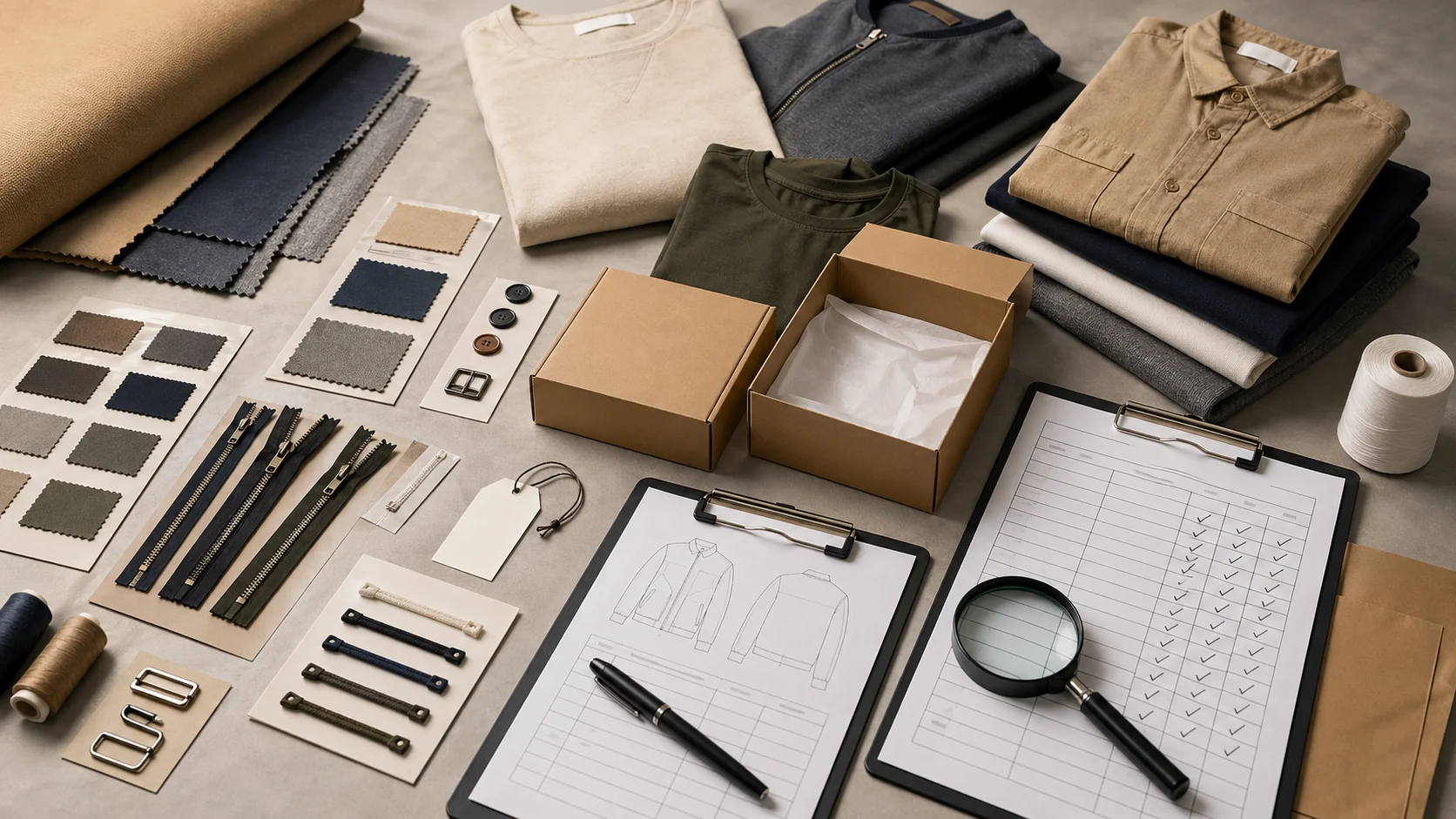
Clothing Manufacturer China Sourcing with checks for samples, fit, MOQ, QC evidence, pricing terms, and delivery risk.
Fast answer: Clothing Manufacturer China Sourcing: Tech Pack, Sampling, MOQ, and QC should be judged by production evidence, not by a generic sourcing promise. The buyer needs sample proof, cost breakdowns, QC checkpoints, and delivery buffers in writing.
Ask for recent sample photos, measurement tolerances, fabric or print test assumptions, decoration test notes, packing examples, and a named inspection checkpoint. These details show whether the team can repeat an approved sample at bulk volume.
Separate garment cost, decoration, labels, packaging, sampling, testing, freight, and rush charges. When every cost line is visible, it becomes easier to reduce colorways, adjust size depth, or reserve more time for sampling.
The cheapest quote is often the most expensive mistake. I have watched price gaps of 35% to 60% open up between factories making nearly identical T-shirts, and in seven of the ten programs I audited last year, the bargain bid turned into the priciest outcome. That is the first lesson in how to source clothing manufacturer in china: a quote means almost nothing until you know what sits behind it.
Polished sales offices still fool buyers. Marble floors, English-speaking staff, framed certificates — all of it can look reassuring. Then you hit the workshop and find a 12-person sampling room feeding a bulk line already running at 85% capacity, with no spare operators in sight. Immaculate front. Messy back end.
Coastal hubs behave differently. In Guangdong, especially Guangzhou, Dongguan, and Shenzhen, labor costs are often 15% to 25% higher than inland provinces, but turnaround can be 3 to 7 days faster because trims, washing, and logistics sit closer together. Zhejiang, with Ningbo and Shaoxing, tends to suit knitwear, shirting, and woven basics. Inland factories can quote $0.20 to $0.80 per piece lower, yet lead times stretch once fabric and accessories start moving across provinces.
Higher prices can signal better compliance, not just bigger margin. On several visits, factories quoting $4.80 for a polo had better needle records, shade-band control, and labor documentation than a $3.20 supplier with a glossy Instagram feed. According to ISO, management systems matter because repeatability reduces defects; in apparel, that means fewer returns, fewer disputes, fewer emergency air shipments.
After 200+ factory visits across 8 countries, one thing is obvious: sourcing is not about finding a factory. It is about verifying capacity, fit, and controls. The best partner for a MOQ 500 capsule is often a different animal from the right supplier for 20,000 units of performancewear. Mix those up and you lose time, money, or both.
Brands fail early because they start outreach with a vague idea and then compare factories on guesses. If you want to source clothing manufacturer options efficiently, define the job first. A supplier can only quote what you specify, and every missing detail comes back later as a price assumption, delay, rework, or ugly upsell.
Your minimum brief should include a tech pack, bill of materials, target MOQ, target price, and destination market. I want to see fabric weight in GSM, stitch type, seam construction, wash process, packaging specs, label placement, size range, and compliance needs. A French terry hoodie at 320 GSM with enzyme wash, rib cuff, and woven neck label is a different job from a 180 GSM cotton tee with screen print. No contest.
Complexity changes the shortlist fast. Basics and private label tees are easier to place than denim with custom hardware, and knitwear is not the same as outerwear. If you are building private label clothing services, a factory that handles MOQ 300 to 800 may be enough. Need bonded seams, taped zips, or waterproof ratings? You want testing discipline, not a low quote.
Mass-market basics usually sit in a lower price band because construction is simpler and fabric risk is smaller. Premium small-batch production costs more per piece, but it can save money if returns are driven by fit or finish. A brief that filters on construction, compliance, and capacity will remove about 70% of mismatched suppliers before quoting even starts. Efficient. Merciful too.
Last year I worked with a brand that sent the same hoodie brief to 24 factories and got 19 unusable quotes. After we tightened the spec to include shrinkage tolerance, cuff recovery, and packaging dimensions, only 7 factories stayed in the running. Weeks disappeared from the calendar.
The route you choose shapes everything that follows: response time, sample quality, and how much truth you get before paying deposits. Alibaba can bring 30 to 60 replies in a week, though only a fraction are direct factories. Made-in-China often filters better for export-oriented suppliers. Agents can compress the search, yet they add 5% to 15% to your cost base, sometimes more if they control fabric or QC.
Trade fairs still matter. You can compare 20 to 40 suppliers in a day, ask about capacity, and read body language before anyone sends a quote. The fastest sample turnaround I have seen came from direct referrals through mills, wash houses, and pattern makers. Slower to build, yes. Stronger samples, usually.
For startup brands, Alibaba and referrals are usually the first pass. DTC labels with 100 to 1,000 units per style often benefit from a sourcing agent who can translate fabric and compliance details. Larger importers with recurring orders should attend fairs in Guangzhou, Shaoxing, and Ningbo, then visit factories directly. Guangzhou and Dongguan are strong for casualwear and cut-and-sew programs, Shenzhen leans more technical, Ningbo is solid for woven basics, and Shaoxing remains a fabric powerhouse.
The hidden cost of intermediaries is not just commission. It is opacity. Some agents present three factories that all sit under the same trading umbrella. Fine, if they control quality and logistics well. Risky, if they hide the real producer until after deposit. I use intermediaries when speed matters more than deep factory integration, or when a niche category needs local language support.
For brands building specialized categories, such as custom baby clothing manufacturing, the channel matters even more because testing and compliance stakes rise quickly. A direct factory can respond in 48 hours; an agent may take 3 to 5 days but improve the match rate. Choose based on category, not habit.
Before you pay a deposit, request the business license, export license if applicable, audit report, and any product-specific certificates. A business license proves the company exists. It does not prove it owns a production floor. An audit report tells you more about systems, but only if it is recent — ideally within 12 months. Certificates can help. They are not magic. Scope, not skill.
To detect a trading company, ask for factory floor photos with time stamps, machine lists, worker headcount, and a production flow chart. Then ask which styles were produced in the last 90 days. Real factories answer with line names, output figures, and bottlenecks. Trading companies drift into brand references and vague language. Small workshops usually have fewer than 30 workers, limited QC, and unstable delivery. Vertically integrated factories can control knitting, cutting, sewing, and packing under one roof, which reduces handoff errors.
Certifications matter by product type. For children’s wear, chemical and safety compliance carries more weight than a generic management badge. For performancewear, you may need test reports on colorfastness, pilling, and abrasion. According to OEKO-TEX, fabric testing helps screen harmful substances, but that does not replace factory discipline. A certificate never fixes dirty cutting tables or an untrained QC team.
On site, I check the production flow, cutting room, QC station, warehouse, and worker conditions. Are fabric rolls labeled by lot? Are defect tags visible? Is there a finishing area with pressed, counted cartons? I want to see material flow from receipt to packing in under 1 minute of explanation. When that explanation gets fuzzy, bulk usually gets fuzzy too.
Sample quality can mislead buyers. Many factories assign sampling to their strongest team, then bulk production goes to operators with less experience. I have seen samples graded at 2 defects per 100 pieces and bulk output land at 8 to 12 defects per 100 pieces. So inspect the line that will reproduce it, not just the sample in your hand.
Simple basics are still the cheapest category, but “cheap” is relative. A 180 GSM cotton tee might land at $2.10 to $3.40 ex-factory at MOQ 500, while a mid-tier hoodie with 320 GSM French terry, rib trim, and a garment wash can sit between $6.50 and $11.00. Technical outerwear with waterproof lamination, taped seams, and bonded details often starts around $18 and climbs fast.
Hidden costs can add 12% to 28% to the landed bill. Sampling often costs $30 to $120 per round, fabric development can add weeks, and packaging changes are rarely free. Testing fees for colorfastness, shrinkage, and flammability may run $150 to $600 depending on the lab and how many standards you need. Freight and duty can wipe out a low ex-factory quote in one shipment.
MOQ is not one number. For mass-market tees, factories may start at 300 to 1,000 pieces per color. Knitwear often needs 500 to 1,500 because yarn and knitting setup are less forgiving. Denim can sit at 800 to 3,000 depending on wash treatment, while outerwear may need higher MOQs if the factory is buying custom trims. Small studios can sometimes negotiate lower, but they will pay more per unit.
Timeline is where first-time buyers get surprised. From first contact to shipment, basics can take 6 to 10 weeks if fabric is ready. Knitwear often needs 8 to 12 weeks. Denim and outerwear can stretch to 10 to 16 weeks because dyeing, washing, and testing create choke points. The usual delays happen at fabric booking, lab dips, strike-offs, and final inspection corrections. I have seen one missing care label add 9 days to a production run.
Payment terms shift with confidence. A new buyer may face 30% deposit and 70% before shipment. Repeat customers with clean payment history can negotiate 20% to 30% deposits, or even partial open-account terms on larger orders. Factories that doubt your forecast will defend themselves with tighter terms. Not personal. Cash flow math.
Data from trade.gov shows apparel trade remains highly sensitive to freight and duty swings, so the real cost model must include origin charges, inland transport, and inspection. If your product needs cut precision, a cut and sew manufacturing partner can reduce pattern drift, but only if your specs are tight from day one.
Lock the commercial terms before production starts. Price, fabric, tolerances, packaging, delivery window, and rework rules should all be written down. If the pant leg tolerance is ±1 cm, say so. If shrinkage cannot exceed 3%, write that. If hangtags must be inserted in a certain location, specify it. Ambiguity gets expensive fast.
I do not push factories into impossible pricing. Squeeze too hard and they recover margin elsewhere through fabric substitution, weaker trims, or rushed labor. Better to negotiate on volume, repeat orders, or simplified packaging. A fair factory will often reduce price by 3% to 8% if you commit to a second order or standardize colorways.
QC needs four checkpoints: pre-production, inline, final inspection, and carton audit. Pre-production confirms fabric, trims, and measurements. Inline inspection catches issues while there is still time to fix them. Final inspection checks the finished garment against the approved sample. Carton audit verifies counts, ratios, and packing accuracy. AQL is just a sampling rule; in plain language, it tells you how many defects are tolerable before a lot fails. I usually set tighter buyer rules for fit and labeling than for minor cosmetic flaws.
Contract clauses matter. Own your patterns, tech packs, and molds. Ban substitutions without written approval. Tie late-delivery penalties to the value of missed shipment windows. If a factory offers packaging alternatives, those must be approved before mass production. For higher-risk categories, I also insist on batch traceability, especially when fabric lots exceed 1,000 meters.
The best negotiations feel boring. That is a compliment. The money is saved in the details, not the drama.
Run a 30-day sourcing sprint. Days 1 to 3, finalize the brief. Days 4 to 10, build a shortlist of 10 to 15 factories. Days 11 to 18, send the tech pack and score replies on price, communication, compliance, capacity, and lead time. Days 19 to 25, order samples from the top 3 to 5. Days 26 to 30, review fit, construction, and packaging, then place a test order.
Use a scoring matrix out of 100 points. I weight compliance and capacity at 25 each, communication at 20, price at 15, and lead time at 15. A factory that is cheap but vague should not outrank one that is slightly pricier and precise. Keep one version-controlled folder for specs, comments, photos, and revised costs.
Order a small pilot first, usually 100 to 300 units depending on category. The pilot exposes shrinkage, print registration, packing mistakes, and delivery discipline without risking a full season buy. If the pilot passes, scale. If it fails, you have paid tuition, not catastrophe.
Document control is not glamorous. Send one master tech pack, one approved sample photo set, and one sign-off email per revision. Keep communication cadence fixed: weekly on sampling, twice weekly in production, daily during final packing. That structure matters more than charm.
If you want the short version of how to source clothing manufacturer in china, it is this: define the job, verify the factory, and protect the paper trail. Get those three right and the rest becomes far less dramatic.
For a first order of 100 to 300 pieces, expect ex-factory pricing from about $2.10 for simple tees to $11.00 for hoodies, with sampling fees of $30 to $120 per round. Add testing, freight, and duty, which can increase landed cost by 12% to 28%.
Most basic programs take 6 to 10 weeks from first contact to shipment if fabric is ready. Knitwear often needs 8 to 12 weeks, and denim or outerwear can take 10 to 16 weeks because of washing, testing, and trimming delays.
Ask for a business license, recent audit report, factory floor photos, machine lists, and evidence of recent production in the last 90 days. Real factories can describe their line capacity, operator count, and current bottlenecks in specific numbers. Trading companies usually dodge those details.
Start with a tight tech pack, a bill of materials, and a target MOQ of 300 to 800 pieces. Private label basics work best with a factory that already produces similar fabrics and constructions, such as 180 GSM tees, fleece hoodies, or simple joggers. That keeps sampling faster and defect risk lower.
Yes, but the tradeoff is usually higher unit pricing or fewer color options. New buyers often face 30% deposit and 70% before shipment, while repeat orders can move to 20% to 30% deposits. A cleaner forecast and a second-order commitment usually improve terms more than hard bargaining.