
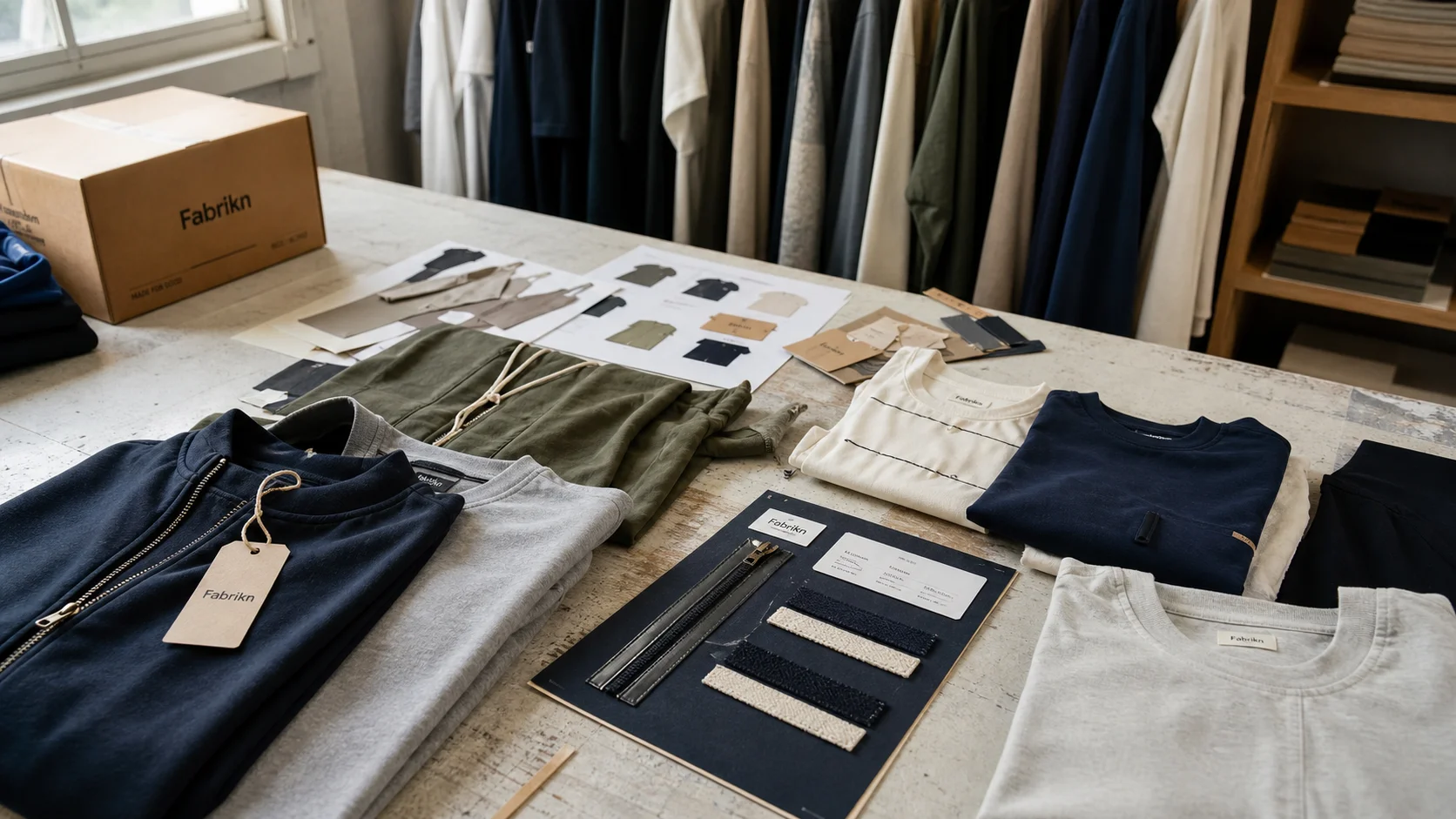
Use this private label polo factory checklist to compare fabric, collar construction, embroidery, size sets, carton packing, and wholesale reorder support.
Use this page when wholesale buyers need polo production that can repeat across store groups, catalogs, or distributor channels.
Decision pointWhat to confirm before productionProduct specFabric weight, fit block, size range, trims, and decoration method.Order economicsMOQ, sample cost, unit tiers, packaging, freight, and repeat-order terms.Quality controlPre-production sample, color approval, measurements, labeling, AQL, and carton marks.Wholesale retail buying teams do not choose a custom apparel factory on price alone. They choose on whether the factory can repeat a product, hold quality across larger orders, and move through sampling without turning every revision into a delay. For teams sourcing private label apparel, promotional capsules, retail basics, or seasonal programs, the right partner is less about flashy promises and more about disciplined execution. In practice, that means a factory that can keep a 180-200 GSM combed ringspun cotton jersey tee or a 300-320 GSM fleece hoodie consistent from first sample to final carton, not just from showroom pitch to prototype.
A custom apparel factory for wholesale retail buying teams needs to support the full chain of decisions: fabric selection, trim matching, sampling, production planning, inspection, carton packing, and shipment timing. The best factories reduce risk before the order is confirmed. The weaker ones create risk after the PO is signed. Common sourcing details to confirm early include the exact fabric composition, yarn count or gauge, shrinkage tolerance, color standard, trim brand, and whether the factory controls cutting, sewing, decoration, and packing in-house or through approved subcontractors.
Buying teams that perform well usually approach factory selection the same way they approach assortment planning. They define the product requirement first, then match the supplier to the job. That order matters. A factory that is excellent on lightweight jersey with flatlock seams may not be the right fit for a brushed fleece program with screen print, woven labels, and polybagging requirements.
How Wholesale Buying Teams Choose a Custom Apparel Factory - Clothing Manufacturer manufacturing guide
Wholesale buying teams usually care about four things: consistency, traceability, responsiveness, and margin control. A factory can look attractive on paper and still fail on one of those points. A supplier that can make a beautiful sample but cannot repeat it at volume is not a strong wholesale partner. A supplier that can meet a target cost but misses delivery windows creates markdown risk that can erase the margin advantage. For most retail programs, buyers also want one practical answer up front: can this factory source the right fabric lot, sew it to spec, and ship it within the buying calendar without reworking the order?
Retail buying teams also need clarity on what the factory actually controls. Some factories source fabric in-house, some outsource most trims, and some assemble only after the buyer secures materials. The more the factory controls, the easier it is to coordinate timing. The more fragmented the sourcing chain, the more the buyer needs to manage approvals and buffers. Typical sourcing detail: a factory that stocks basic CVC jersey, 1x1 rib, and YKK or SBS trims can often move faster than one waiting on custom-dyed fabric, branded elastic, and bespoke woven labels from separate vendors.
The best custom apparel factory for wholesale retail buying teams is one that can explain its process in plain language. That usually signals stronger internal discipline than a polished sales pitch with vague promises. Ask for the actual sequence: tech pack review, BOM confirmation, fabric booking, lab dip or strike-off approval, pre-production sample, inline inspection, and final AQL check before carton release.
A factory is not just a production site. It is a risk-management partner, and the first test is whether it can describe that role without overpromising.
Strong buying teams define the product before they compare suppliers. A heavyweight fleece hoodie, a performance polo, a woven overshirt, and a basic jersey tee all ask different things from a factory. Knits and wovens have different sourcing patterns, stitch requirements, and defect risks. Decorated products bring another layer of approval around print placement, embroidery density, and color matching. For example, a 100% cotton 180 GSM tee with a 2.5 cm rib collar and twin-needle hem is a very different production job from a 100% polyester interlock polo with moisture-wicking finish and chest embroidery.
Buying teams should begin with a short product brief that covers fabric type, garment construction, decoration method, size range, target retail price, target margin, and delivery window. That brief helps filter out factories that do not match the program. It also makes the sample process more efficient because everyone is working from the same specification. Typical sourcing detail: include the exact measurement points, tolerances, stitch type, seam allowance, and approved trim list so the factory can quote against a real BOM rather than an assumed one.
If the product needs a very soft handfeel, shrinkage control, or repeated wash performance, the supplier should be able to show what fabric systems it normally uses and what testing it can support. If the garment requires a special wash, bonded detail, heat transfer, or multi-step decoration, the factory should explain where quality usually slips and how it checks those points. Common checks include wash testing for shrinkage, crocking and colorfastness, needle detection after sewing, and print adhesion tests for heat transfers.
Not every program can optimize for all five. A buyer who wants a very low MOQ usually gives up some unit cost. A buyer who wants the shortest lead time may need to accept a narrower fabric choice or fewer decoration options. Clear priorities prevent expensive confusion later. Typical sourcing detail: if a buyer wants a 500-piece trial in three colors with embroidery and woven labels, the factory may quote a higher per-unit price than for a 3,000-piece single-color run because cutting, setup, and trim minimums do not scale linearly.
Many sourcing teams focus too much on whether a factory can say yes. The better question is what exactly it can do well, at what scale, and with what quality controls. A custom apparel factory for wholesale retail buying teams should be evaluated on capability fit, not general optimism. Typical sourcing detail: ask for a line map or production flow for the relevant category so you can see whether the factory runs single-needle, overlock, coverstitch, or specialized equipment for your garment type.
Factories usually perform better in a narrow lane. A supplier that handles premium knit basics may not be the right choice for tailored woven shirting. A factory that excels at decorated fashion tops may not be the strongest option for heavy outerwear. Buyers should ask what categories the factory produces most often and where its sewing lines are set up for repeat work. Specific equipment matters: Juki single-needle lockstitch machines are common for straight seams, Brother or Pegasus overlock machines are often used for knit construction, Yamato or Kansai coverstitch machines handle hems and neck binding, and Tajima or Barudan embroidery machines are typical for logo work.
Typical MOQ ranges vary widely by product, fabric, and decoration method. Many custom apparel programs start around 100 to 300 pieces per style or color when the factory is already set up for that category. More complex dyed fabrics, specialized trims, or custom-developed materials can push minimums into the 300 to 1,000 piece range. Limited runs may be possible at lower numbers, but the unit price usually rises. A common retail sourcing benchmark for a basic custom tee is about $2.50-4.00 per unit at 500 MOQ, while a heavier fleece hoodie with print or embroidery often lands higher depending on fabric weight, trim package, and packing requirements.
Buying teams should treat MOQ as a commercial signal, not a simple yes-or-no threshold. A low MOQ can help test demand, but it may also reflect weaker material leverage or a less efficient production line. A higher MOQ can improve cost, but it raises inventory risk if the sell-through is uncertain. Typical sourcing detail: ask whether MOQ applies by style, color, size ratio, and decoration method, because a factory may accept 300 pieces per style but require 100 pieces per color or 50 pieces per size.
Good factories can explain the difference between standard mill options and custom development. They should be able to discuss fabric weight, yarn composition, shrinkage expectation, dye consistency, and trim compatibility. For wholesale buying teams, trim issues often create more headaches than major garment construction problems. Wrong zippers, inconsistent buttons, poor labels, and weak hangtags can cause shipment delays that have nothing to do with sewing. Common material examples include 100% combed cotton jersey, cotton-poly fleece, recycled polyester interlock, 2x2 rib, twill tape, brushed terry, and woven twill for labels.
A useful supplier should be able to name what is stock-supported and what requires sourcing time. If a brand needs a custom rib, specialty label, branded elastic, or exact Pantone matching, the factory needs to say how long those pieces normally take and what can block approval. Typical sourcing detail: custom dye lots often require a lab dip approval first, and woven labels, hangtags, or metal trims often add 7-14 business days depending on the vendor and complexity.
Wholesale retail programs often require basic compliance paperwork, material declarations, testing records, and carton labeling discipline. A buyer should ask what documents the factory can provide before production starts. The exact requirements vary by market and product type, but the factory should not act surprised when compliance questions come up. Real certifications that buyers commonly request include GOTS for organic cotton programs, OEKO-TEX Standard 100 for chemical safety, WRAP for social compliance, and BSCI for audit-based supply chain oversight.
Factories that manage documentation well tend to manage production better too. Missing paperwork is often a sign that the operation is loose in other areas. Typical sourcing detail: ask for prior test reports from an accredited lab, material composition declarations, and copy of any current certificates so you can confirm the scope covers the specific product category you are buying.
Buying factor What to ask the factory Why it matters Product fit Which categories do you produce most often? Specialized factories usually make fewer execution mistakes. MOQ What is the minimum by style, color, and size ratio? MOQ affects cost, risk, and how fast the line can be booked. Fabric control Do you source fabric in-house or through approved mills? Fabric sourcing drives lead time, cost, and consistency. Sampling What sample stages do you offer before bulk? Each approval step reduces the chance of a costly bulk mistake. Inspection What internal checks happen before shipment? Inspection discipline lowers the chance of returns and claims.Sampling is where buying teams save money later. Cutting corners here usually means a cleaner invoice and a more expensive shipment. The right sample sequence depends on the product, but the process should be structured enough to catch fit, fabric, and decoration issues before bulk cutting begins. Typical sourcing detail: a well-run factory will log every sample revision, note measurement deltas against spec, and identify whether changes are caused by fabric shrinkage, pattern adjustment, or sewing tolerance.
Not every order needs every sample stage, but wholesale teams should know which ones they are skipping and why. For a plain tee in a standard fabric, a fit sample and pre-production sample may be enough. For a washed hoodie with embroidery and special trims, a strike-off, lab dip, size set, and pre-production sample are usually worth the extra time. Typical sourcing detail: lab dips often take 5-7 business days, strike-offs 3-7 business days, and fit samples commonly 7-14 business days depending on pattern complexity and fabric availability.
Each sample should answer a specific question. Fit samples answer proportion and construction. Lab dips answer color. Strike-offs answer print placement, ink density, and edge sharpness. Pre-production samples answer whether the final material package works as a complete system. If the factory cannot explain the purpose of each sample, it probably does not have a disciplined approval workflow.
Lead time is never just sewing time. It is fabric booking, trim sourcing, sample approval, cutting, sewing, finishing, packing, and final inspection time. For wholesale buyers, the fastest way to miss a season is to assume production starts on the day the PO is issued. Typical sourcing detail: a simple stock-fabric program can often finish in 18-22 business days after all materials and approvals are locked, while custom-dyed fabric, specialty decoration, or imported trims can push the total timeline to 30-45 business days or more.
Buying teams should ask factories to separate lead time into dependencies. A useful schedule shows what can happen in parallel and what cannot. For example, fabric knitting or weaving can run while trims are being approved, but bulk cutting should not begin until shrinkage is verified, color standards are approved, and the pre-production sample is signed off. If embroidery is part of the order, the digitized file, stitch count, and sew-out approval can also affect timing.
Seasonal programs need more buffer than basics. Holiday, back-to-school, and promo drops often stress fabric mills and freight bookings at the same time. Common sourcing detail: buyers often reserve 10-15% of the planned timeline as contingency when the order includes custom fabric development, non-stock zippers, or complex finishing like garment wash, enzyme wash, or silicone softening.
Short lead times are possible, but they come with tradeoffs. If a factory promises speed, the buyer should ask what it is using to save time: stock fabric, simplified construction, existing trim inventory, or a smaller production queue. Typical sourcing detail: the fastest programs are usually built around stock-supported fabric, standard thread colors, minimal decoration, and a single fit approval cycle.
Quality control starts before cutting and ends after carton sealing. The best factories build checkpoints into the process so defects are caught when they are still cheap to fix. Common checkpoints include incoming fabric inspection, inline sewing inspection, end-line measurement checks, final AQL inspection, carton count verification, and needle or metal detection where needed. Typical sourcing detail: many wholesale programs use AQL 2.5 for major defects, though the exact standard should match the buyer's risk tolerance and product category.
Buying teams should know which defects are most likely for their category. In knits, common issues include puckering, twisting side seams, uneven collar rib, skipped stitches, and shrinkage after wash. In wovens, buyers often see seam slippage, button placement drift, misaligned plaids, and poor pressing. In decorated goods, the risks are print misregistration, embroidery tension, heat transfer edge lift, and color variation between production lots.
Factory process details matter here. Incoming fabric inspection may use a 4-point system. Sewing lines may run on Juki, Brother, Pegasus, or Yamato machines depending on the operation. Final checks may include measurement against a sealed gold sample, thread trimming review, barcode verification, fold accuracy, polybag thickness, and carton labeling. A factory that can describe these checkpoints in order is usually more reliable than one that simply says "we inspect everything."
Inspection should also be documented, not just verbal. Buyers should ask for defect photos, measurement reports, and lot-level records. Typical sourcing detail: if the product is going to a retailer with strict vendor compliance, the factory may need carton labels, country-of-origin marks, fiber content labels, and pack configuration to match a buyer-specific routing guide.
Commercial terms should be read as part of the sourcing strategy, not just finance paperwork. The buyer needs to know what is included in the quoted price: fabric, trims, sampling, decoration, packaging, testing, cartons, and freight. A quote that looks low may exclude key components such as hangtags, woven labels, or final inspection fees. Typical sourcing detail: always ask for a line-item breakdown so you can compare apples to apples across factories.
Price changes with order size, complexity, and material choice. A basic custom tee at 500 pieces may land around $2.50-4.00 per unit depending on fabric quality, print method, and packing spec. A heavier fleece hoodie with embroidery, branded trims, and individual polybagging can cost materially more. If the factory is quoting below market, the buyer should ask what it is omitting. Often the answer is not cheaper sewing; it is thinner fabric, fewer checks, or less robust trim sourcing.
Buyers should also ask about payment structure. Common terms include deposit before production and balance before shipment, but the exact split varies by factory and order history. Typical sourcing detail: larger or repeat programs may negotiate improved terms once the supplier has proven on-time delivery, stable quality, and accurate paperwork across multiple seasons.
Commercial discipline also includes how the factory handles changes. Buyers should ask what happens if the color is revised after lab dip approval or if the size ratio changes after sampling. Typical sourcing detail: any late change to fabric, trim, or decoration usually triggers a cost and lead-time reset because the factory may need to rebook mills, reset cutting markers, or re-digest the embroidery file.
Not every program needs the same type of factory. A retail basics program may need a high-volume knit specialist with stable fabric sourcing and efficient sewing lines. A fashion capsule may need a smaller factory that handles detail work, complex trims, and tighter fit tolerances. A promotional program may need speed, stock materials, and simple packaging. The right fit is the one that matches the product and the calendar. Typical sourcing detail: the more custom the product, the more useful it is to choose a factory that can show past work with similar seam construction, decoration type, and fabric weight.
Teams should ask how the factory allocates lines. Does it run separate teams for knits and wovens? Does it keep dedicated decoration rooms for embroidery or heat transfer? Does it have in-house cutting, or does it rely on a shared cutting floor? These answers matter because line organization affects consistency. A factory with an organized flow is more likely to produce a repeatable 1x1 rib collar, an even coverstitch hem, and a clean carton pack than a factory that improvises line assignments.
The best fit often comes from a supplier that knows its lane and stays inside it. That is a strength, not a limitation. Typical sourcing detail: if a factory admits it subcontracts certain steps, the buyer can still work with it, but only if those subcontracted steps are controlled, documented, and approved in advance.
Working with Fabrikn is most useful when the buying team wants a structured sourcing process rather than a one-off quote. That usually means translating the brief into a workable tech pack, narrowing material options, validating MOQ against target margin, and aligning sampling milestones before bulk starts. Typical sourcing detail: a strong sourcing partner should help compare stock-supported materials versus custom development so the buyer can decide whether the savings in lead time outweigh the difference in unit price.
For wholesale retail teams, the practical value is coordination. A useful partner can help identify whether the program is better suited to combed cotton jersey, cotton-poly fleece, recycled polyester knit, or woven construction; whether GOTS, OEKO-TEX, WRAP, or BSCI documentation is relevant; and whether the order should be structured around standard trim packages or custom-developed components. That kind of guidance reduces back-and-forth with factories and helps avoid quoting against the wrong spec.
On a typical program, the most useful output is not just a supplier name. It is a clear sourcing path: what the MOQ should be, what the likely unit cost range is, which samples are required, what lead-time dependencies exist, and what inspection checkpoints should be locked before bulk. Typical sourcing detail: the more complete the brief, the more accurate the factory comparison and the fewer surprises later in the calendar.
Get a free quote from Fabrikn — your trusted B2B clothing manufacturer with 10+ years of experience. MOQ as low as 200 pieces.
Get a Free Quote →Start with product fit, MOQ, lead time, and documentation. Ask the factory what it makes most often, what minimums apply by style and color, how long the full process usually takes, and which certifications or test reports it can provide. Typical sourcing detail: the best first question is often, "Show me a similar style you have produced in the last 6-12 months."
Use the same spec sheet, same fabric target, same decoration method, and same packaging requirement for both quotes. Then compare unit cost, sample speed, responsiveness, and inspection discipline. Typical sourcing detail: if one factory quotes a lower price but excludes testing or custom labels, the comparison is not valid until those costs are added back in.
For apparel sourcing, buyers often request GOTS for organic content, OEKO-TEX Standard 100 for chemical safety, WRAP for social compliance, and BSCI for audit-based supply chain management. Not every factory will hold all of them, and the relevant one depends on the program. Typical sourcing detail: always confirm the certificate scope and validity dates against the exact product category.
The biggest delays usually come from fabric approval, trim sourcing, lab dips, sample revisions, and late changes after pre-production approval. Decoration-heavy orders can also slow down if embroidery files or print strike-offs are not locked early. Typical sourcing detail: custom-dyed fabric and branded trims are frequent lead-time drivers because they depend on third-party vendors outside the sewing floor.
For a simple stock-fabric style, 18-22 business days after approvals is a common benchmark. For custom fabrics, special washes, or complex decoration, 30-45 business days is more typical. Typical sourcing detail: the timeline is only reliable when the buyer has already approved fabric, trims, decoration, and pre-production sample.
Buying teams make better decisions when they evaluate factories like production systems instead of sales vendors. The right partner is the one that can show how it will build the product, control the risk, and deliver the order on time with the same result from first unit to last carton.
Use these related guides to compare specs, costs, quality checks, and buyer decisions before making the final call.